Puzzling Perseverance

School mathematics has a bad reputation for being intellectually unattainable and mind-numbingly boring for many students.  Proclaiming the falsity of these beliefs is usually not enough to convince kids (or people in general) of their untruth.  Students need to experience their own success in mathematics and be given the opportunity to engage in curiosity-sparking mathematics.  For me, one of the very best moments in a classroom is when a self-proclaimed math hater fully engages in a challenge and is motivated to work hard to arrive at a solution.

Enter January 2nd and 3rd.  Students are back for a two-day week which they view as punishment and a rude-awakening from a restful winter break.  To boot, the Governor Dayton announced today at about 11 am that all Minnesota schools will close Monday, January 6th due to impending dangerously cold weather.  You can imagine where the motivation level was in school today.

As the CEO of room 114, I decided to make an executive decision and do a puzzle from Nrich (shocking, I know) in my probability and statistics class.  Technically, the students could use the mean or median to help solve the problem, so I wasn’t veering too far off of what I had previously planned.

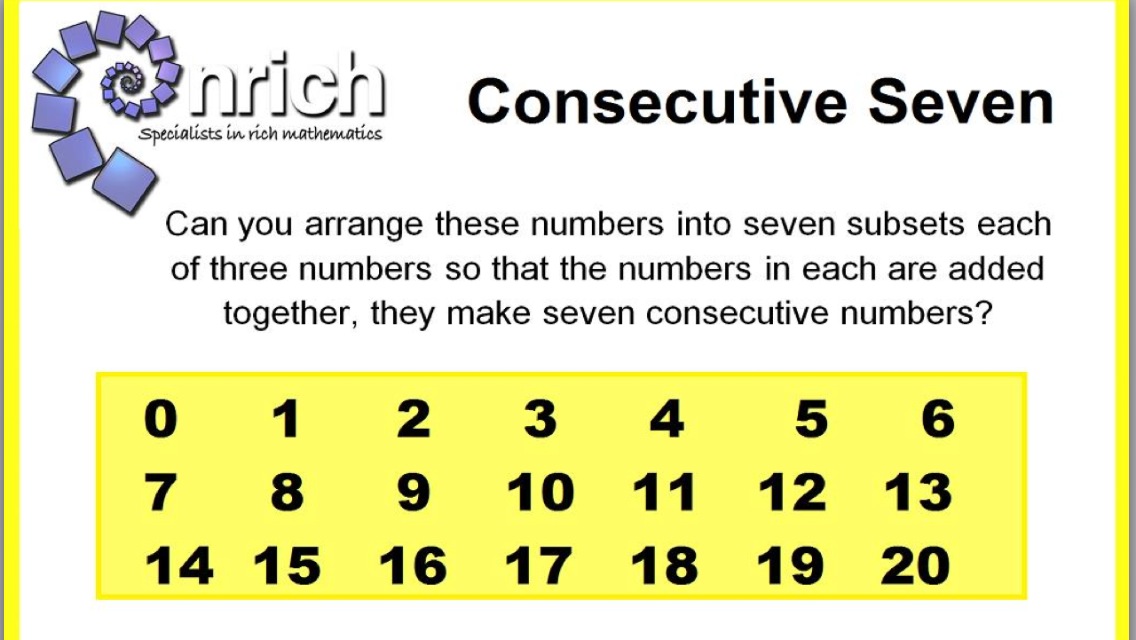
The Consecutive Seven puzzle starts like this:
IMG_2684 

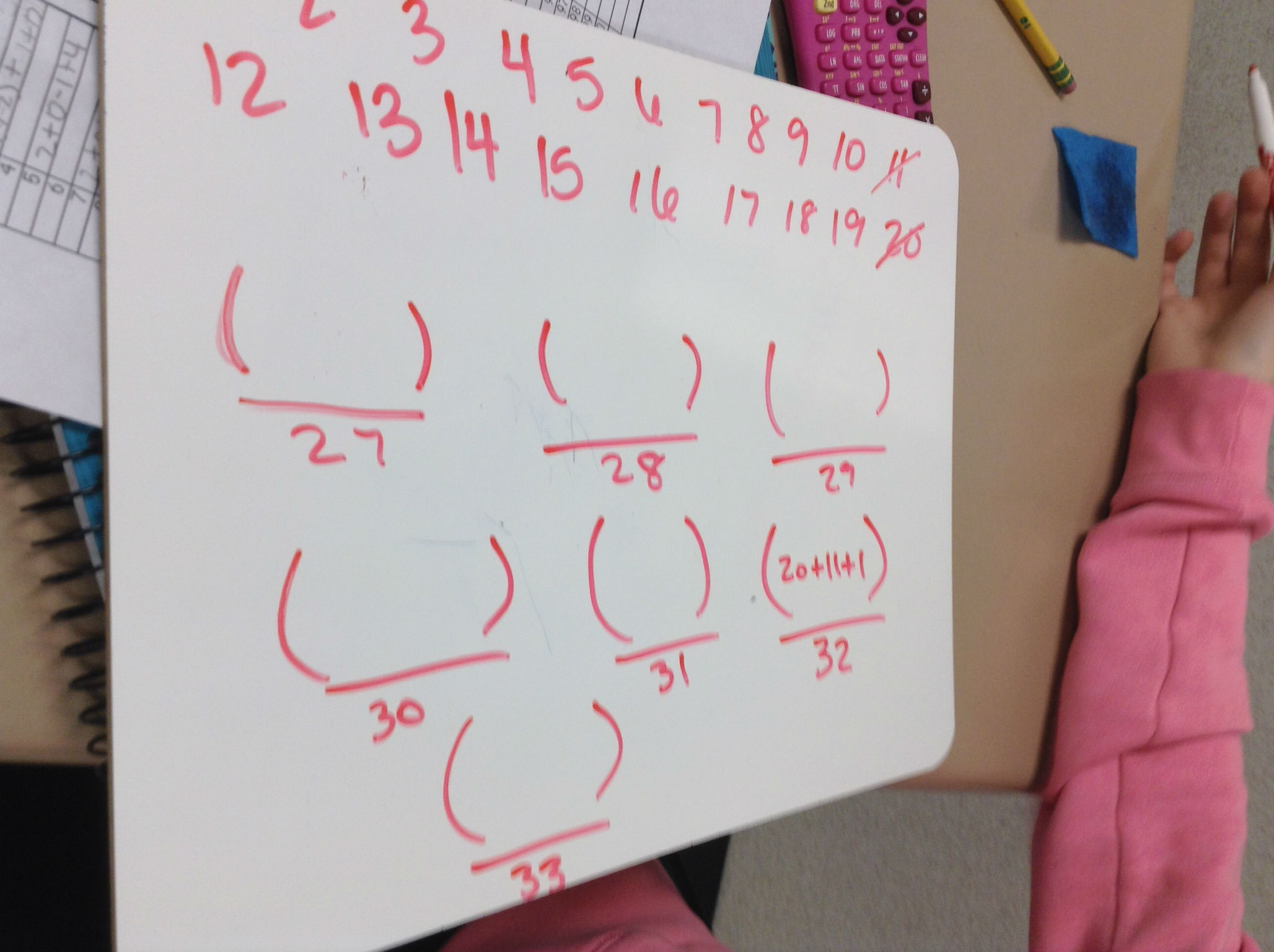
Initially, one student began by explaining to me that she took one number from the beginning of the set, one from the middle and one from the end.  Then she figured the other consecutive sums needed to be above and below that number.  (Spoiler alert:  These numbers actually end up being the seven consecutive sums, so I was very interested in her explanation of how she arrived at those particular answers.  )
IMG_2668

It’s worth noting that this student’s first words to me at the beginning of the trimester term were, “I hate math and I hate sitting in the front.”  So you can imagine my excitement when she dove in head first into this particular task, happily and correctly.

Adding to my excitement about the class’s progress, another girl (who was equally enthusiastic about math at the beginning of the term) was the first one to arrive at a correct solution.  And although she probably wouldn’t admit it, she was thrilled when I took a picture of her work.  And I am more than thrilled to display it here:

photo 2

If you were wondering about how math-love girl #1 fared in completing the task, she persevered and impressed her skeptical cohorts:
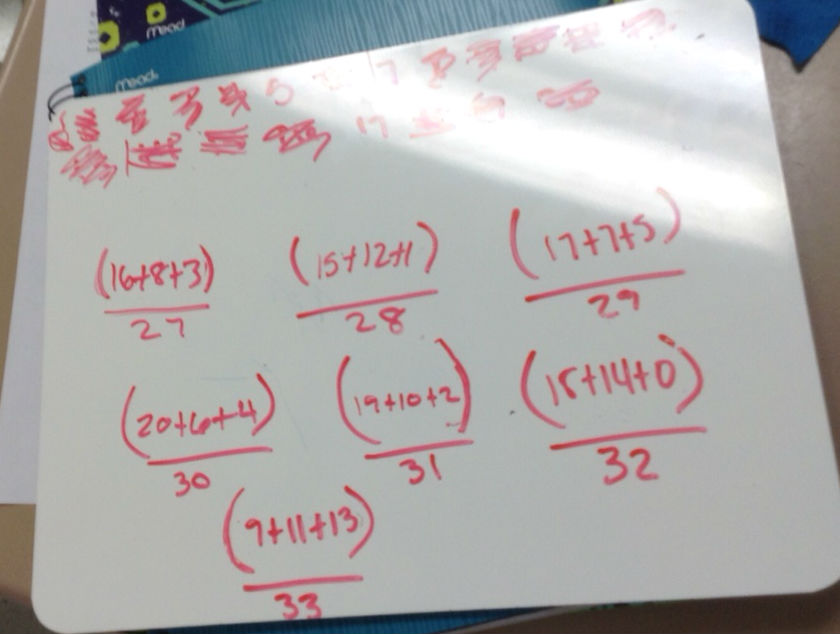
photo 1

This phenomenon fascinates and excites me that students, when confronted with a puzzle, highly engaged and motivated throughout the lesson.  Dan Meyer summarized this idea nicely on his blog recently:

“The “real world” isn’t a guarantee of student engagement. Place your bet, instead, on cultivating a student’s capacity to puzzle and unpuzzle herself. Whether she ends up a poet or a software engineer (and who knows, really) she’ll be well-served by that capacity as an adult and engaged in its pursuit as a child.”

And who knows.  Maybe one of the girls featured above will become a puzzling poet.

A Visual Comeback

Please excuse me while I geek out for a few minutes about Visual Patterns.  My love affair with this versatile website has made the transition from autumn to winter as I engage in select patterns with my Algebra classes.  I didn’t start using these until a unit on quadratics last trimester, so I was very pleased that a linear pattern could create just as much conversation and mathematical excitement.

For example, this is a replica of pattern #114 that we looked at in class today:

Lego 114

The equation y = 3x + 4 was not terribly difficult for these kids to decipher. But the fun began, as usual, when I asked them to relate their equation back to the figure.  Here are some of their findings:

1.  Students used the idea of slope and recognized that the slope is the change in the number of squares divided by the change in the step.  The y-intercept is the value when the “zero” step is determined.

2.  There are always 4 squares in the corner and each “branch” off of that square has a length of x.

3.  SImilarly, there is one square in the corner and each branch from that one square has a length of x+1

4.  There are always x “sets” of three squares, and four squares left over.

5.  The arithmetic sequence formula works nicely here, common difference of 3 and first term of 7.

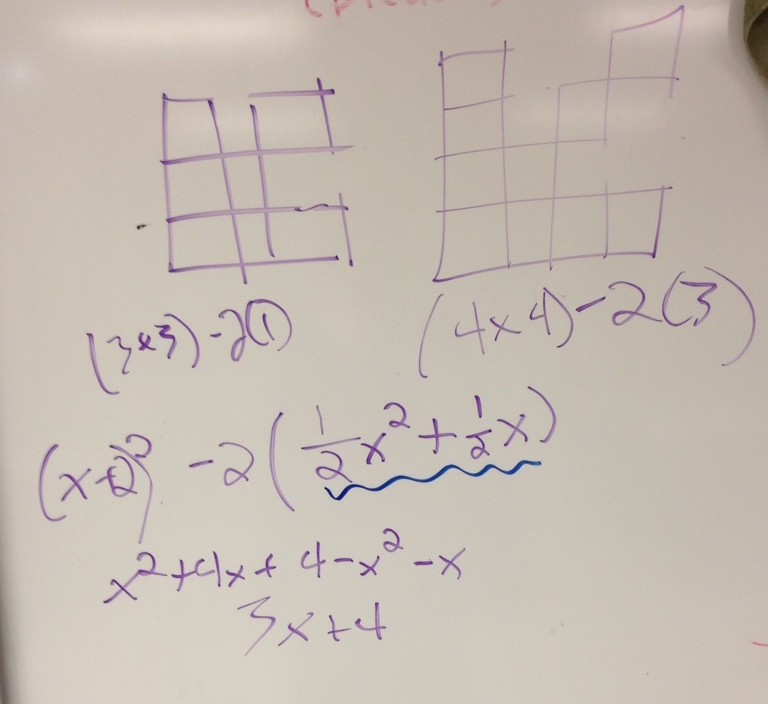
The final observation deserves its own paragraph, as I was completely blown away by the thought process.  The student noticed that if we made each step in the pattern a square, then the formula would be (x+2)^2.  He then noticed that the portions that were missing were two sections, each consisting of a triangular number.  Recalling the formula we worked out last week (by accident) for the triangular numbers, (.5x^2 + .5x) he took (x+2)^2 -2(.5x^2+.5x) and simplified it.  The result is, you guessed it, 3x + 4.  Below is a photo of this amazing insight:

Pattern 114 Triangle

What I like most about these visual patterns this time around is that it helps the kids get comfortable having a mathematical conversation.  Students build on each other’s thinking and discover new insights by listening to their classmates.  This was difficult to do last trimester with a similar group of kids.  I think that by starting with a linear patterns, rather than quadratic, the students have acclimated themselves to different ways of approaching the patterns.

A Top Down Approach?

A new trimester is upon us in St. Francis, MN which means a new group of advanced algebra students as well as two classes full of squirrely 9th graders.  I’m amazed that these sets of students can have things in common and a lesson for one class can serve as a bell-ringer for another.  I have said in the past that my favorite activities are the ones that can be used across multiple ability levels and this task is no exception.

This week, in advanced algebra, we’ve been working on problems that allow the students to connect specific patterns and examples to general formulae.  I feel that this trimester, I have done a much better job of sequencing the class problems in a way that has help build student confidence in the problem solving process.  As I’ve done in the past, I chose some nrich problems that have a low barrier to entry and a high ceiling.  These problems feel like number play:  Pair ProductsAlways a Multiple, Think of Two Numbers, and Calendar Capers.  Although I’ve had the occasional moan from students who prefer their math to be in lecture/practice format, I’ve seen much more willingness to engage in the problem-solving process this time around.

One particularly memorable day, we used a Math Forum problem called Baffling Brother in which a brother is attempting to amaze his younger sister by having her choose a number, perform some operations on the number and then telling her the result.  I’m disappointed that I didn’t think at the time to have the students act out this scenario.  That could have been spectacular!

These being upper level students, I always encourage them to attempt the “extra” for these problems.  On this task, they needed to come up with a number puzzle of their own that resulted in an answer of 7 each time.  I told them that I would be giving these number puzzles to my 9th grade classes to amaze.

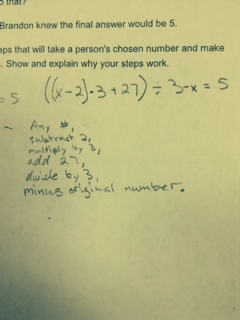
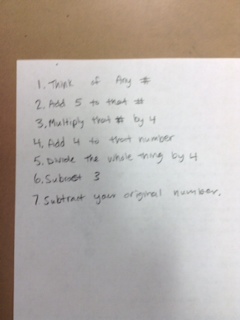
Here are some examples:

image (1) image

What happened next I could not have predicted and was not an iota shy of completely awesome!  I presented one of these number puzzles to my 9th grade class and stood in the back of the room as I read the steps to them.  When they arrived at their final answers, I had them compare with one another.  I wish I had a camera on the room to capture the amazed look on their faces when they realized they all got an answer of 7.  Icing on the cake:  the advanced algebra students were very satisfied that they were able to amaze 9th graders with problems that they created.  I’ll call that one a win for engaging kids in “boring” old, non-applicable, relevant Algebra.

Motivating with a Math Story

I’ve observed over my career that as a high school teacher, 9th graders are amongst the most challenging yet most rewarding groups of students.  Challenging in the sense that they never stop talking or moving, but rewarding nonetheless because of their naivety and innocence. This combination makes engagement and relevance easier to create day to day.  

For example, today in my 9th grade probability and statistics class, I adapted an IMP activity involving sample size and the ratio of mixed nuts.  I literally had these 9th graders believing that I counted all of the nuts in a container of mixed nuts and compared it to a fictitious “nut ratio” from Planters’ website. It’s worth noting that my intention was to tell a story about mixed nuts, but they seemed to believe that this must be true, so I just played along. They think I’m a little crazy for counting the number of nuts in a can, but they were bound to reach that conclusion at some point, nuts or no nuts.  This little “fib” served me very well today as the students now wanted to figure out if I was short-changed on the number of cashews in my can of mixed nuts and whether I had enough evidence here to sue Planter’s Peanuts.  I don’t plan on making up stories of this nature all trimester, but the fact that changing the character in the problem from Mr. Swenson to Mrs. Schmidt played out in my favor was satisfying.

I felt a little guilty having mislead them, however, so I scoured the internet for anything relating to Planters nut ratio.  I found this interesting post about a similar (albeit smaller) bag of mixed nuts. The entire blog was actually pretty intriguing as its entire purpose is to critique gas station food fare.  I’ll probably show this to my students tomorrow just to see where their brains go with it.  

Pushy vs. Persistent

“Sharing is caring” does have a nice rhymey ring to it. Although lately, I’ve felt a little bit like my version comes off as ‘sharing is pushing and over-feeding’.  I’ve had teachers in my department inquire about problem solving and desire to get kids to invest and engage.  I like sharing what I’ve discovered and what I have found that works, but sometimes I get so excited about sharing resources that I end up like Tommy Boy and his pretty new pet.  I sometimes fail to realize that trying new approaches can be uncomfortable, unpredictable and downright scary and not all teachers want to dive into the change head first as I did.

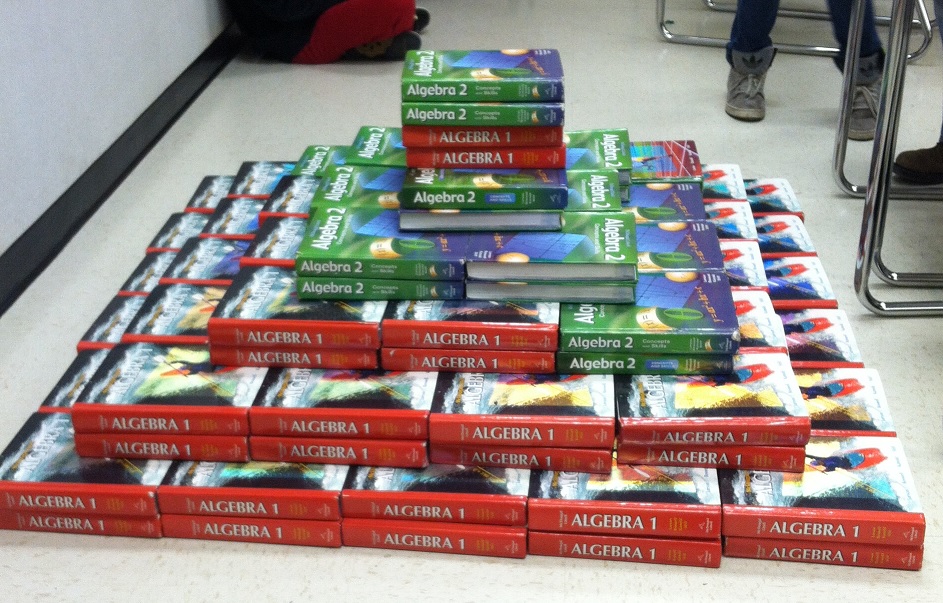
Here’s a great example: we had final exams in 2-hour blocks right before Thanksgiving break.  To say that the kids get “restless” by the middle of the second day is sugar-coating it.  A new teacher in our department, (let’s call her Sheryl) sent this picture with the caption, “My algebra kids were bored after their final and built this with their textbooks.” booktower

Of course, my brain couldn’t just let that one go and say, “Nice book tower, Sheryl.” Dan Meyer calls this perplexity and modeling this behavior is a key to getting students curious. Instead, my eyes lit up and I thought, “what a great math problem!”  As we looked at this photo, I said, “what do you think kids will notice and wonder about this photo? Do you think you could get them to come up with how many books are in the 10th row or the nth row?”  Of course the question that’s raised, legitimately, is “what do you do when students say ‘there are green books and red books’ or ‘some are faced forward and some are faced backward’?”  This is the part that I believe is scary for a lot of teachers is relinquishing control of the immediate direction of the lesson and not being so certain about how students will respond.  At least when we give them a quadratic to factor, we have a pretty good idea of the limited number of directions they can move to arrive at a singular correct answer.

But what I believe is imperative here is validating and acknowledging those seemingly math-less observations and creating a math opportunity with it.  With the instance of “some are red and some are green,” we can now extend that declaration of color to ideas like percentages, ratios, and so forth.  But by first validating this red/green response, we’ve invited this student to the conversation and made them part of the creation of the problem we are about to solve.  Now they are empowered by the process and more motivated to step in to the problem-solving ring.  Whereas before, this same student might have disengaged completely.

A recent example of this from my own classroom:  We were beginning Dan Meyer’s 3-act task using the Penny Pyramid.  When collecting wonderings, one student asked how many 1996 pennies were in the pyramid. He was born in 1996, and was probably just fascinated by that year, but I didn’t want to dismiss that from the discussion.  I have a bucket of pennies in my room that I use occasionally for probability experiments, and I hoped that this kid could draw from his knowledge about samples to make a reasonable estimation of how many 1996 pennies were in that pyramid.  As it turns out, that students off-hand question turned into a great math discussion about random sampling.

But back to this book tower:  After I’m sure that I’ve thoroughly freaked out this new teacher with my enthusiasm over a book tower, something awesome happens.  This new teacher, races into my room after 1st period on Monday and says, “I did it!  I did the book tower, and it was AWESOME!”  I’ve had some great moments with other teachers, but that one is going to rank pretty high on my list for a long time. At lunch, she was STILL raving about it. She even said that the students were so engaged, that they ran out of time talking about it during class. Maybe there’s hope for Tommy Boy after all.

Transitions and Transformations

The trimester schedule that our school uses has many benefits, including 68 minute periods.  This seems to be the perfect amount of time for me as a math teacher to give the right amount of weight to each part of a lesson. One major drawback, however, is that sometimes I’m not ready to let them go.  Maybe it is an overall resistance to change, but more likely I feel that after 13 weeks, my classes are starting to make some major progress down the persistent problem solving path.  And then I have to let them go.  There are very few students that end up in my class more than once per trimester since the majority of what I teach is College Algebra and Probability and Statistics (both one trimester courses).

In my college algebra course, I’ve seen the progression and improvement in their problem solving abilities, but I wanted to see what they would say if I asked how they thought they had progressed.

So, as the last question on their final exam, I asked them what skills developed in this course they felt were most valuable.  (Oddly enough, none of them said factoring a quadratic equation.) But they did say some things that helped solidify my approach to this class.  Most frequently, students mentioned that they have improved their problem solving skills.  I’m confident that they are referencing problem solving skills in relation to rich problems, since that is a majority of what we did in this class.  Another common comment had to do with multiple approaches to solving problems.  Many students mentioned that they didn’t realize how many different ways there are to approach a problem until these varieties were laid out by other students. I, too, improved my ability to look for and appreciate the diversity in problem solving strategies.

My favorite comment overall was from a girl who works very hard but who hesitates to share her ideas with the class.  She states, “I can problem solve without a set procedure and now I feel like I can solve anything.”  Bingo.  I hope that I can help build that confidence as I work to improve some of the methods I used in this next trimester.


The fabulous life of Megan Schmidt

I read an article recently that asked when being “busy” became the new black.

When we ask students how they are, we always get the same answer: tired. Teachers, on the other hand can always be counted on to tell you how BUSY they are. Sometimes, you’ll even be lucky enough to get a teacher to tell you, “busy, but good.” As if to say, “I want to be polite, but get the heck out of my room so I can get something done!”

I once asked myself, if I had extra hours in the day, would I use them to be more productive with what I have on my plate? Or would I find new projects to fill up the time? If I’m being honest with myself, I’d have to say it would be the latter.

My day begins at about 5:25 am after about 45 alarm snoozes. I unglue the two beagles that have suctioned themselves to my arms and feet during the night. My husband and I leave to drop our daughter off at Montessori at 6:15. I want to take this moment to acknowledge how blessed I am to work at the same school as my husband. Getting to drop our daughter off together is a priceless bonus. I’m always drawn to the different building sets and usually sit down and play with her before we head off to our own school.

We try to arrive a little before 7am which doesn’t always happen.  Our school day starts at 7:25am so those 25 minutes can be pretty frantic.  Lunch goes into the fridge in the math office on my way to my room.  Then I walk into my classroom and wonder why I left it such a mess the afternoon before.  I then organize my paper stacks to give my desk some semblance of order.  I then need to run upstairs to grab copies, say hello to the office professionals up there, and hit the bathroom (very important).

We run a 5 period, trimester schedule, which makes each of our classes 68 minutes.  First hour is math recovery, which is about 20 kids that have failed a previous math course.  Their abilities are all over the place and their motivation to do mathematics is as well.  It’s a challenge to engage them sometimes, but they’ve gotten to know Andrew Stadel pretty well.  As Mr. Stadel talked about in his recent post, I too have acquired some puzzles over the course of the last 9 years and let this class work with them during the last 20 or so minutes of class.

Second hour is college algebra so I’ve got 7 minutes to run to the bathroom (I know but I drink a lot of soda).  This class is amazingly exhausting.  I’ve been just blown away by the mental power in that room.  When I give them a problem, those kids go AT IT.  I swear that the brain sweat is palpable.

Third hour is my prep period.  I have a million things going on during this 68 minutes since I am also the head of our department.  I never feel like I get enough done, but is there any teacher that feels like they are caught up ever?

We then have a 28-minute “study hall” time where kids can study, meet with clubs, go to the media center, make up assessments, etcetera.  Most students use the time to sit and chill out.  I don’t blame them; high school demands a lot.

At about 11:30, 4th hour officially begins.  This is an advanced probability and statistics course, and it has been fun to challenge these kids with real world scenarios.   These kids are naturally curious, and we often spend an entire class period discussing a problem and all of the statistics that come into play.  I end that class period wishing I taught it more than once a day.

It’s now 12:41.  Yep, the day starts at 7:25 and some of the kids don’t eat until 12:41.  Brutal.  I run to the bathroom, suck down my kale salad, and laugh with my co-workers.  One great thing about my department is lunch usually brings about hilariousness for one reason or another.   I really enjoy that comradery and I’m very lucky to be part of a department that enjoys one another.

1:17 is the beginning of 5th hour, so I will of course need to run to the bathroom one last time.  This class is college algebra again.  This is the last hour of the day, so the kids are a little more energetic but no less mathematically clever.

The bell rings at 2:25 for the day.  Unless I have a meeting after school, I leave between 2:50 and 3:30.  I want to get my T25 workout done before I pick up my daughter from her school.  (T25 is a great workout program from Beachbody.  Best workout I’ve ever done.)

Once my daughter is home, we usually build with Legos, play a game, or make a fort.  Bedtime routine starts at 6:00 so it’s not long before we are watching her allotted half-hour of TV and then reading books.  (I try to suggest Team Umizoomi everyday, but their mighty math powers are usually trumped by Minnie and her Bowtique.)

She’s asleep by about 7:30pm and we won the kid sleeping lottery, so unless it is an extreme circumstance, we don’t hear from her until we wake her in the morning.  Now it’s time to catch up on blogs, lesson plans, working through problems, or adding student feedback.  Since mathematics has also become a personal passion of mine, working on these things at night is enjoyable as well as productive.

I enjoy most of my days because I have a pretty positive outlook on being a teacher.  I have a strong belief that what I do makes a difference and that belief is what drives my passion for teaching.  When you show kids that you believe in them, there is a tremendous benefit to both you AND them.  Each day, I try to spread that to my students.  If they know that I believe in them first, they are more likely to believe in themselves and achieve more mathematically.

Creating Mathematically Curious Students

Part of my goal for my students this year is to help them become comfortable being mathematically curious.  In an effort to help students develop a growth mindset and to facilitate learning opportunities that foster this, I try to pose questions that allow time for exploration.  This has been more difficult than I thought it would be, since I am somewhat attempting to undo 10-11 years of an unwritten didactic contract:  teachers instruct, students passively absorb and regurgitate information.   Repeat as many times as necessary.

Most of the trimester I have gotten questions like, “Is this what you are looking for?” or “Are we going to be tested on this?” I thought that as the trimester progressed, this would happen less often.  I was wrong.  I had to admit to myself that as long as I was in charge of giving these kids a grade and as long as their grades remained a driving force in their outlook on education, I didn’t see this changing much.

I wanted to make note, however, of the progress these kids have made toward being more mathematically curious.  I’ve exposed them to some interesting graphs, and some students have shared how they expanded those ideas to make even more intricate versions of those graphs.   (Ever wondered what y=xsin(1/x^13) looks like?)

I had another student explore the graph of y = 1/(x-2) + 1/(x-2) and wonder if there was an equation we could write that would isolate just the middle portion, between the two vertical asymptotes.  He thought that it looked cubic, so he played around with a number of cubic functions, but couldn’t get the graph to fit quite right.  I commended him for his efforts, because this was the type of student known for wanting his math straight to the point.  I asked him the range of a cubic function compared to the range of the graph he was trying to match, and he quickly saw that his initial thoughts on a cubic function were incorrect.  I challenged him to keep searching for an equation (or two) that would match the portion of the graph he wished to isolate.  This was an important moment for both me and this student.  I had gotten him to explore and wonder with something that had no external purpose.  He did this for the meer wonderment of whether it would work or not.

This was fantastic and worth reflecting over for me as an algebra teacher.  Much of high school algebra is taught in a dry, procedural manner.  Unfortunately, the kids expect it this way, and the high achieving kids even want it this way.  They’ve been successful with it so far, why change it?  I hope as I continue to pose mathematical questions to these kids that they continue to push their understanding forward by exploring.

Nrich – Factors and Multiples Puzzle

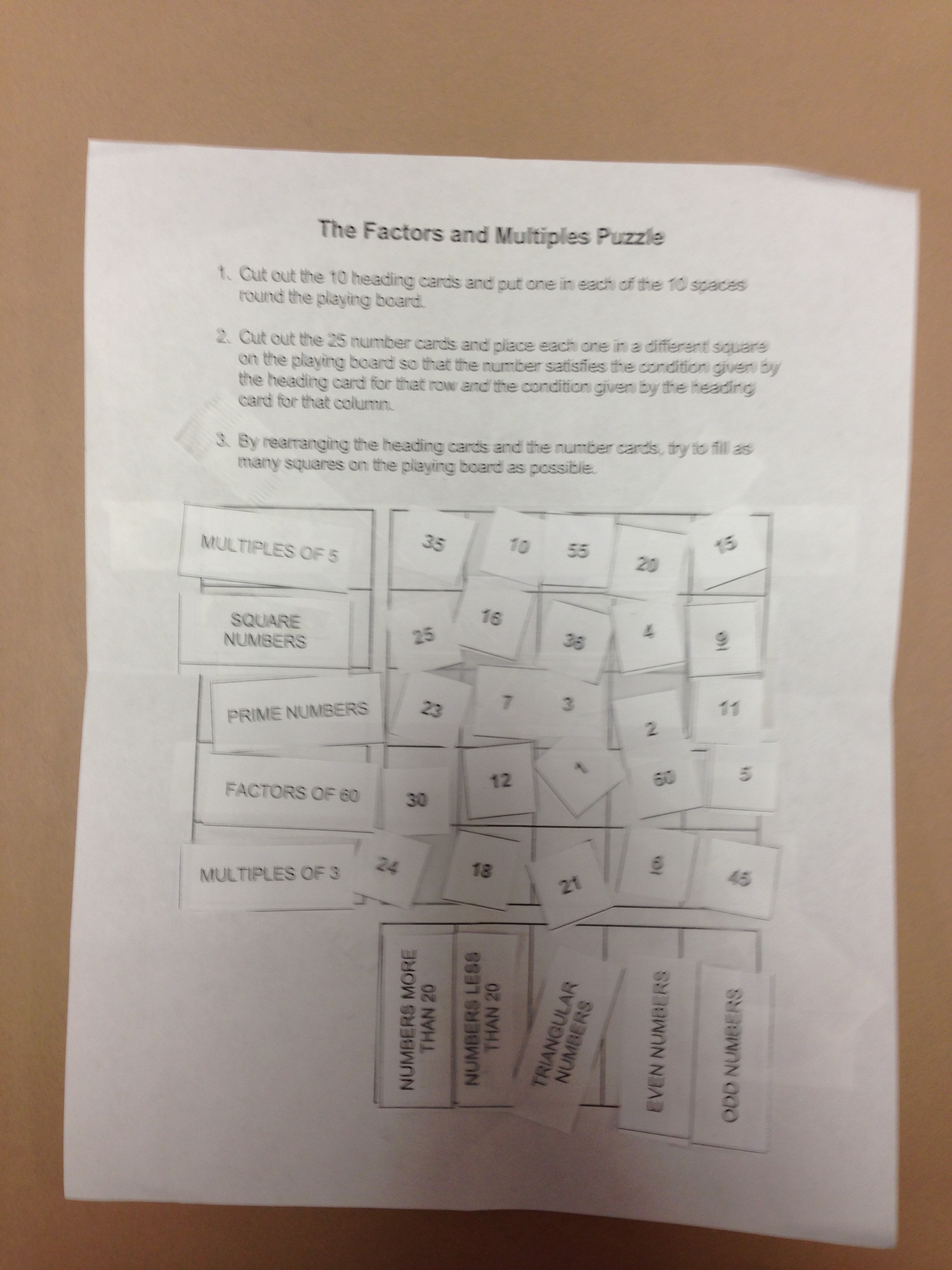
Nothing gets me more excited about teaching mathematics than a task that can engage my lower level students while simultaneously challenge my high achieving students. The Factors and Multiples Puzzle from Nrich did just that. (Thanks to @drrajshah for posting this on twitter.)

I’m glad I used this in multiple classes because if nothing else, it gave students the opportunity to learn about triangular numbers! What a testament to the fact that we don’t allow students to explore with numbers nearly enough: I’ll bet only one student out of 60 had any idea what triangular numbers were.  A fantastic, interesting set of numbers, arithmetically and visually, was unbeknownst to 99% of my students.

My math recovery students were intrigued by the puzzle portion of it. In fact, I have one student in particular who is not particularly motivated by much . He’s a ‘too cool for school’ kind of kid, and he’ll tell you as much. When I bust out a puzzle, he’s all in. And when I say ‘all in,’ I mean 100%, until he solves it. It’s pretty awesome stuff to have been able to catch his attention and see how cleverly he thinks through things. Amazing.

I also gave this task to a group of advanced students. An interesting strategy these students developed was to grab a whiteboard to work out some patterns in groups of numbers.  I loved walking around and hearing their strategies.  As some groups finished, they started walking around and giving tips (not answers) to other groups.  It was wonderful.

One of my particularly eager students taped his together uniquely.  I appreciated his humor.  🙂

fmp

Why I Blog, for Kate

Kate Nowak was the one, whether she knows it or not, that gave me the convincing boost I needed to start blogging.  So I figured I owed it to her to respond to her request of “why I blog.”

1. What hooked you on reading the blogs? Was it a particular post or person? Was it an initiative by the nice MTBoS folks? A colleague in your building got you into it? Desperation?

I was taking a PD class called Thinking Mathematics through my districts Teacher Academy.  As part of the course, we were to read a chapter from Accessible Mathematics.  Of course, I bought the whole book instantly because it was exactly what I needed to get me excited about changing some of my teaching practices to become a better teacher. The book was so easy to read, easy to follow and made so much sense.

Anyway, as part of this class, we were given time to develop a unit plan and formulate lessons.  I was determined to scour the internet for some good resources.  I found myself flooded with them.  I can’t recall the very first blog I came across, but I found that I needed to start reading blogs regularly because there were some great math teacher bloggers with some great ideas and who were open and freely willing to share their resources.  I was immediately hooked.  Good thing I already had an iphone.
2. What keeps you coming back? What’s the biggest thing you get out of reading and/or commenting?

I found that the more you give, the more you get.  I started blogging and commenting on blogs at about the same time.  The more I commented, the more I wanted to write more blog posts, the more I wanted to comment, the more I wanted to blog, the more I …you get the idea.

I am find that I always love to hear other people’s ideas face to face.  I knew that reading about other people’s ideas could be even more fun!

Just as students learn more about mathematics by talking to one another about mathematics,  we as teachers should take that same advice.  The more we collaborate across the web, the more multi-faceted our lessons can be.
3. If you write, why do you write? What’s the biggest thing you get out of it?

Enter Kate Nowak.  Once at a Global Math Department meeting, she mentioned something about why SHE started blogging.  She said she started blogging for herself, to get her teaching ideas out of her brain and to reflect on her lessons.  I took this to heart because I realized that if I was going to blog, my goal should be for self-reflection.

The first blog post I wrote was for Dan Meyer’s Makeover Monday.  It was the last week where he kills it with the Desmos Penny Circle.  I was very intrigued that there were other teachers across the country that cared about my input on a particular task.  It shouldn’t have been a surprise to me.  I care what other teachers have to say, why shouldn’t other teachers care what I think?
4. If you chose to enter a room where I was going to talk about blogging for an hour (or however long you could stand it), what would you hope to be hearing from me? MTBoS cheerleading and/or tourism? How-to’s? Stories?

Your story.  How blogging transformed your teaching and your view of how teachers connect.  And how easy it is to get started.  I’d love to hear it.  Good luck, Kate.