Questimate saves the day!

My computer was being upgraded to Windows 8, so I didn’t have a computer for 1st hour.  My first hour is my math recovery class (i.e. students who had failed a previous high school math class.)  We usually start out doing Visual Patterns or Estimation 180, so I hoped that I was able to keep the first part of the class productive.

Enter Questimate.  If you have never seen this amazing, engaging, fascinating ipad app before, you are in for a treat.  Made by Motion Math, the players come up with their own estimation questions from a list of choices.  For example, how many blue whale tongues are as heavy as a Marlin?  Or:Questimate! Make your question!

My favorite is when they can size the objects themselves:

Questimate! Visual pinchingThe kids in this math class are not thrilled with school in general, as you can imagine.  They were all totally engaged with Questimate.  I gave each kid a chance to create a question and estimate an answer.  Happy kids, Happy teacher. It was a great class period.  

Ever-loving Evernote – #ExploreMTBoS 6

When I started discovering the math teacher amusement park that is the MathTwitterBlogosphere, I quickly found myself so excited about what I had discovered and so overwhelmed about what I had discovered.

My first instinct was to bookmark, bookmark, bookmark.  I made bookmark icons on my ipad, bookmarks on my web browsers and bookmarks on my desktop.  I had bookmarks inside bookmarks inside bookmarks. The problem:  I couldn’t find resources when I got ready to use them and I now had more bookmarks on my ipad than I had actual apps.

Then an angel appeared in the form of Kate Nowak at a Global Math Department session last spring.  Kate suggested Evernote as a method of organizing all of the resources I had found.  I had a few things in Evernote and had used it very infrequently as a medium for holding a few PDF files or interesting articles.  Kate Nowak uttered the words I was waiting to hear when deciding how to organize my mountain of resources:  Tagging and Searchable PDFs.

Many of you might be thinking “there are plenty of sky drives that are searchable.”  (Maybe you are now wondering what a sky drive is.)  Anyway, none of the online storage platforms have been as versatile, flexible, and easy to use.  I’ve tried Adobe Reader, Dropbox, Google Drive, iCloud, the works.  Evernote surpasses them all.

A bonus:  Evernote and Adonit joined forces and created Jot Script, a one-of-a-kind stylus for note-taking.  Now, I can handwrite notes into Evernote and they are searchable as well! It’s like Christmas and my birthday!

Vegan Teacher Crazy about Cheeseburgers

A year and a half ago, I made the best dietary decision of my life and decided to try a vegan diet for 30 days.  Fast forward to now, I love the vegan lifestyle and I’d never go back to a diet filled with animal products.  I know too much.  But that’s a story for another post.

A couple of weeks ago, I logged into Robert Kaplinsky’s presentation on Global Math Department.  He started off with a visual, which is usually good to draw listeners into the presentation.  However, this visual was a cheeseburger.  And he went through more and more visuals, and the cheeseburgers kept getting bigger and bigger until finally I’m face to screen with 100×100 cheeseburger from In N’ Out burger.  I try very hard not to be one of those ‘enlightened and superior’ vegans who constantly judge the dietary choices of others, but these burger pictures were not how I envisioned spending my Tuesday evening.  His methodology had my attention however.

After explaining his problem solving process and distributing his problem solving template, he threw this photo into the mix and asked,

“How much would that 100×100 cost?

Now I was hooked and needed to figure out how much that 100 x 100 cost.  I didn’t care if it was a cheeseburger or a truckload of kale.  The wizardry of Robert Kaplinsky drew this vegan teacher into the problem solving process and made me care how much this monstrosity of a cheeseburger cost.  Brilliant.

Then Robert Kaplinsky threw down the dynamite:

That’s right.  The actual receipt of this 100×100 cheeseburger.  A boatload of kudos to Mr. Kaplinsky for presenting something that was simple, with some great mathematics to go with it.

I’m glad this weeks ExploreMTBos mission was LISTEN and learn.  This was a great presentation, a great lesson, and a great resource.  I’m glad I took the time to listen to Robert Kaplinsky’s presentation, even if it wasn’t so appetizing on the outside.

The Mr Barton Gem

Over the last year, I’ve looked at hundreds of awesome math resources that have truly helped transform my teaching practice into something I’m really proud of.  I’m so grateful to the truckload of great math teachers out there who willingly, freely, and eagerly share the wonderment that happens in their classroom.  One of my favorite things to do is to talk to other teachers about what they are doing in their classes.  How fortunate am I that I get to also do this collaboration with teachers across the globe.

One of the most fantastic collection of resources that I’ve have the pleasure of stumbling upon is that of Mr Barton.  The link is easy to remember, and I’ll post it again because you won’t want to miss this guy’s stuff:  www.mrbartonmaths.com.  He’s compiled websites, activities, and videos exploring all kinds of fun math stuff for all levels of the classroom.

One of my absolute favorite things that Mr Barton does every month is his TES Maths Podcast. This podcast is where I first learned of Nrich, and I’ve been in love ever since.  He’s done many excellent interviews with math professionals across the globe, and it’s my favorite day of the month when the podcast becomes available.

I hope you’ll take some time to check out his stuff.  He really does a great job of compiling some of the best resources out there.


Visual Patterns – Visible Improvement #MTBoS – 3

For a few blog posts now, I have been singing the praises of Visual Patterns and how they have helped my classes to make concrete connections between an abstract formula and a visible pattern.

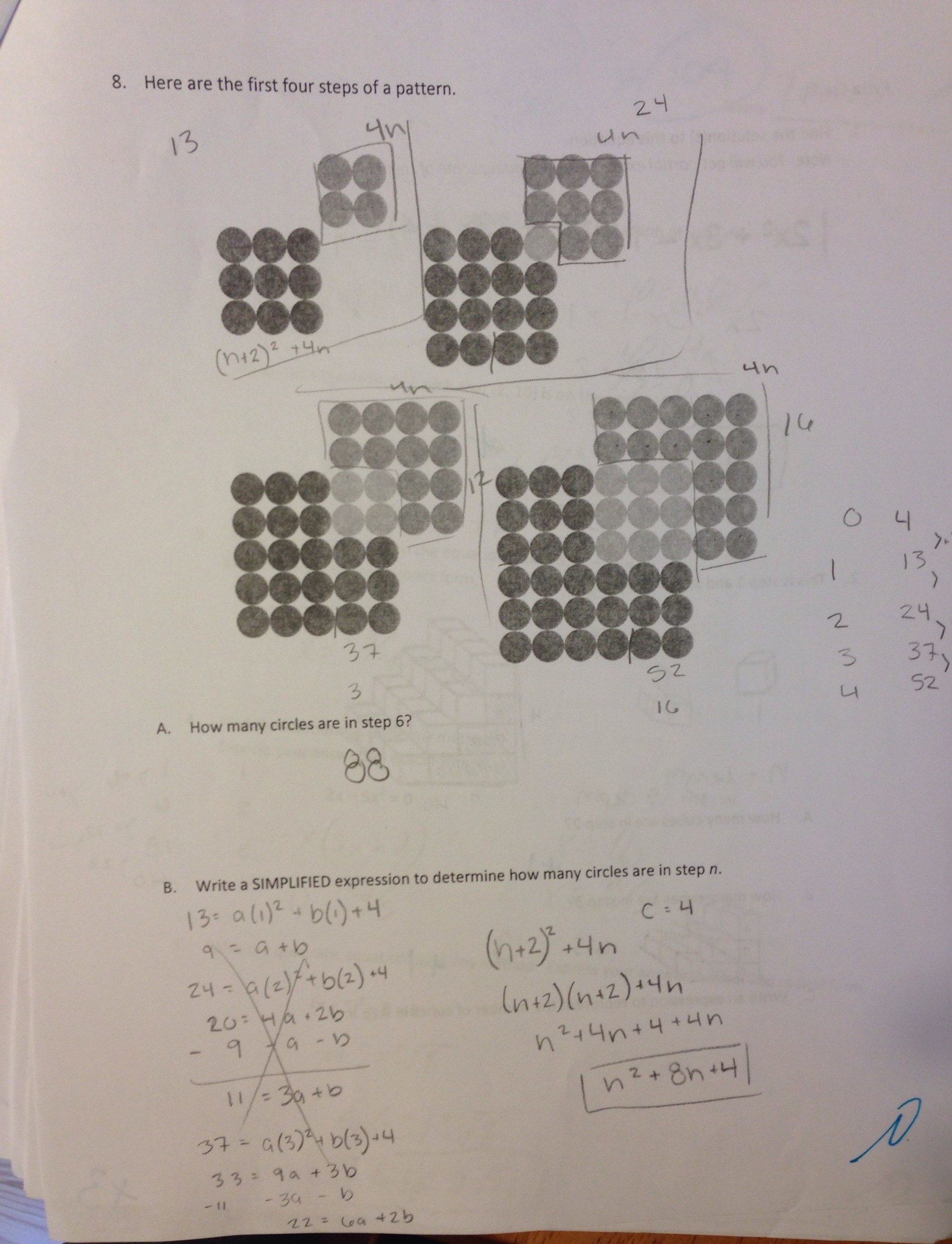
Friday was our test on Quadratics.  I put pattern #86 on the test the students had 2 tasks:

1.  Find the number of circles in step #6.  [I wanted a question that most students would do correctly, to keep the barrier to entry low.  Step #5 resulted in the number that math teachers hate the most, so I went with step 6 instead.]

2.  Write a simplified formula for the nth step.

I took multiple pictures of student work to compare their different methods of arriving at the simplified answer of n^2 +8n + 4.  My favorite though (and the one that most represents the growth I’ve been hoping for) is the student that abandoned the algebraic method of creating a system of equations from the table for a more conceptual representation derived from generalizing based on the picture of the pattern.

Here is that student’s work:

I love how the student got most of the way through the algebra and still opted for the other approach.  The student even figured out the “c” value of the quadratic, which is the value that students opting for the algebraic approach struggle with the most.  These students are realizing, after 8 weeks of struggle, that they cannot easily recall since they were usually memorized rather than grounded in conceptual understanding.

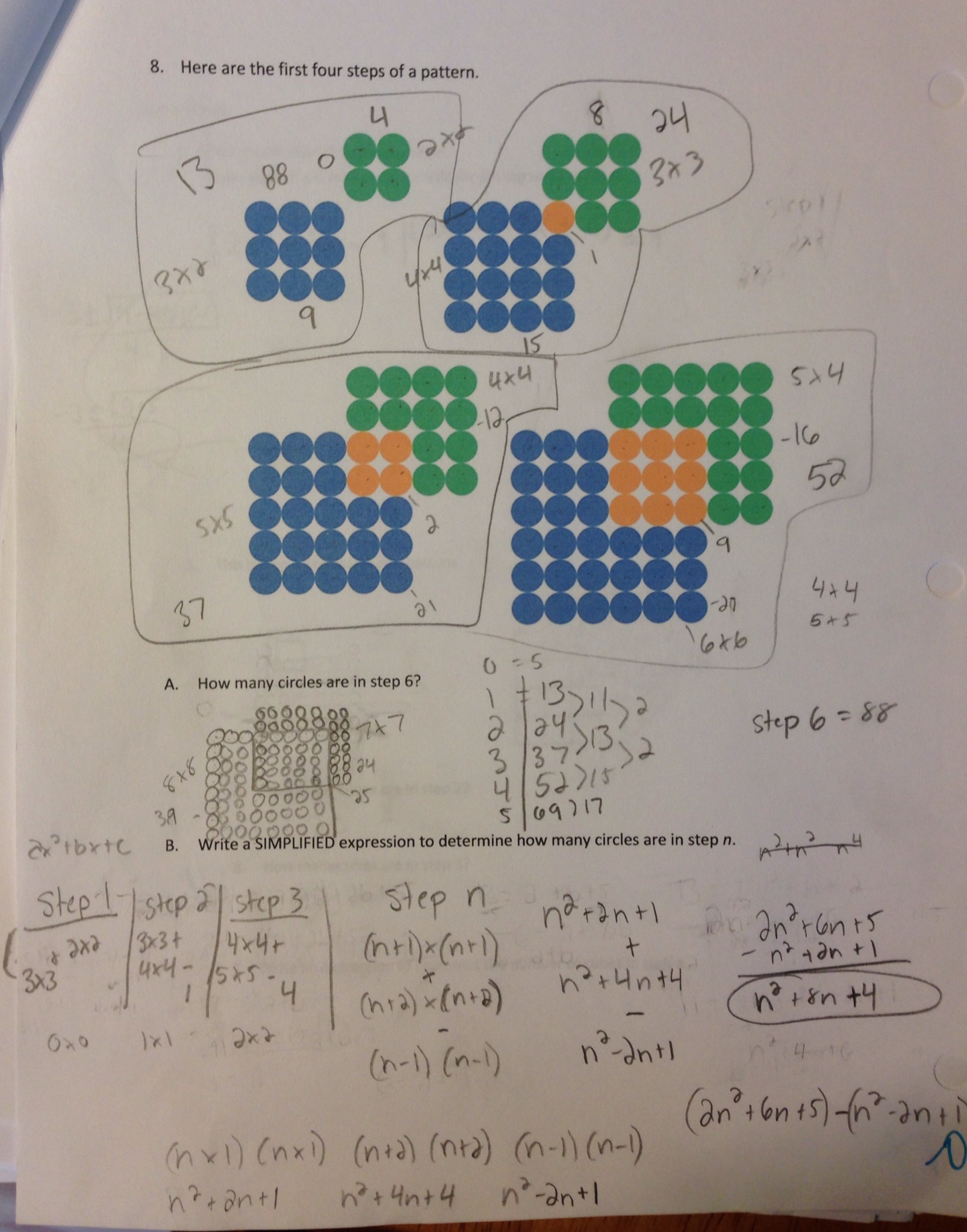
Here is another student’s work:

image

This student came in before school to take the test because she was going to miss the class period due to a field trip.  (which is why her test was printed in color).  Anyway, it took her a while to finish this problem.  I was so proud that she was able to arrive at the correct answer with lots of persistence and without relying on an algebraic algorithm.  At the beginning of the trimester, this is one of the students that would stop when she reached difficulty in a problem and then would wait for someone else to put up the correct answer so she could memorize the method.  I’ve seen her move from that lack of confidence to a place where she is willing to make mistakes so she can formulate her own methods for solving problems.  I’m very impressed with this girls (and this class’s) efforts.

Oh, UNIfix cubes! I get it!

I’ve done a lot of professing my new found love for Visual Patterns lately, and today will be no exception.  If I haven’t convinced you of the flexibility and differentiation available in these seemingly simple patterns, let me have one more stab at it.

Today, my College Algebra class looked at pattern # 28.

I took out the unifix cubes for those who wanted to actually have the three dimensional shape in front of them.  This was helpful for some, however, I realized the limitations of the cubes…the fact that they only will “fix” to one other cube (hence the name UNIfix). This may not be mind blowing information to many of you, but I just put those two things together in my brain today.  Because of the one fixture, they were hard to take apart in usable “chunks” without the whole figure falling apart.

Anyway, back to the pattern. I wanted to workout ahead of time all of the possibilities that students would come up with so that I could more effectively use the 5 Practices of Orchestrating a Mathematical Discussion and anticipate their responses.  I’ll tell you what, I played around with those expressions so many times, and thought for sure I had came up with at least the majority of responses I would encounter. They were all quadratic. Then, out of left field, the students threw me for a loop. The majority of students came up with n^3 – (n-1)^3!

Now, you might be thinking, duh! It’s 3 dimensional AND a portion of a cube.  However, my algebraically trained brain started with quadratic expressions and stuck with them since I saw from the difference of differences table that this pattern was in fact, quadratic.  Yes, the n^3 terms get cancelled out when the expression is simplified and the simplified expression becomes quadratic but this opened up a whole new avenue of discussion with my class. We were now able to talk about the misconceptions of expanding something like (n – 1)^3, because if they found the expression for the nth step another way, they could use that as a check for simplifying their answer.

What was eye opening for some of the students that chose an algebraic method (such as using a table of differences and then setting up a system of equations) was that the “c” value in ax^2 + bx + c was hard to conceptualize.  It was very difficult for students to grasp that the first term and the non-existent “zero term” had the same number of cubes.

Finding the surface area formula for step n was even more awesome, because it was in this portion of the pattern that I was able to see real growth in my students’ willingness to attempt a more conceptual method.  There are certain students whose default method is to set up a system of equations using the table of values for the pattern steps. These students are noticing more that they encounter errors much more often than those who have a conceptual understanding of how the pattern is built.  I found this time around, less students relied on the algebraic method (about 7/35) whereas last week, probably 15/35 of them were starting algebraically.  As we are covering more and more concepts in this course, the students are realizing that they do not remember specifics about formulas and procedures from their previous algebra courses.  They remember “learning” the topics, but they usually can’t quite nail down the specifics of each method.  I really feel that we are making some good headway toward solidifying their conceptual understanding of the algebra as I see more and more students break away from the procedural methods toward a more conceptual one.

We talked about this pattern for an entire 60 minute class period.  You know it’s a good day when kids look at the clock and say, “whoa! Class is over already?”

Olympians, Tweagles, & Friends in my Phone

I started tweeting in 2008, around the Beijing Olympics. It was cool that actual Olympians would respond to my tweets.  When Summer Sanders responded to one of my tweets, I about fainted. Twitter was new, they probably didn’t know any better.  

I followed a few celebrities. I found some of their off-color honesty hilarious and sad at the same time.  In the meantime, my hilarious brother managed to rack up tens of thousands of twitter followers. (@sucittam if you are looking to add some hilariousness to your timeline). Here’s one of his tweets being featured on Ellen:

He opened my eyes to the idea that following actual REAL people is more entertaining and fulfilling. He was absolutely right.

I went through a phase where I followed a bunch of people who tweet as their beagle.  I’m pretty sure I was the first one to use the term Tweagles, although I have no proof of that. 

Then in January 2013, my indifferent view of people on twitter changed forever. My 29-yr old sister in-law, Danielle, suffered a massive brain aneurysm and it wasn’t certain she would recover.  She was in the ICU at the University of Iowa for almost 6 weeks, and while my brother stayed by her side every day, his twitter followers rallied support that went viral. All of these people, most of which he’d never met, wanted to reach out to help. Benefits were organized, gifts were donated, and memorabilia was auctioned all to benefit Danielle whose recover was slow, but steady. 

Rex Huppke (@RexHuppke) wrote a beautiful article illustrating that the people we interact with on twitter are not just cyber-acquaintances.  Danny Zucker makes the best point:

 “We’re willing to accept the concept that cyberbullying is real, and it is. But if you can accept the idea that the negative is real, then you have to accept the idea that the positive is real. If strangers can hurt you, they can be friends as well.”

And just like that I leaped head first into the T of the MBToS. I realized that people like Fawn Nguyen, Andrew Stadel, Kate Nowak, and Christopher Danielson were real teachers just like I was.  They had great blogs, and they were on twitter too. And if I wanted to get a real benefit from all of the resources I had found online, I needed to start posting feedback of how I incorporated them into my classroom.  And then tell the creator of the activity about how it went. Through this I’ve really been able to experience the genuine human behind all of these @ symbols. These are not only great teachers who don’t just shine on their own. They want to freely share what they’ve done so that others can shine just as brightly. 

I’m gushing again over Visual Patterns

Today we looked at Pattern #5 from visualpatterns.org.

I was intrigued by this one because I thought they looked like crab claws.  Anyway, what was fascinating about this one was that the kids did not immediately expect it to be quadratic.

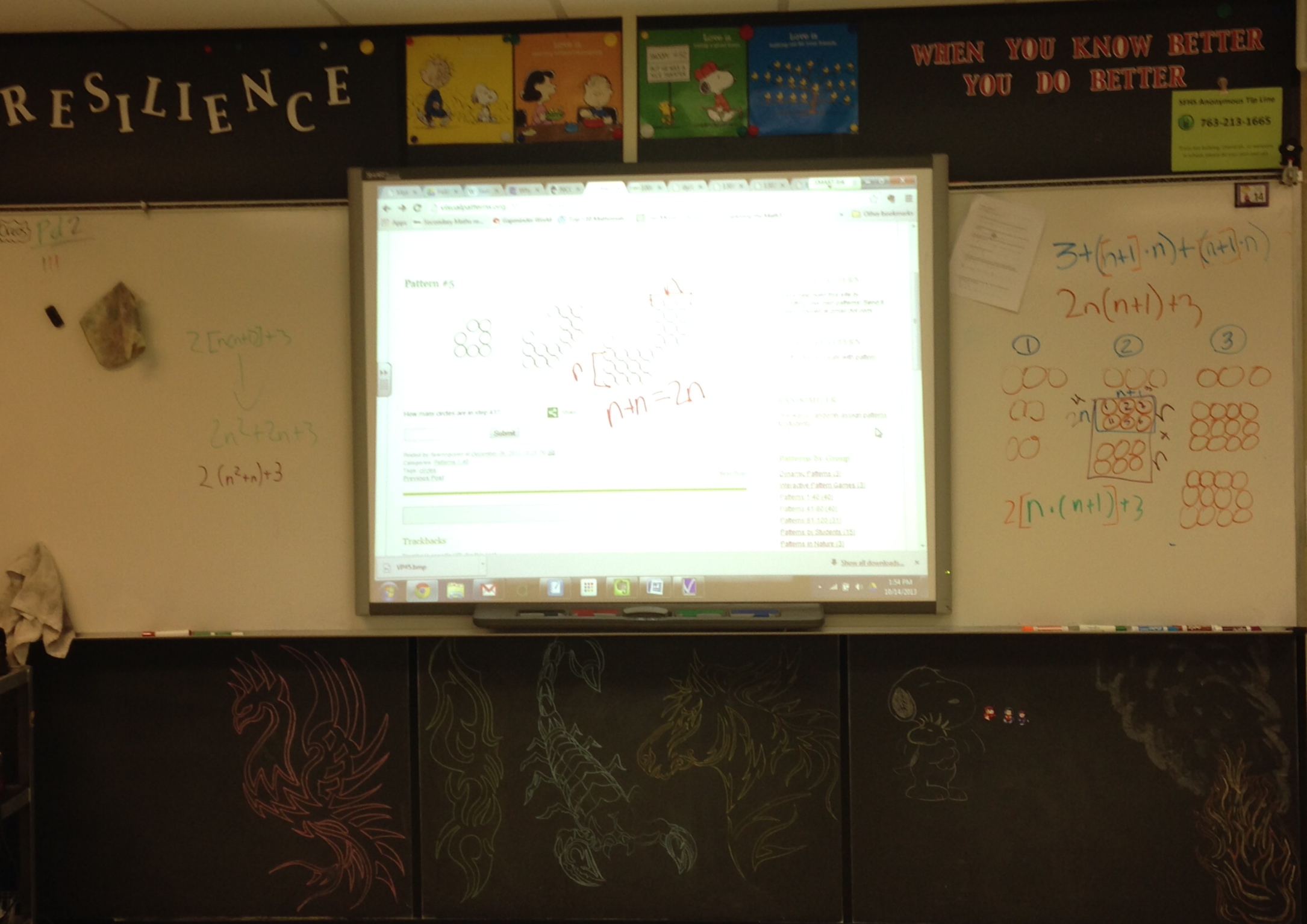
They came up with the following pre-simplified expressions for the nth step:

  • 2n(n+1) + 3
  • 1 + (n^2 +n^2) + (n+1) + (n+1)
  • 2[n(n+1)] + 3
  • 2n(n+1) + 3
  • 3 + [(n+1)n] + [(n+1)n]
  • 3+2(n+1) + 2[(n+1)(n-1)]   **This one was the most intriguing to me.
  • 2n^2 + 2n + 3

For each of these, I had the student put the expression on the board.  I then had different students explain the thinking of the student who came up with the expression and relate it to the pictured pattern.  I saw a real improvement here from when I had them do this activity the first time last week.  I had many more students volunteer to explain the thinking of their cohorts and much less hesitation to work out what the terms in the expressions represented.  The students sort of thought of ‘explaining thinking’ that was only represented by numbers and n’s was like decoding a puzzle.  They could see that they all simplified into the same final expression, but working backward to find where that expression started was part of the challenge that they have been more willing to accept.

Here’s a picture of some of their work.  I’m sure they’d be thrilled to be part of my blog post.

photo (1)

What was REALLY special about this pattern is that we were able to relate it then to quadratic equations in x,y coordinates.  We talked about all kinds of things related to quadratics such as what the +3 means in the pattern and in the quadratic graph, how we could use the “0” step to make finding the quadratic equation easier, and how a system of equations could be set up as well to find the coefficients of the x^2 and x term.

What I really appreciate about this website is that there are so many extensions to all of the patterns.  There is no much more for students to uncover other than finding the 43rd term.  I love that I am able to use these patterns in multiple levels of my math classes and the students are given the opportunity to pull out the necessary mathematics.

Resilience leads the way

Intrigued by Matt Parker’s tweet yesterday, I decided to have a go at it.
Arrange the numbers 1-17 so that adjacent numbers sum to a perfect square.
It’s the kind of problem that makes students who struggle at math, or hate puzzles, shutter. I decided to take this problem on, in my lowest level remedial math class. This class has about 20 kids, 9th-12th grade, all who have failed a previous math class. These kids range in ability as there is a large variety of classes failed.
I started off by having them number little pieces of paper with the numbers 1-17. I think this helped in setting up the task in a low pressure way. Numbers 1-17, how hard could it be?
Then we talked about what numbers were square numbers. Those who thought they could begin were off.
Others who still couldn’t wrap their head around how the numbers could be arranged, together, came up with some examples of pairs of square numbers. Then, all students were able to make triples with adjacent square sums. They built on those smaller sets and began to come up with strings of 4 or 5 or 6 numbers. One student noticed that the highest square number that could be made from the numbers 1-17 was 25, so 16 and 17 needed to be on the ends of the arrangement since only one other number each would sum to 25 from the list.
Toward the middle of the task, I saw students getting frustrated that they only had a few left and they couldn’t seem to place them. We talked about how 1 could pair with multiple numbers on the list. That discovery seemed to re-energize them to rearranging more numbers and persevere in solving the problem.
The students had differentiated themselves at this point and some were working alone and some together. What I found very interesting is that when one of them solved it, they weren’t immediately drawn to that person to show them the answer. They wanted to figure it out on their own. They weren’t rushed either as students finished. Sometimes when students finish quickly, others become frustrated and just want the answer.
The students also developed some interesting strategies, like grouping pairs that totaled 16 and 25. By the end of the 30 minutes, every single student had arrived at the correct solution. I’m not sure if it was the physical manipulative or the puzzle-like feel of the task, but I was so proud of this group of kids. These are students who have already failed at math and have convinced themselves that they are inherently bad at it. Today they proved that not only is the latter completely false, but also that success is in math is achievable with perseverance and resilience.

Aha for patient problem solving

I teach two different classes with a similar (if not identical) mix if students: college algebra and accelerated probability and statistics. I have been using problem solving in college algebra as a basis for our classroom discussions and I like the material I’ve chosen. However, it didn’t seem as though the college algebra students were developing those patient problem solving skills as much as I’d hoped. Most were working hard, but many of them were stopping when they hit a snag and then waiting for the “smart” kids to come up with the formula or equation.
The aha moment came when I gave a problem to my accelerated prob and stat students that was similar to that of the college algebra class: there were multiple entry points, many solving methods and a high ceiling. I noticed that as the problem progressed, more of the students in the stats class were still working on formulating a solution than would normally be doing the same in college algebra. The students in stats valued all of the methods as productive in some way, whereas in college algebra, many students reject ‘guess and check’ as it doesn’t seem like ‘real math’ to them. I realized why this was: they didn’t have a concrete formula they were searching for. They truly had to discover it on their own. Having accepted that there was no formula, they then trudged onward toward a solution that made sense. I made an assumption, that my college algebra students confirmed that in algebra, they have always been told that they need to set up an equation, find the right formula, or pick the right method. So when problems get hard, they know they can wait for the smart kid to figure out the formula and they can then apply it to a similar scenario next time. And advanced kids are very good at repeating a process, as long as it’s easy to figure out which specific process applies.
Don’t get me wrong, these are VERY smart, hard-working, awesome kids. I am just struggling with how to get them to, well, struggle, a little bit longer.