Des-Man Does Double-Time

If you work at a high school, you probably don’t need a reminder that it’s Friday the 13th, and it’s the day before Valentine’s day.  When it comes to adolescents, the mood is a mixture of giddiness and angst.  A student asked his girlfriend to prom by filling her locker with ping-pong balls.  No doubt every student in my 3rd hour was able to snag one of those little white balls of sound-joy and test their durability all over my classroom.  Good times.

Regardless, I was determined to make an attempt at engaging them mathematically.  Enter Sandman (oops.  DES-man).  I had read on twitter about teachers using this activity as a platform for having students share graphs.

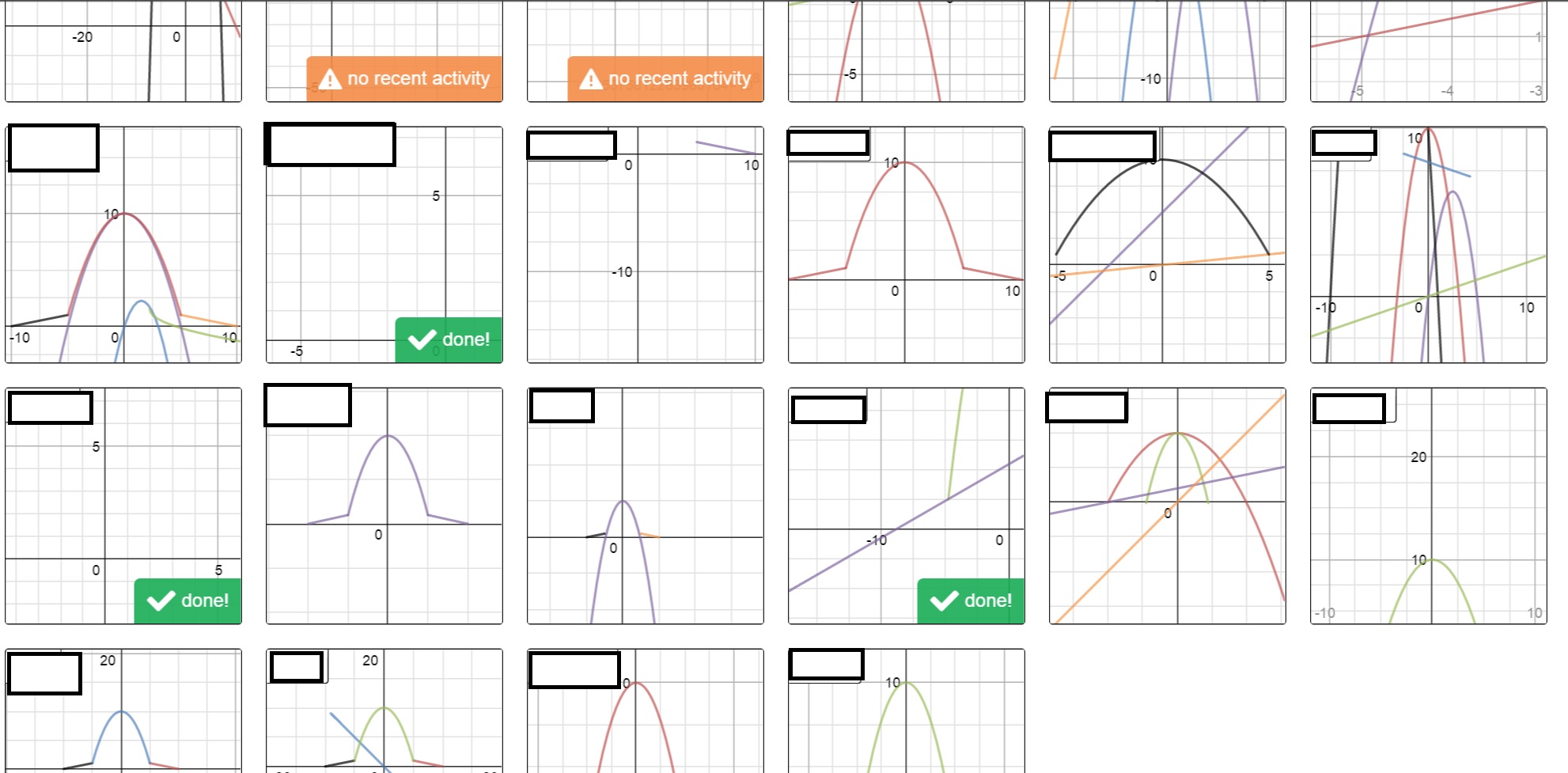
I posted a Daily Desmos graph on the projector and then watched them attempt to create it using the Des-man Dashboard on my tablet.  It was delightfully challenging for them to get the graph through the correct points and restrict the domain perfectly.

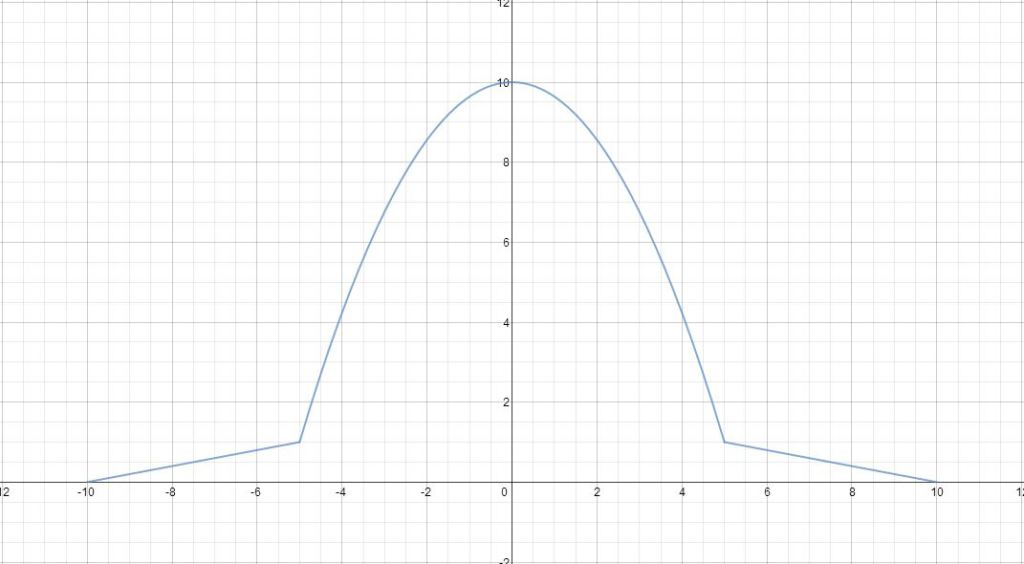
Because this was our first time formally restricting domains and ranges for piece-wise functions, I kept to the basic challenges.  Here’s one that stumped a few of them:

dd241b

(Thank you @marybourassa)

Here was their attempt:

Desman

I’m pretty sure I got so excited about the possibilities in my other classes that I took my tablet and raced down the hall to share the awesomesauce with my colleagues.  Not sure they were as geeked out as I was but they humored me regardless.


How Do We Define “Pep”?

Unexpectedly, I decided to supervise the commons area during a pep-fest and took that opportunity to take a page from Christopher Danielson’s book and bring some games and leave them for students to “discover.”

I chose a few that were more portable and set them out.  No one bit.  

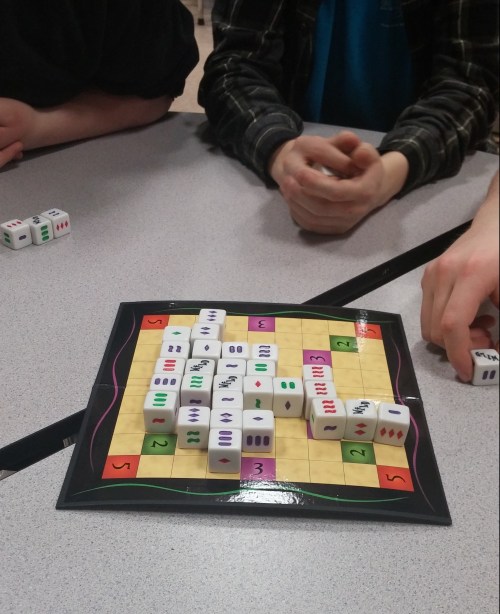
I could have packed them up and continue on my merry, grading way, but I thought, “NO.”  This was the second time this week my game-bait had been rejected and I was not having it. (The first was from my daughter who caught onto my clever placement of shapes as soon as she walked in the door)  There were about 15 kids in the commons area, and I was determined to get at least 5 of them to play Set Cubed with me.

So I called a few of them over, taught them how to play, and some serious fun ensued.  It was four boys and I for 45 solid minutes, and no one flinched for a second to check his phone.  Not one of them.

Here’s what I learned:

This week was Snow Week at our school.  Four themed dress-up days,  a talent show, a dance, and a pepfest. Something for everyone!  Well…most everyone.   Students who don’t wish to attend the pepfest must bring a note from their parent excusing them or they can sit in the commons area for the hour.  It’s safe to assume that the heavily involved students attend the pepfest, some begrudgingly go, and many students opt to bring in a note excusing themselves.

That leaves a small group of students who do not feel a connection to school spirit and do not have another ride home.  They’re marginalized for one reason or another.  And what do we do to accommodate them?  We put them in a room, ask a few teachers to supervise them, and cross our fingers that they sit down and put their face in their phones for the hour.  We silence them because they don’t want to sit in a crowded, noisy gymnasium and watch the crowning of Snow royalty and see a principal kiss a pig.

I want to be clear, my goal is not to not criticize pep-rallies or school-spirited events.  Our students and teachers do an excellent job of making sure these events are entertaining for those who attend.  But we need to acknowledge and honor the fact that there are students where school is their safe place but overt participation in it is not comfortable for them.  Their needs involve being supported by school, which doesn’t necessarily mean they don’t support their school.  And because of this deep need, we need to offer them a place where they can feel valued and not marginalized and unappreciated.

I will finish with this: it sure felt good making those kids feel comfortable today.

0123151353a

Math is Messy. So Are Gender Roles.

I have been absolutely humbled by all of the positive feedback I have received from my previous post.  Thank you to infinity for taking the time to read, write, and share.  I believe that it is our common humanity that makes it possible for us to learn from one another, not necessarily our knowledge of content.  There is so much of my sobriety that goes into my teaching.  It is an incredibly freeing feeling to be able to be honest about that part of my life as I blog.

Rose Eveleth wrote a great piece about the roles that girls find themselves taking on in group work.  In short, Eveleth focuses on acknowledging that girls often self-assign the “recording” role, absolving (and downright excluding) themselves from a problem solving opportunity.  The end result, career-wise, may lead women away from high-profiled positions.   As teachers, it’s easy for us to overlook this discrepancy because girls, generally speaking, are neater and more organized, and may seem like the best fit for the job.  In a related article, Dale Baker does a great job of asking teachers to examine gender preferences that exist in our classrooms in order to help encourage all students to step into the “lime light.”

On Friday, I tried a simple version of this.  First, students were presented this scenario (taken from the Math Forum POW section):

The Student Council at Rahkenrole High School is planning a concert.  They’ve hired the Knox Mountain Boys, a popular local band, for $340.  A poll among the students has shown that if tickets cost $5, 140 people will come to the concert.  For every dollar the ticket price goes up, 10 fewer people will come, and for every dollar it goes down, 10 more people will come.  

I’ve been a huge fan of the Math Forum, long before I joined Twitter (and got to fangirl Max Ray at TMC14).  The reasons might not seem obvious from this scenario, but kids noticed right away that there was no question asked at the end.  What’s brilliant here is that there is literally an infinite number of questions that we could ask here.  Granted, some questions are more important than others, but I framed the task in a way that elicited what I needed.

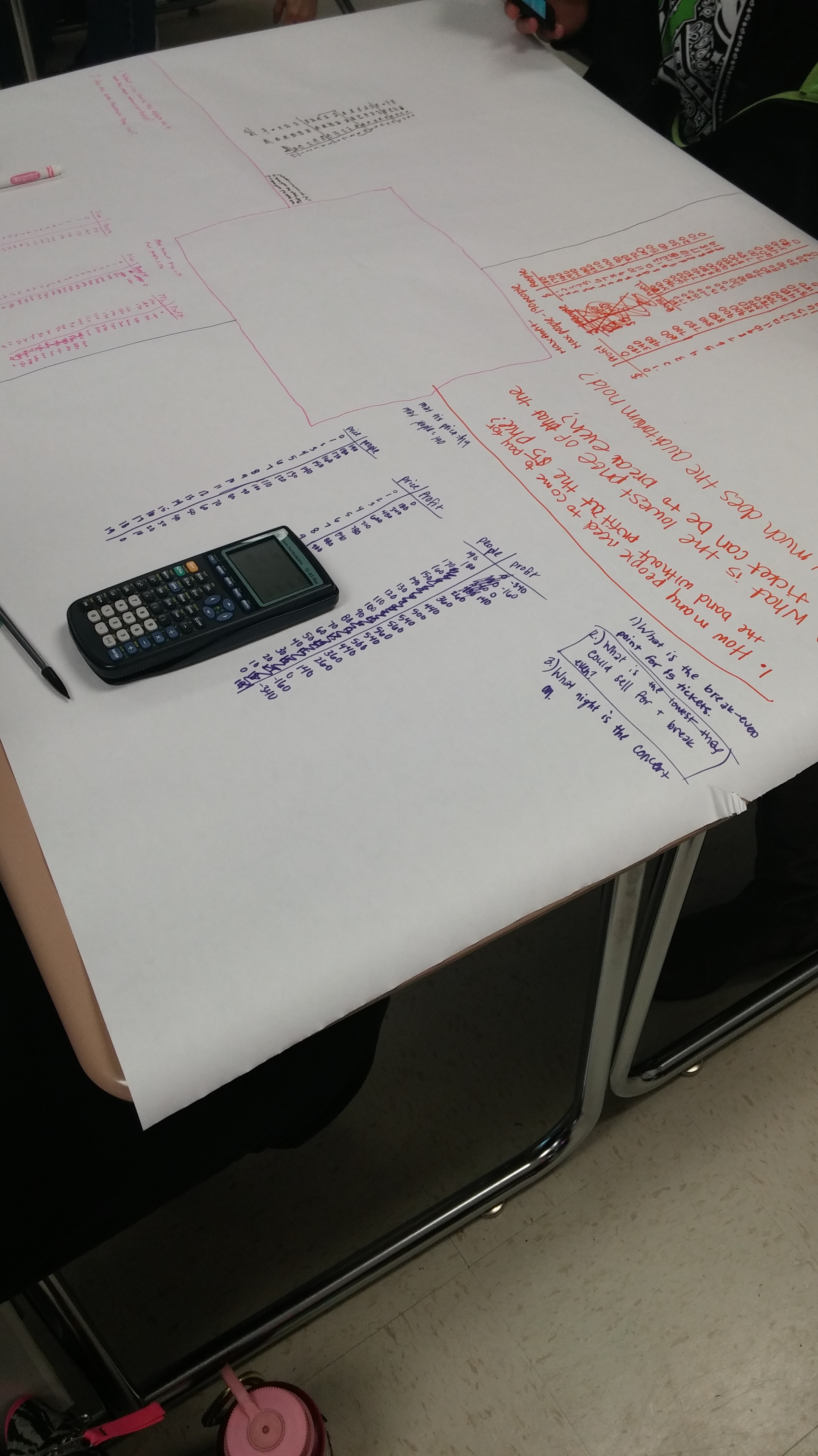
I handed out a big white piece of paper to each group of 4 and had them divide the paper up into sections.  This way each person in the group was both the recorder and the problem solver.   I asked them to write down 2 questions they think that I would ask about the scenario and one question (anything) that they would ask.  They identified their group’s most important question and put it up on the whiteboards on the wall.

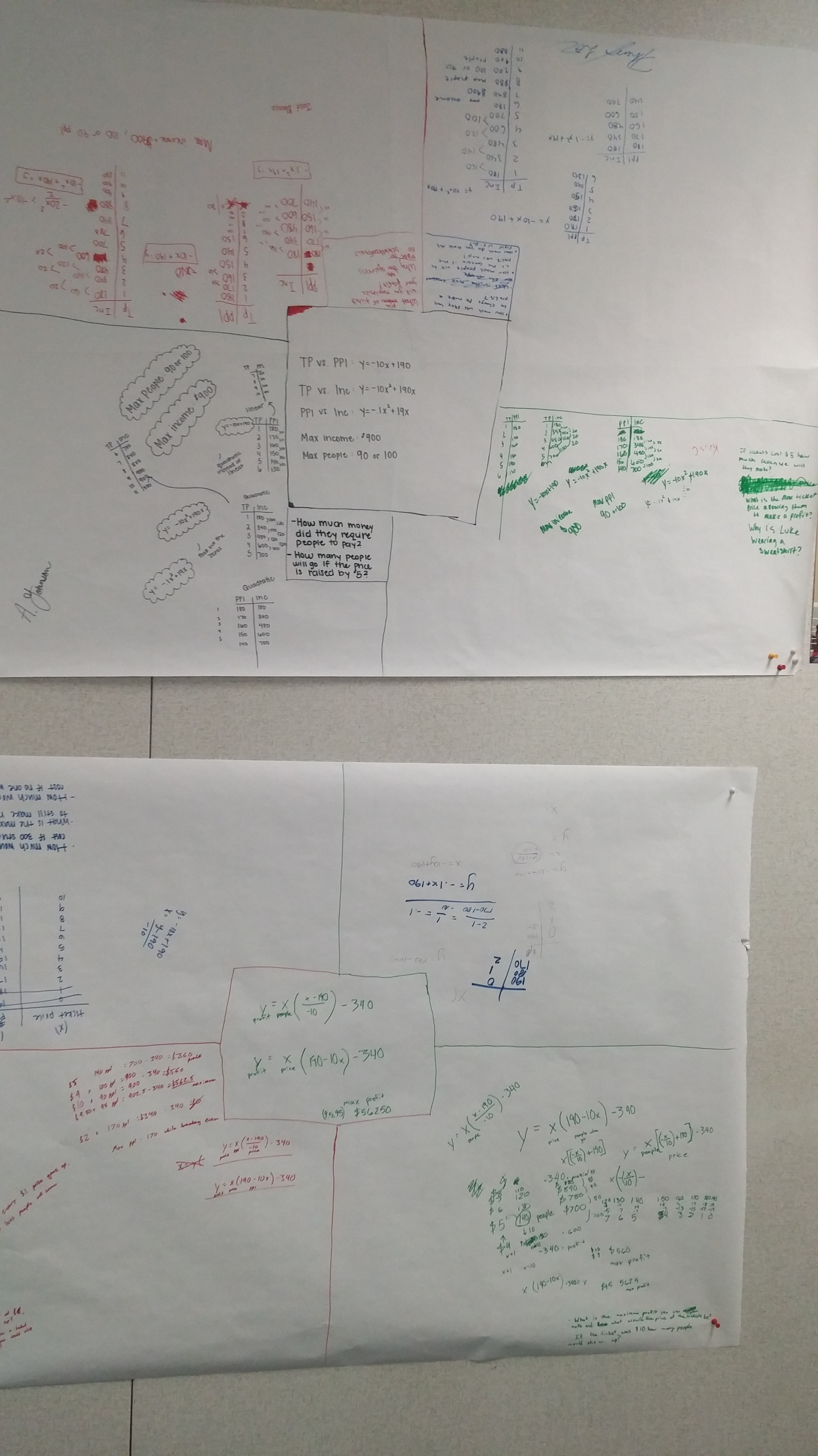
Low and Behold!  They READ MY MIND! They asked about maximizing profit, income, and people, and also requested modeling equations for each.  The excellence in this scenario (and the Math Forum in general) is that it can be applied to so many levels of math for so many reasons.  For example, most high school kids can make a table and figure out a reasonable answer for the maximization questions, and kids with more know-how can develop mathematical models.

Some great things happened:

  1. They knew they needed ONE set of answers in the center of their paper.  This meant they had to communicate the work in their section. The traditional group roles dissipated, and they all had equal stake in solving the problem.
  2. They solved the problem in so many different ways.  (Do you remember these types of questions from Algebra 1/2?  I’m sure they have a trendy textbook label that alludes me at the moment. But they are solved by making the variable “number of price increases. Interestingly, very few students solved it that way successfully.)
  3. They were messy. And I loved it.  In fact, I made the second class use markers exclusively so that they could not erase.
  4. They were uncomfortable leaving some of the questions unanswered.  When I didn’t label certain questions as “bonus” or “extension” they felt that all were necessary to be successful.  My goal was for them to collaborate with ownership in their individual contribution.  I may have gotten more joy out of this part than I should have 🙂

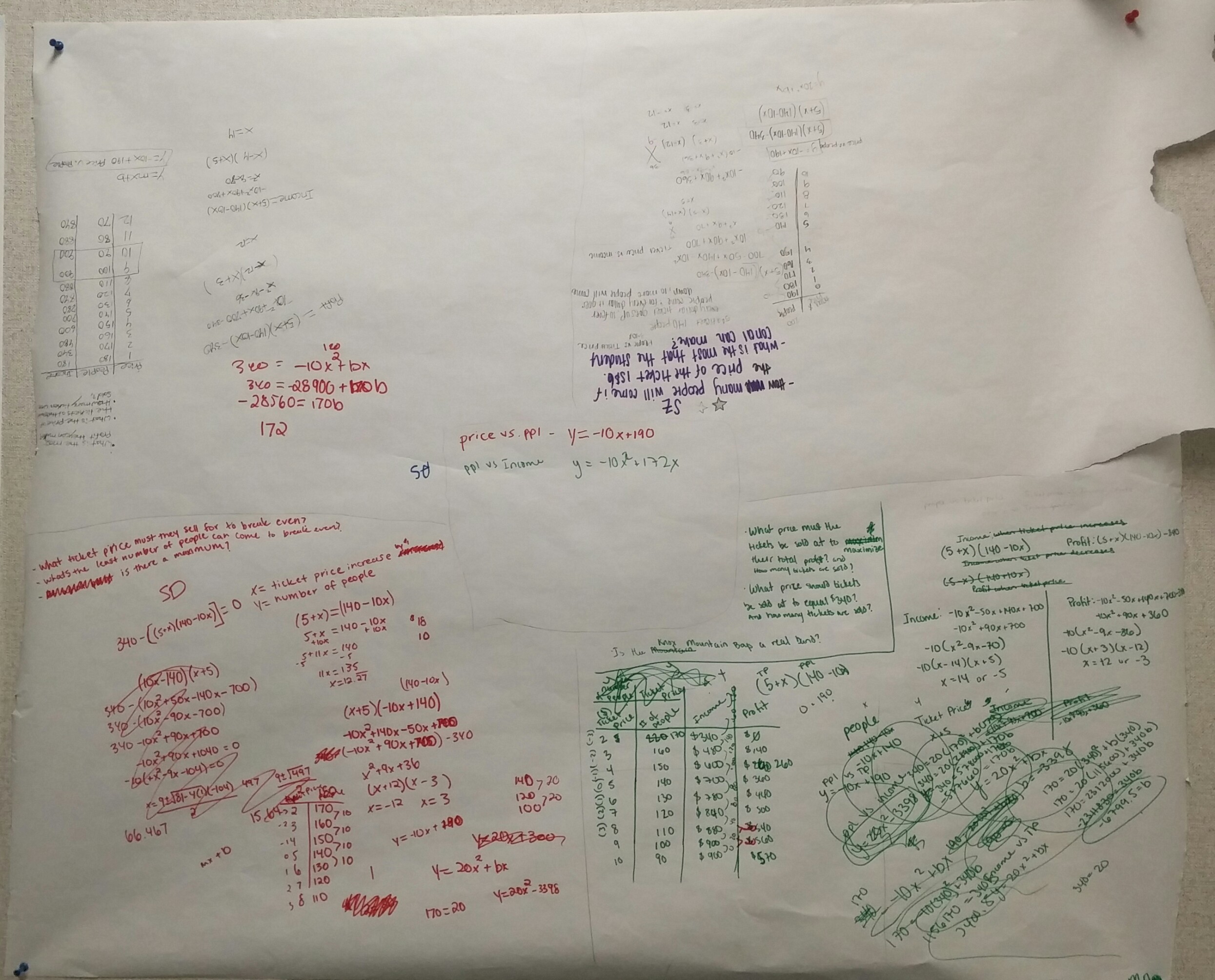
Here are some fun photos of their work:

0109151104-1 0109151149 0109151215


Hi. I’m Megan.

The time finally came for us to move the crib-turned-toddler-daybed out of my daughter’s room and clear the way for her new big girl bed.  While clearing out the menagerie of clutter that remained from under her bed, I came across a card that I must have given my daughter to play with when she was collecting “credit cards.”  It was my therapist’s business card, and on the back, as was typical when I was attending therapy, was a question for me to reflect on before my next session.  “What is Normal?

Growing up, I experienced more square-peg, round-hole situations than I care to recall.  Moving, switching from private to public school, changing swim teams to find the right fit kept “normal” seemingly out of reach for me.   A career change, divorce, and seven years of therapy later, at the age of 31, I realized that this “normal” that so many of us live in constant pursuit of does not really exist at all.

[Side note: If when you hear the word therapy, you think  “I don’t need to pay someone to listen to my problems.  I’ve got friends for that, I want to be the first to tell you you’re wrong. There’s a professionalism and unbiased skill that a therapist has when uncovering the root of an issue. Just like content experts don’t make the best teachers, friends don’t make the best therapists.]

I’ve struggled internally with how to write this blog post for a long time.  I wrestled with the idea of writing anonymously, but “unnamed” has never been my way about things.  My ultimate goal in this is that my experience, strength and hope can inspire, encourage, and support someone who is having a similar struggle.  I feel I can do that most effectively with a genuine story, rather than an incognito account.  So, without further introduction, I’m taking a deep breath, putting my big girl pants on, and opening up.


Hi.  I’m Megan.  I’m a mother, a wife, a vegan, a dog lover, a math teacher, and an alcoholic.  On March 31, 2012, I admitted my powerlessness over alcohol and this March will mark 3 straight years of sobriety for me.  I’ve attended AA meetings, in numerous cities, and the message is the same:  The addiction is merely a symptom to an underlying problem.

On August 29, 2010, I gave birth to a baby girl named Maria.  Her perfect eyes, toes, and full head of hair illuminated my world like I could not have imagined.  Being a mother was going to be the most rewarding, beautiful experience of my life, yet I felt the heavy burden as the life of this child was placed in my arms. Nothing short of divine intervention was going to come between me and protecting my child.  Nothing, of course, but the power of an addiction to alcohol, which no human force could ever remove.  I remember looking at Maria’s perfect blue eyes and stroking her soft baby skin, while slowly emptying the remaining contents of a bottle of Kettle One vodka I’d stashed under the sink.  Alcohol pulled me deeper and deeper into helplessness as it seduced me night after night.  That first sip after a hard day dealing with students sent a rush of relief throughout my body. But that relief was short lived when the need for more grew greater and greater.

Everyday, people are touched by the promises of Alcoholics Anonymous.  Every profession in the world has been affected by the disease of alcoholism.  But as a teacher, I have experienced the anxiety that comes with wondering if AA is truly anonymous. I hesitated so many times to walk through the welcoming doors and admit my powerlessness over a drug that held me down.  Fearful that inside those rooms I’d lock eyes with a parent, former student, or colleague who would divulge my secret that I struggled with alcohol.  As teachers, we desire control and order.  Trying to control my intake of alcohol was something out of my reach, yet the fear of being recognized as a teacher kept me from attending a meeting and seeking real help.

I still attend AA meetings and no longer fear running into school parents or former students.  In fact, I’ve become friends with a few that also attend meetings.  When I run into former students, I look for ways I can be helpful to them rather than shying away.    Along with therapy, I’ve learned to embrace my abnormality.   I’m a math and dog-loving, vegan, alcoholic.  I’ve been told not to open with that description, but that’s who I am at the core.  I don’t fit into many social circles naturally, but I’m fiercely committed to those I call friends.  Since I’ve put down my drink, my life has not stopped getting better.  And I’ve built a confidence in myself that there isn’t anything I want to accomplish that’s out of my reach.

There’s a lot of cliched “if I can do it, you can do it” rhetoric that follows stories like this, so I’m going to try to go a different route.  Social media does a lot of great things, but the glow of perfect Instagram photos and self-congratulatory Facebook statuses seems to tell us to put our best foot forward and discourage us from showing the hurt that lies underneath.  Many of us mourned when Robin Williams lost his battle with addiction by taking his own life, but how many of us reached out to the Williams’ in our timelines?  The face of addiction isn’t necessarily the homeless person on a bench with a bottle in a bag.  Because it’s also the teacher down the hall who holds it together during the day and falls apart at night.

I will be an alcoholic for the rest of my life, and my goal in posting this is to shed light on the deep rooted issues that even the most connected of connected educators hide.  If you struggle with addiction, please reach out.  Alcohol happened to be my drug of choice, but the many threads of addiction run together under common themes.  Please share this post far and wide, especially if you think it would help someone who is struggling with this destructive, life-threatening condition of addiction.

We open our hearts and souls to our children every year, but struggle with opening ourselves to help.  We support each other with twitter chats and lesson sharing, but I know that so many fellow educators struggle with similar issues that don’t translate well in 140 characters.  But we can’t heal a hurt we keep hidden underneath educational technology and growth mindset posters.  Let’s lift each other up in a way that helps us grow from the inside and helps us appreciate our own abnormalities as perfection.

Teaching Is Not Just Auld Lang Syne

It’s been an emotional year of edu-quarrels over standardized testing, teacher tenure, and state standards. Yes, teachers are constantly defending their profession and looking for ways to ensure all students have access to the high quality education they deserve. It’s a difficult, never-ending, sometimes thankless task that we take on when we decide to pursue being an educator.  It’s easy to get wrapped up in the never ending struggle of achievement-gap closing and raising test scores and end up believing that we can’t possibly make a difference.

Rather than repeat that rhetoric, as the calendar year closes, I wanted to reflect on a few things I appreciate this time of year about being a teacher.

10.  Summers off mean I get to attend awesome conferences like Twitter Math Camp.

Yes, those usually come out of my own pocket.  And yes, TMC15 being in Los Angeles isn’t going to be cheap.  But how fortunate are we that on a regular basis in the summer, groups of driven, passionate educators gather across the country to help better themselves and help others do the same.  There may be other professions that have numerous conferences filled with great opportunities, but I’d be willing to bet that inspired teachers who voluntarily attend professional development opportunities make some of the greatest professional experiences on the planet.

IMG_6268

Fun times from Twitter Math Camp in Tulsa


9.  Today is Tuesday, and I had the opportunity to have lunch with just my husband.

My husband is also a teacher, and I know this isn’t a privilege that every educator has.  But these extra-special moments I get with him are priceless and precious.  He’s supported me in every endeavor I’ve pursued and helped to guide me through mistakes I’ve made with an infinite amount of kindness and without a speck of judgement.  I’m confident that his understanding of me as a teacher has strengthened our relationship in un-measurable ways.

FB_IMG_1420042416651

The two loves of my life


8.  The extra time during winter break allows me to learn an outdoor winter activity that I can do with my daughter.

Returning from vacation to a balmy 5 degrees (Fahrenheit) and a clear sky makes me feel like the sun is mocking me.  Fellow Minnesota teacher, Casey Rutheford, challenged me to explore a winter activity.  I’ll admit, I resist attempting any wintry feats simply because of the outdoor temperature.  The extra days off over the winter holiday will allow me to bundle up and try something new and maybe even discover a talent I didn’t know I had.

It can't all be vacation

It can’t all be vacation.

7.  I have the chance to be a positive role model for kids. 

I purposefully leave my twitter handle public.  I know that everything I post there can be scrutinized and sometimes taken out of context.  I use this public forum, however, as a platform to spread positivity.  I’m not perfect, but I’d like to think that any person reading it would see an optimistic, caring individual.  I don’t see being a role model as a burden but as a challenge for continual personal growth.

6.  Each class period, I get to experience the creativity of  my students. 

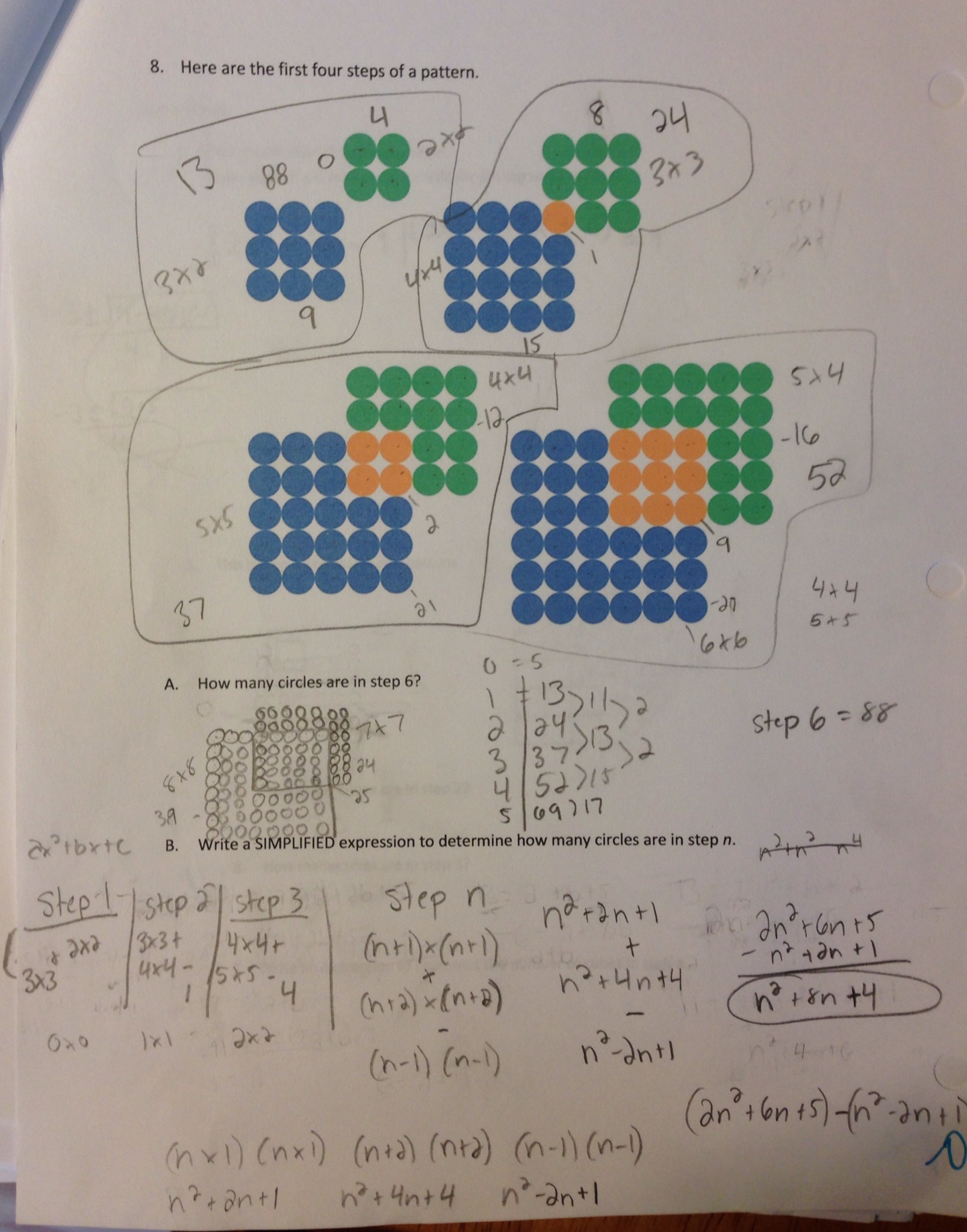
A lot of teachers will tell you that what they love most about teaching is the “light bulb” moments kids have when they “get it.”  I enjoy those as well, but what’s a hundred times more gratifying is when kids can explain their thinking in creative ways and enlighten their fellow classmates.  Sporadically, the student doing the “out of the box” explaining is the one who struggles with their confidence in their math abilities.  And that experience is icing on the numerical cake.
image

This student previously struggled with visually representing patterns.


5.  Every once and a while, a former student will contact me and boast about the awesome things they are doing.

Recently, I received a letter from a student I had about 5 years ago.  He was in remedial math, felt that many teachers didn’t look past his disinterest in academics and failing grades.  One day, I sat him down and told him that I believed in his ability to chase his dreams, if he desired to do so.   I’m so grateful that he took the time to write to me and tell me that he is now working in education and has used my words as motivation.

4.  I get to teach what I’m passionate about.

My brother and his wife got me an entirely math-themed Christmas gift this year because they know that mathematics is my passion.  I don’t know very many people outside of education that work day in and day out in a field that drives them.  This fulfillment is greater than any dollar amount on a paycheck.

3.  Every day is another golden opportunity to learn something new in my field.

I spent this evening doing geometry with Justin Aion.  I’ve blogged before about my geometric struggles, and I’ve used them to help motivate me to learn more about a topic I’m out of practice in.  Justin has a knack for tough geometry problem solving.  I’m happy to report that I’m improving because of my persistence (and his patience) with my attempting these problems.  I’d recommend to every math teacher to find a math buddy.

2. I have a chance to stand up for marginalized students.

I don’t think teachers take this part of their job serious enough.  This article changed the way I thought about how I address student interactions in my class and made me realize the duty we have to protect all students and give them a voice.  I believe that no matter what subject we teach, it’s vitally important for us to break down the walls of status and make our classrooms safe for the kids we teach.

1.  Every day, when I go to work, I have the opportunity to make someone’s life better.

The most important, yet most undervalued task we have as educators is to forge meaningful relationships with our students.  Our students won’t remember the formula for a circle in standard form.  They will remember that we genuinely cared for them and nurtured their emotional well-being.  These lasting impressions are part of our job that can never be replaced by tutorial videos and cutting-edge technology.  They can only be developed through personal interaction, and I’m blessed to engage in those interactions each day.

I want to wish a Happy New Year to all of my fellow educators.  Make 2015 the year you change the world.

Where Do Your Students Max Out?

Some of my tweets this week have gone insane.  Hedge (@approx_normal) and I have started Insanity Max 30  (Read: Twitter Math Camp is in LA this summer).  One of the major components is to write down the time in which you “max out” or take a break for the first time.  The obvious goal is to increase your time before maxing out with each consecutive workout.

This exercising format made me think about my own students and their ability to push further before maxing out.  The knee-jerk reaction for students is to seek clarification from the teacher rather than from their small group when they get stuck.  My personal take on this phenomenon is that students are fairly certain that the teacher will be able to provide the necessary clarification, whereas their classmates may not.  Regardless of their reasoning, I want to create an environment in my class where students try to push as far as they can before asking me for help.

Tomorrow being the last Friday before winter break, I’m going to take the opportunity to test them on their brain endurance.  Their task: the Catwalk Mystery problem I’ve shared before.  Unless, of course, the Problem Solving Fairy appears in my dreams and gives me something better.  You never know.  Dreams can be strange.

This problem seems suitable for a few reasons:

  • It provides an appropriate challenge for a class with a wide range of mathematical fluency.
  • It is well-suited for group work.
  • There are multiple ways in which to approach the problem.
  • There are specific places in the problem in which I know students will struggle, but I know it’s possible for them to unstick themselves.
  • Based on assumptions they make about the problem, they may arrive at different solutions.

My goal is for them to progress through the problem as long as possible without asking me for assistance.  When they feel like they are roadblocked, they can max out, ask a question and then get right back into the game.  But I want them to challenge themselves to take as few “breaks” as possible and arrive at a confident answer.  So send some good brain vibes up toward Minnesota because these kids are about to test their limits.

Times When I Suck

I’m pursuing a National Board Certification and am in the midst of preparing for the content knowledge portion.  An area in which I know I struggle:  Geometry.

I gave this problem to my students on Thursday, with the hopes that a student would be able to figure out (and show me) how to solve it.  When that plan failed, I knew I needed to start preparing more formally for my impending exam.

1095

So I  spent my Saturday evening working on geometry.  (Math teachers lead such exciting lives, I know.)  I started with some problems from A+ Click Math.  Wrong answer after wrong answer lead me to seek out a more formal review.  I know there are other websites out there for geometry review (and if you can PLEASE point me to them, I’d appreciate it), but I sank to a new low and turned to Uncle Sal.  The 6 minute video was excruciating to watch as he repeated himself as he drew , but to be fair, I understood the triangle inequality theorem much better at the end of the seemingly endless 6 minutes.

Today, I tried Brilliant, which is geared toward problem solving.  I suppose I should be pleased with my progress and my willingness to try again in the face of defeat.

Some takeaways:

  • Failing sucks.  We need to remember that when we ask our students to be okay with failure and mistakes.
  • It’s hard to admit you aren’t good at something.  We need to acknowledge that when we expect students to approach us with questions about their learning.
  • To some, being wrong means admitting you’ve failed.  We can’t automatically expect students to transition into that mindset.
  • Tell your students that you struggle as well.  Give them specific examples of when you’ve failed and let them know that they can persevere.


Making a Point

Our school uses a 5-period, trimester schedule which means that every 13 weeks, I have a new group of angels in my classroom.  I decided to give Talking Points another try, with the goal of incorporating some exploratory talk related to the topics in our units of study.  Additionally, the practice of “no comment” has proven to be undeniably helpful in encouraging students to listen to one another.  [Note:  Elizabeth Statmore introduced these at Twitter Math Camp this summer.  See the “Talking Points” link for more information.]

My goal is the same:  Addressing status in my math classroom and allowing every kid to have a voice. I began with the math talking points and then transitioned into some talking points related to our current unit: Numbers and Operations.  (I’d love to have the students come up with their own talking points as well, although I haven’t tried that yet.)

In their self-assessment, I asked them how difficult it was to practice “no comment” and was quite pleased with some of their responses.  In particular, the student that explicitly stated that he failed in refraining from commenting.  It was an excellent opportunity to encourage them to be better the second time around.

Something awesome that I noticed today:  students respectfully called each other out on cross-talking violations.

Here are the talking points we used today:

Talking Points – Number and Operations

  • The sum of two fractions always results in another fraction.
  • There are an infinite number of fractions between any two fractions.
  • Using a fraction is always a more precise answer than using a decimal.
  • The commutative law of addition (a + b) + c = a + (b + c) only works for positive numbers.
  • For the fraction -x/y, it does not matter if x is negative or y is negative as long as one of them is.
  • The reciprocal of a number is usually smaller than the original number.
  • The square root of a number is always less than or equal to the original number.
  • Zero is neither even nor odd.
  • Taking a positive whole number to a power always results in a larger number.

When having them assess themselves the second time around, many commented that it was much more difficult not to comment immediately.  Although some of the points are intentionally ambiguous, a number of them have right and wrong answers.  Conversely, the topics yesterday were more general “math opinion” related bullets.  Fortunately, when listening to their conversations, I found that many who struggled yesterday improved on today’s task.

I’m encouraged by my take on this activity this trimester.  I think that centering the statements around our units will be helpful in examining mathematical statements that make students think critically and support their decisions.


Plan, Teach, Grade. Rinse, Repeat.

The serendipitous timing of a three hour layover in Newark must be maximized with a reflective blog on my weekend in Pennsylvania.  Specifically, about my day spent observing Justin Aion in his classroom.  If you follow Justin on twitter, read his 180-blog, or have the privilege of knowing him personally, you’re no doubt familiar with his harsh assessment of himself as a teacher and his no-nonsense way of sharing his opinions.  I knew heading into a day of observing his class that I was in for a treat, whatever that meant.

Justin let me blog about the experience as his daily entry, so if you’re interesting in reading about the amazing time I had, head on over there and get reading.  In the meantime, I want to discuss some implications this day-long observation had on me in my role at my school.

As a department head, I have the chance to view the classes of multiple math teachers, once, sometimes twice a year.  I find these opportunities incredibly valuable and I always have a take-away from each observation I do to benefit my own teaching practice.  Usually, I have a 20-30 minute conference with the observed teacher where we can reflect on what is working and how the students responded to the lesson.  These “after parties” are, hands-down, the most important part of the observation process because it is in those post-conferences that enlightenment results from the insights an outside observer can provide. Unfortunately, because all of these interactions have to happen outside of the school day, many of the important issues that arise in these post-conference meetings cannot be dissected and fully examined and therefore result in little or no long-term changes. For example, in the post-conference, a question addressed is “What changes or modifications would you make in the lesson?”  A few lines are filled in on a form and off they go to teach the next group of students. The discussion simply doesn’t happen because there’s not enough time to have it.   And because these observations are shared only with a small group of people (an administrator and an instructional specialist), there is no discussion of what issues arise over and over again in multiple classrooms.  As a result, few can benefit from the individual observation.  And there are hundreds of them done in the district each year.  And it seems as though the math department as a whole isn’t able to reap the maximum benefits of having a trained observer visit classrooms.

What was different about observing Mr. Aion’s class was that the observation happened from 6:30am until 2:50pm, but the post-lesson conference went on for the rest of the weekend.  I’m obviously not suggesting that we all spend a weekend math retreat discussing pedagogy over Thai food and club soda, but the conversations we have as teachers with teachers are important.

Important and not valued.

In fact, any time that isn’t spent actively teaching or planning and grading is consistently shoved outside of the 7-3 school day.  And it seems as though the teachers who want to engage in those discussions and realize their value must sacrifice personal time in order to do so.

Here’s another example:  Just today, at lunch, one of my colleagues brought up his frustration with a student that we share.  His grievances aren’t unique to this particular student and highlight an ongoing struggle that all teachers in our department share.  We were able to have a very meaningful discussion and came to a workable solution for this kid.  The problem:  this conversation, while incredibly productive, had to happen during our already rushed lunch period.

I think this bears repeating:  Teachers need time during the school day to talk with other teachers.  And I don’t mean to lesson-plan for common preps.  I mean to really dig deep into the outcomes of our teaching and have meaningful discussions on how to better serve all of our students.

Are Teacher’s Safe in Admitting Mistakes?

Image from http://en.wikipedia.org/wiki/National_Safe_Place

Sometimes on the way home, I tune my Iphone to the TED Radio Hour podcast.  I love the way Guy Raz re-captivates his audience by highlighting numerous, already captivating TED talks.  Today, I was listening to Making Mistakes and the first segment was an interview with Dr. Brian Goldman.  His words here are striking:

The redefined physician is human, knows she’s human, accepts it, isn’t proud of making mistakes, but strives to learn one thing from what happened that she can teach to somebody else. She shares her experience with others. She’s supportive when other people talk about their mistakes. And she points out other people’s mistakes, not in a gotcha way, but in a loving, supportive way so that everybody can benefit. And she works in a culture of medicine that acknowledges that human beings run the system,and when human beings run the system, they will make mistakes from time to time. So the system is evolving to create backups that make it easier to detect those mistakes that humans inevitably make and also fosters in a loving, supportive way places where everybody who is observing in the health care system can actually point out things that could be potential mistakes and is rewarded for doing so, and especially people like me, when we do make mistakes, we’re rewarded for coming clean.

If we replace doctors with teachers and medicine with student learning, would we proclaim that our profession fosters still safe space for teachers to talk about their mistakes?  Do we have the opportunity to be vulnerable in our classroom approach in order to improve our practice and learn from others who have made similar mistakes in the past?  In an age of education the covers of news magazines equate bad teachers to rotten apples, are we really able to grow directly from what is not working in our classrooms?  Or are we lead to believe that mistakes lead to labels like “ineffective teacher”?

We preach constantly about creating safe mistake-making environments for our students.  This strategy needs to be applied to teaching as well. We, too, need this loving, supportive environment that all may benefit from.   How do we, as teachers, create this space for ourselves so that ultimately, we can learn from those mistakes and make our profession stronger?