The Corn Sandbox

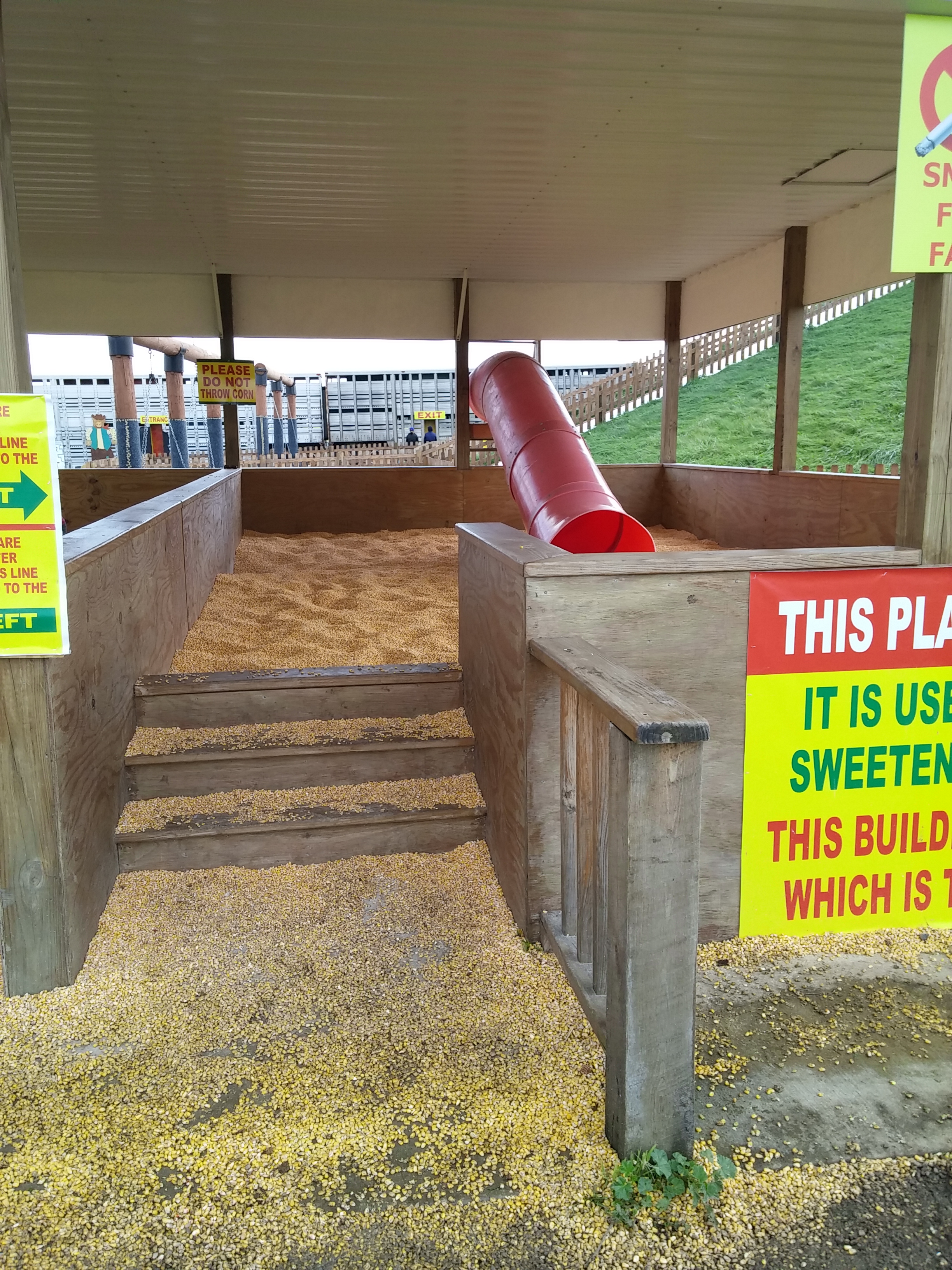
For an entire year, I’ve been anticipating our family’s return to Stade’s Shades of Autumn Festival.  My excitement has been building for one reason:  To estimate the amount of corn contained in their corn play area (or the Corn Sandbox as my 4 year-old has named it).

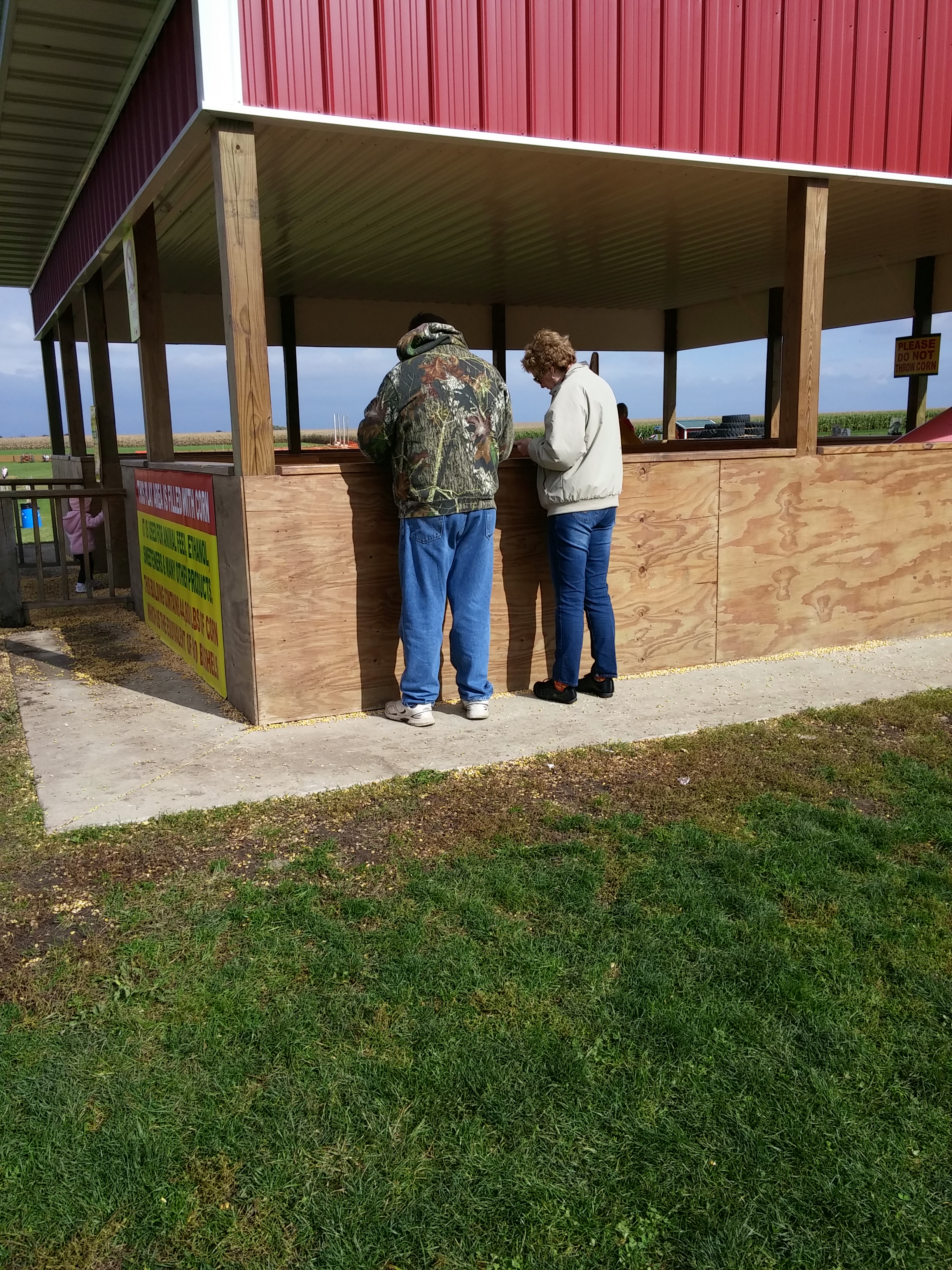
We went last Friday, armed with a measuring tape and a measuring cup.  The sign seemed to give away the answer of 800 bushels, but I wasn’t satisfied given that their was no mathematics to back up their claim.  We needed to attend to precision. Here are some of the photos I took:

1017141102

IMG_20141017_111537.360  IMG_20141017_111603.675 IMG_20141017_111712.631

My favorite is the bottom photo, my parents counting kernels of corn in 1 cup. (There are 579, by the way)

I love when I present a problem to my class, and it takes longer than I anticipate for them to solve. There was supposed to be time for solving inequalities for the group that worked with this, but that will just have to wait until tomorrow.  I’m sure they were crushed.

The essential question we wanted to answer was:  How many kernels of corn are there in this corn sandbox?

Initial estimates were very low.  I let them revise after I revealed that 1 cup contained 579 kernels.
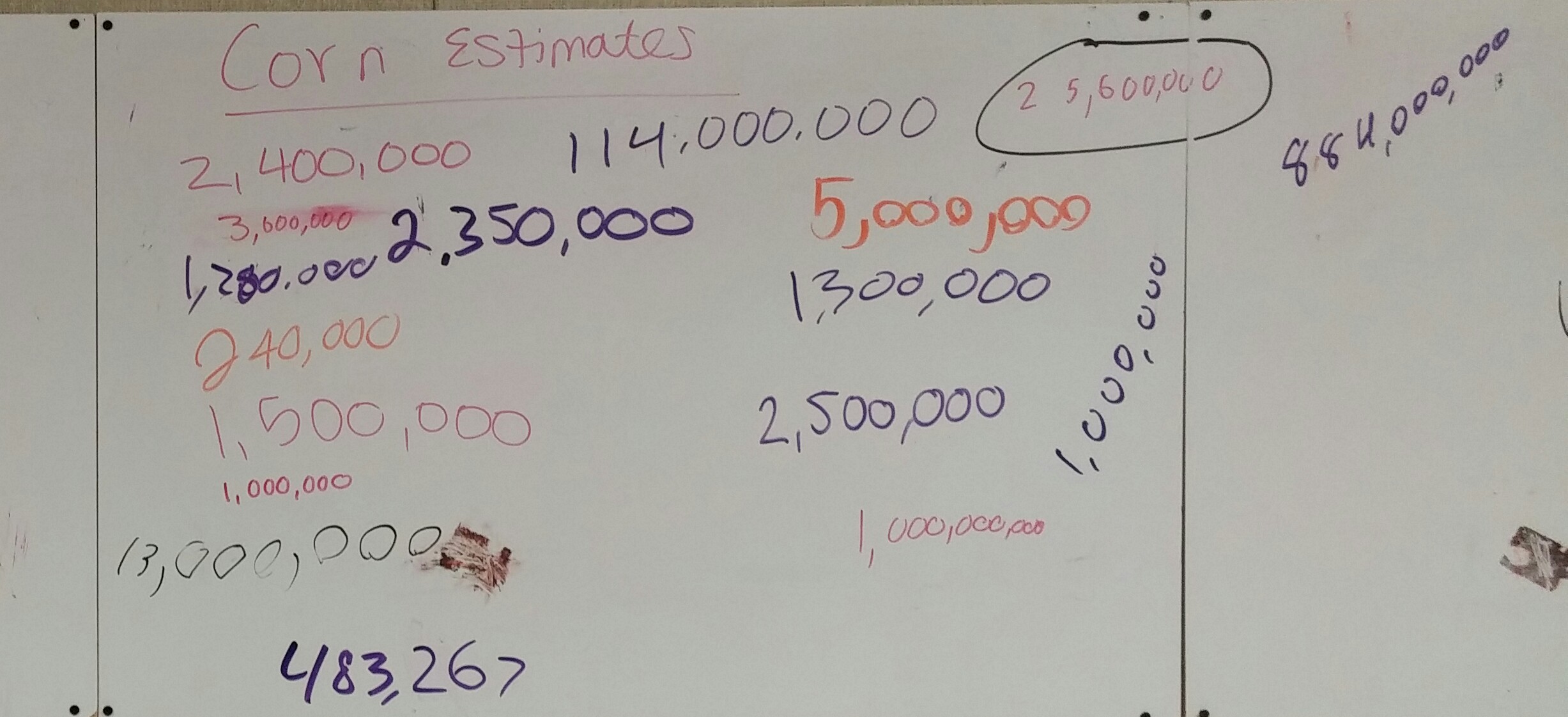
1020141124-1

One approach:  Use the number of bushels to calculate kernels.

After looking up on Wolfram Alpha that 1 bushel = 9.31 gal, we determined that a reasonable calculation of the number of kernels, based on our 1 cup count, was 69,000,000.

Second Approach:  Use the volume of the enclosure to calculate kernels.

This was a little trickier given the irregular shape of the sandbox.  Numerous calculations and conversions later, we arrived at 81,667,931 kernels of corn.

We were uncomfortable with the over 12 million kernel discrepancy between our two methods.  It remains unclear which is more accurate given the fact that one includes actual measurements and assumptions and the other is provided by the farm.  Perhaps Stade’s Farm should expect a call from Mrs. Schmidt’s 2nd hour Algebra 2 class in the near future to clear this up.

Spiders Everywhere!

Steven Leinwand has a huge influence on how I approach a math lesson.  In my experience, one of the easiest ways math can be extrapolated from almost any task is by asking the questions:  How big? How far? and How Much?

This weekend, I came across this picture on social media, posted by David Roberts:

IMG_18108993006491

Of course the question I asked first was “How big is that tarp!?

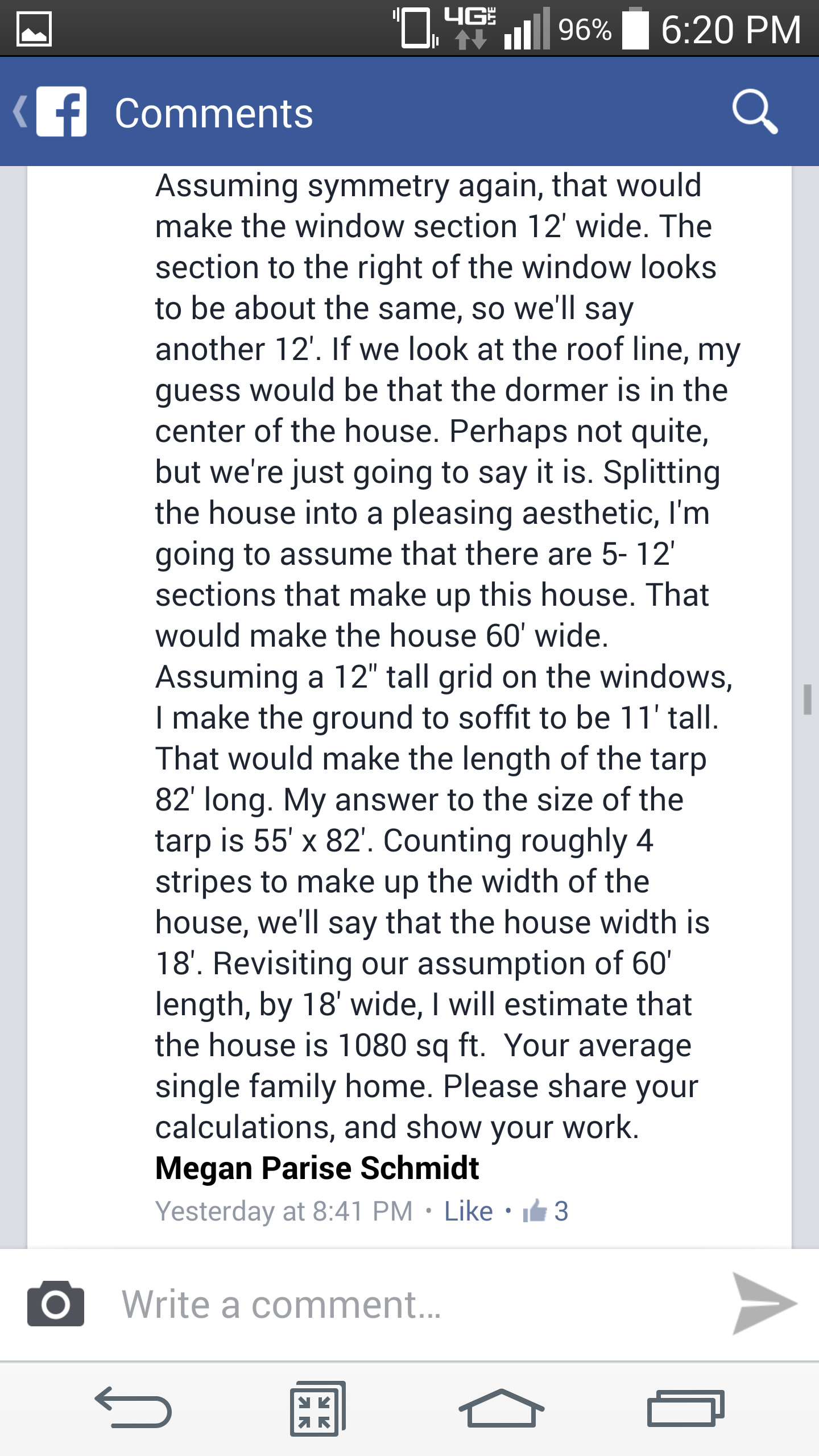
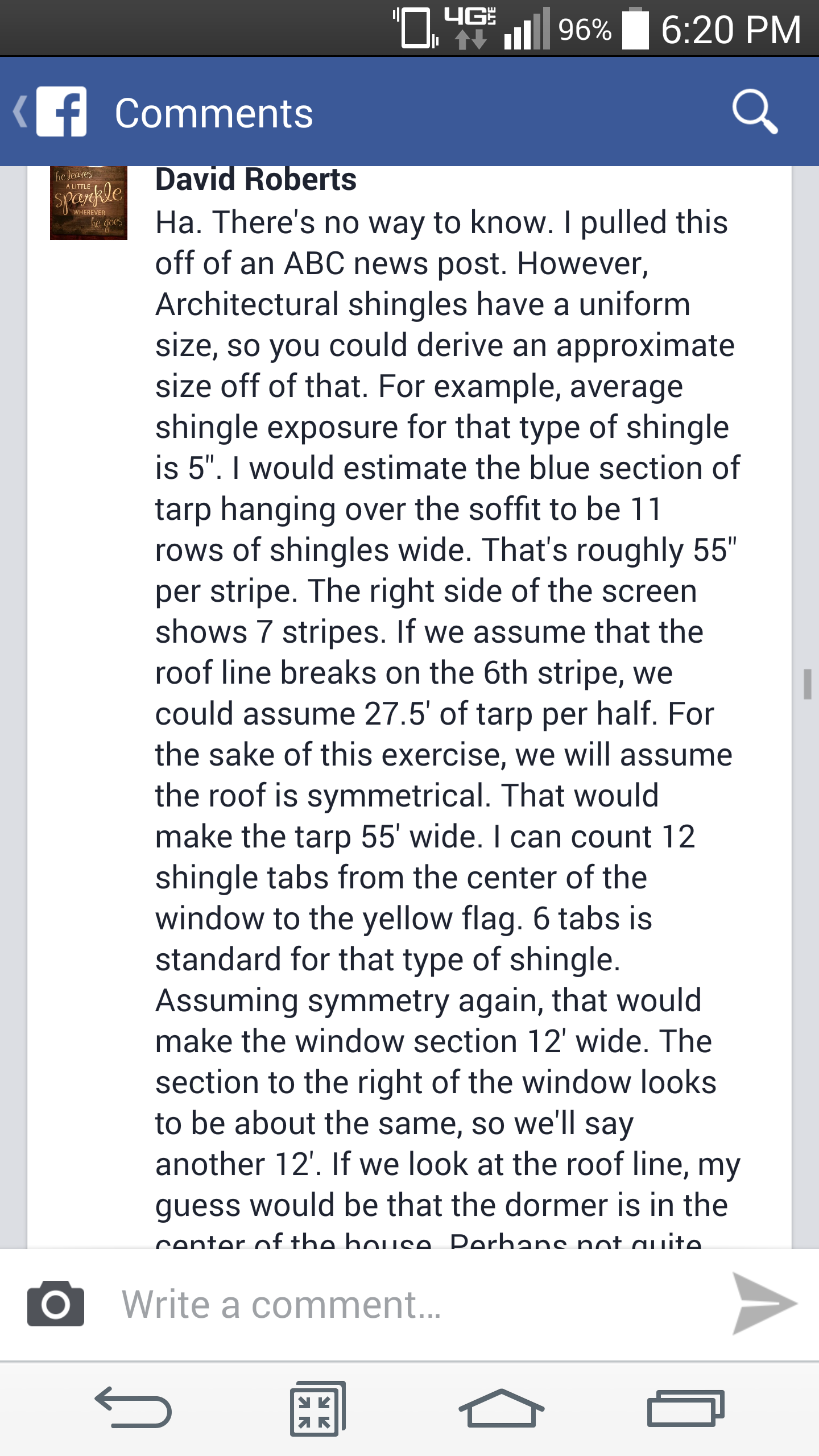
Luckily, David was willing to make an estimate and allowed me to share his reasoning:

Screenshot_2014-10-11-18-20-20 (1) Screenshot_2014-10-11-18-20-27

I thought it might be interesting to present the photo to my first hour and see what questions they would ask about the photo.  Of course, the surface area of the tarp was on their list.

The original article including the photo added more depth to their questions.  As it turns out, the house is being fumigated after a spider infestation.  It seems as though their curiosity surrounded more the spiders than the tarp and legitimately so.  (The article estimates the house was infested with approximately 5,000 spiders)

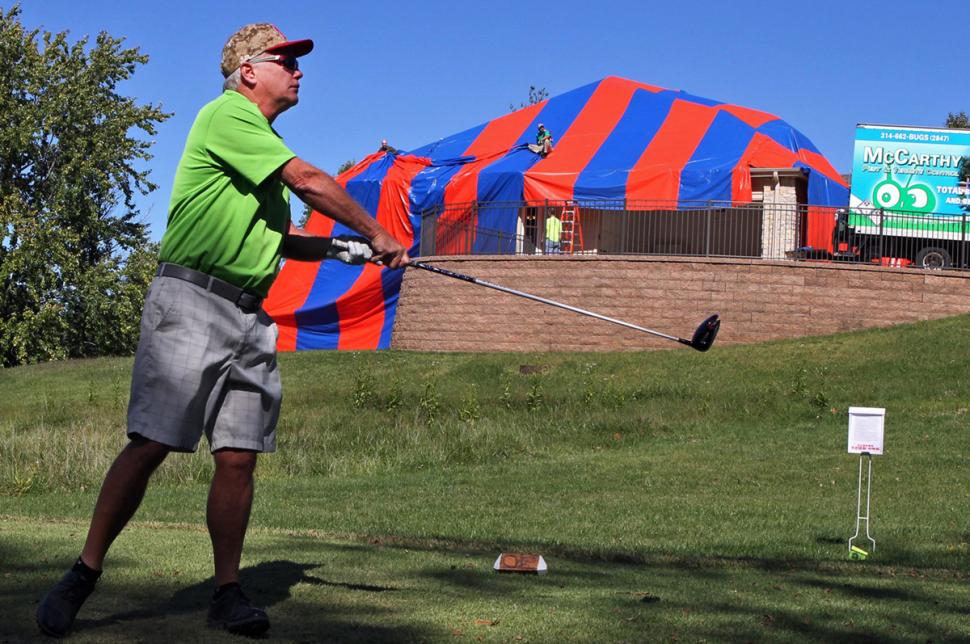
I was pleased that my students used visual cues in the photo to make their estimates including the average height of a story of a house, the approximate height of the man in the photo, and the size of the window.  Luckily, we found another photo that gave us a better understanding of how much tarp was needed for the other side of the house.

news-spider-invasion-4-sl

I’m glad this man’s golf game was not disturbed by a spider problem in the distance.  (sarcasm)

Anyway, after making some calculations, my industrial-minded first hour realized that this type of tarp must have a somewhat standard size.  After doing some Google searching and actually calling one of the companies that manufactures these behemoth plastic coverings (authentic!  Yes!), they decided that there were four 84′ x 25′ tarps covering the house and the space surrounding it. (We were able to have a nice conversation about how multiplying each dimension by 4 was different that multiplying the area of the tarp by 4.)

In the end, their estimate was 8,500 square feet, approximately double of what David had estimated.  We then critiqued David’s argument and decided that based on the picture only, his calculations were reasonable.  Because we were able to dig for more information, my class believes that their estimate may be a tad more accurate.  Thanks, David for sparking our curiosity this morning.


Procedure in the Driver’s Seat

I’m fired up today.  I’m going to quasi-vent on my blog, and hopefully I will not offend too many people in the process.  You’ve been warned.

When I walk into another teacher’s room and all of the students are silently working individually, I get sad.  Forget the monotonous drudgery of textbook procedural homework.  When students don’t talk to one another about mathematics, they most likely are not experiencing math as richly as they could if they were working together.

I had two separate and seemingly unrelated incidents today that frustrated me extensively so I’m hoping that the online community can give me some perspective in these areas.

First, Algebra 2.  Solving equations.  We were doing some practice on the whiteboards.  We haven’t talked explicitly about solving quadratic equations but I wanted to do a little experiment.

Me:  Solve x^2 + 1 = 37.  [writing on the board]
Class: [Crickets]

A few were able to work to a solution, but it was the same students that I would have expected to do so regardless of how the question was presented.

Me:  Ok, let’s try this a different way.  I think of a number.  I square it, then I add 2.  My result is 27.  What number was I thinking of?

Every single kid in the room was able to arrive and understand that the answer was 5.  Some did this very quickly.  Maybe you’re thinking “well, they didn’t know that -5 was also an answer.”  News Flash!  None of the kids remember that.  None.   They know the procedures they used before:  quadratic formula, factoring, taking the square root, completing the square.  But they have no idea why, they have no connection for what x really means and they have no conceptual understanding of a quadratic equation.

Christopher Danielson said it so beautifully yesterday:

THE STEPS WIN, PEOPLE! The steps trump thinking. The steps trump number sense. The steps triumph over all.

Here’s a second example, equally as frustrating.  I’m helping a student get caught up on his algebra assignments for another teacher’s class.  I don’t teach this class, and I like this kid, so I don’t mind helping him at all.

So systems of linear equations.  8x + 9y = 15 and 5x – 2y = 17 (or some bolonga like that.)

Kid:  I don’t get this, I mean, what is x?  II know I can substitute numbers for it and get y, but what does it connect to?

Me:  Read this word problem:  You work two jobs.  One you make $6/hr and the other $8/her.   Last week you worked 14 hours and made $96.  How long did you work at each job?

Kid: [3 minutes and an ounce of brain-sweat later]   8 at the first job, 6 at the second.

Seriously, to see this kid mentally crunch these numbers was magical.  To him, that was common sense.  To another kid, it might be a table.  To a third, trial and improvement.  Why can’t most kids do that?  Because we (you) insist that they set up a system of linear equations every single time.  And because the title of the section in the book is 3.1 Solving Systems of Linear Equations.  And then we focus on the steps and the methods.  Substitution. Linear combination. Elimination. Graphing.   And then a year later, those are just fancy terms that math teachers use to make easy things difficult.

Procedural fluency is important, but it must be built on a foundation of conceptual understanding. The procedure should never lead the discussion, and in most high school math classrooms, it unfortunately is.


What Questions Do They Have?

I’m always delighted by the extra wave of energy students put forth when they are asked to develop their own question to a scenario.  I love my job, and this year has started amazingly.  But today was probably my favorite day thus far.

College Algebra:  

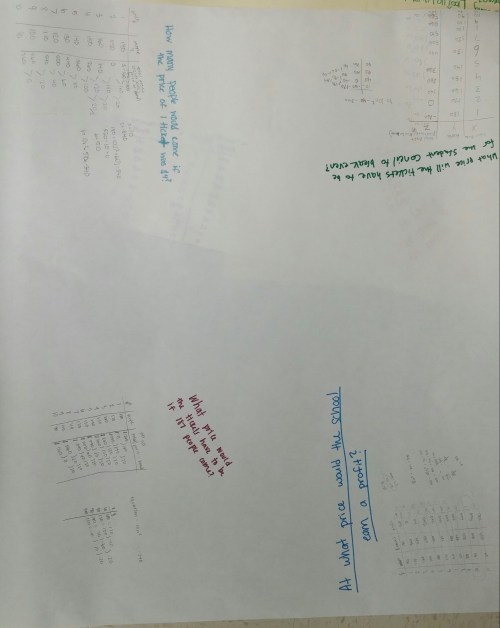
Since we are working on quadratics, we did the Many or Money scenario from the Math Forum Problems of the Week.  It’s interesting (and almost entertaining) to watch them discover that there is no question.  This is the first time we’ve done an activity where they developed the question so they came up with the questions I would have expected:

  • What price will maximize profit?
  • How many students would go if the price were $8?
  • How many students will attend at the maximum profit?
  • (My favorite) Can you write an equation that models Ticket price and Profit?

They were able to get started on answering some of these questions.  I had them work on one large sheet of paper in order to share their work.  The period ended before they could wrap up their work.  Here is what one group has so far:

1008141405-1

When talking with teachers about using the Notice and Wonder strategy is usually surrounding the unexpected “wonderings” that students will have.  I think it’s important to allow them to have that creativity of asking outlandish questions like, what is the band’s favorite pre-concert meal?  But to make sure that the math goals are met, shifting their focus on what we can mathematically deduce from the scenario.  I usually ask what would I most likely ask about this scenario and what questions do you have about this scenario?  


Algebra 2:

Last year, with this same class, we examined Val’s Values.  The authentic, real-world awesomeness of that particular lesson was going to be impossible to re-create, but the scenario was still applicable and intriguing to this new group of students.

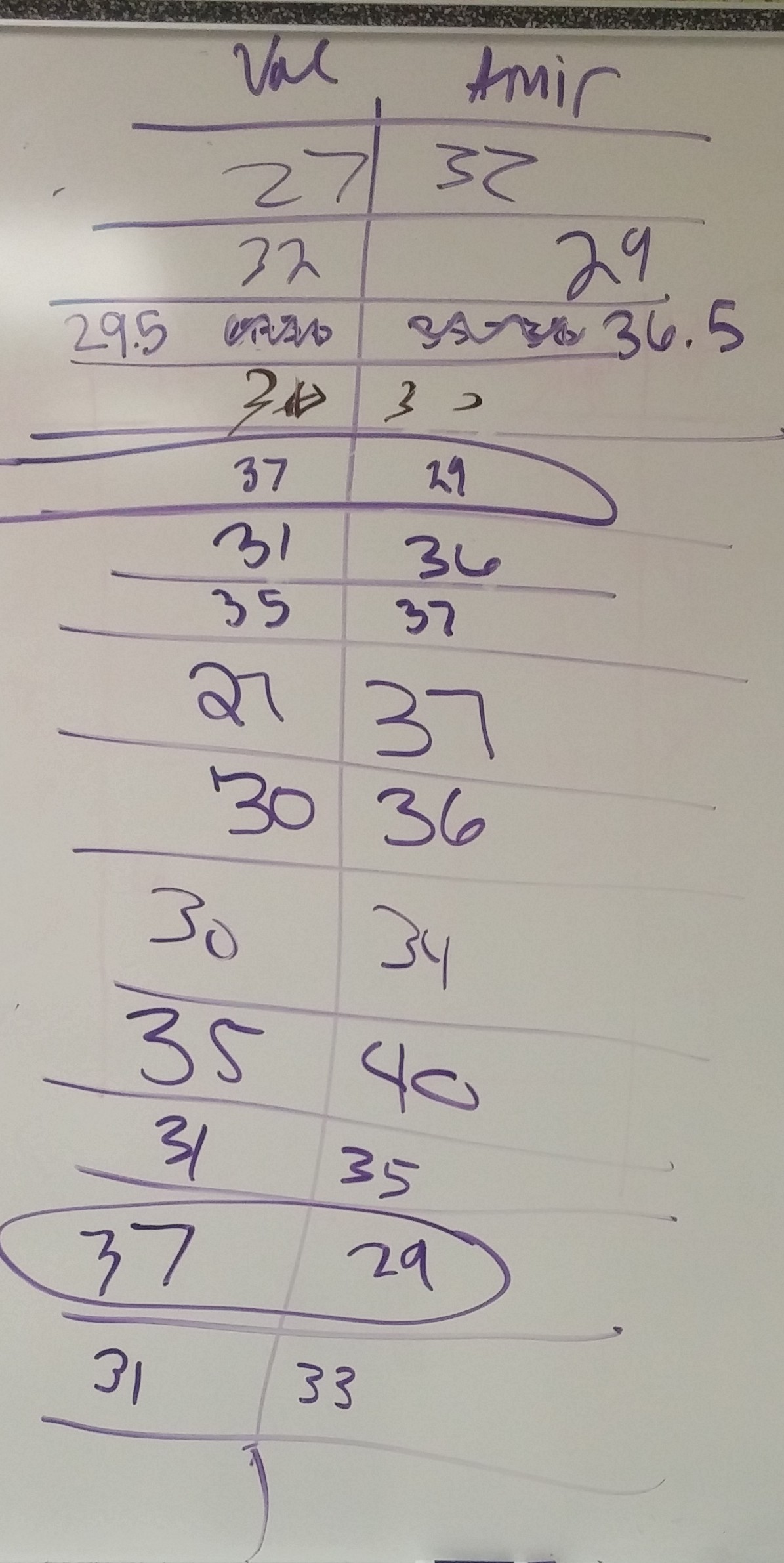
Last year, my students insisted that the ages of both Val and Amir were vital to answering the question Who spends more on jackets over their lifetime?  Most fascinating to me was their estimations of Val and Amir’s ages:

1008140948a

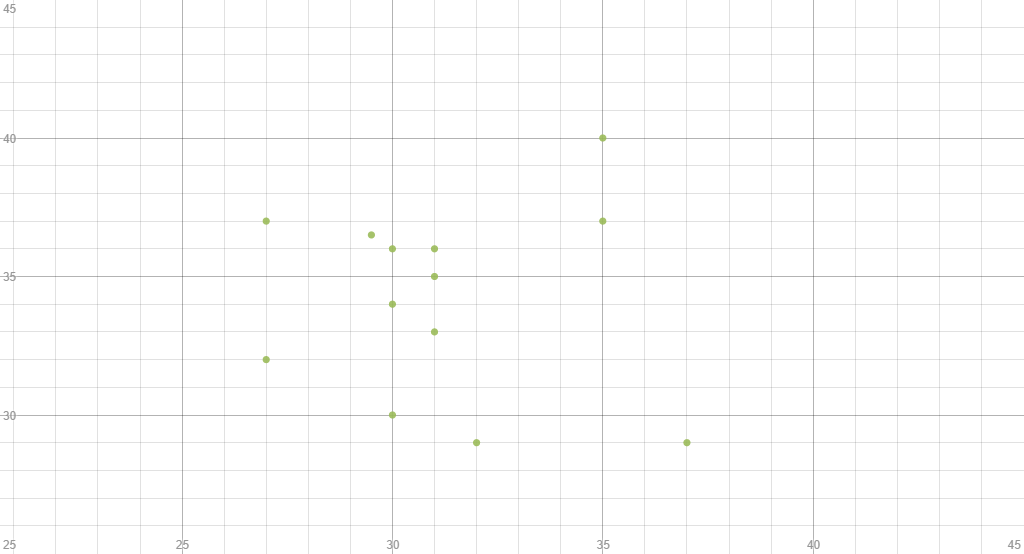
Desmos made up  a nice scatter plot for us that we could also Notice and Wonder about:

7dzmdvzq1g

And Val, my students were slightly disappointed that they didn’t get to examine the entire $300 jacket.  They are VERY curious about it.  😉


The Un-Puzzle

I’ve heard this said a thousand different ways:  a task does not need to apply to the real world in order to be engaging.  Dan Meyer’s version seems to be thrown around most often:  The “real world” isn’t a guarantee of student engagement. Place your bet, instead, on cultivating a student’s capacity to puzzle and unpuzzle herself.

Today is Homecoming Friday.  It’s tough to get students engaged today, as their minds are on the game and the glitter (oh, the glitter).

Here’s a very short video clip of the noise level in my Algebra class.  Crickets.

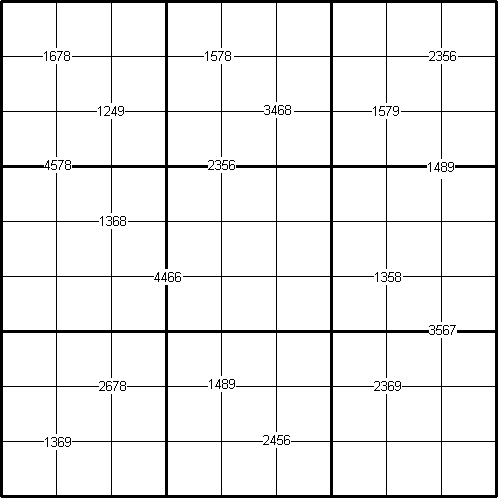
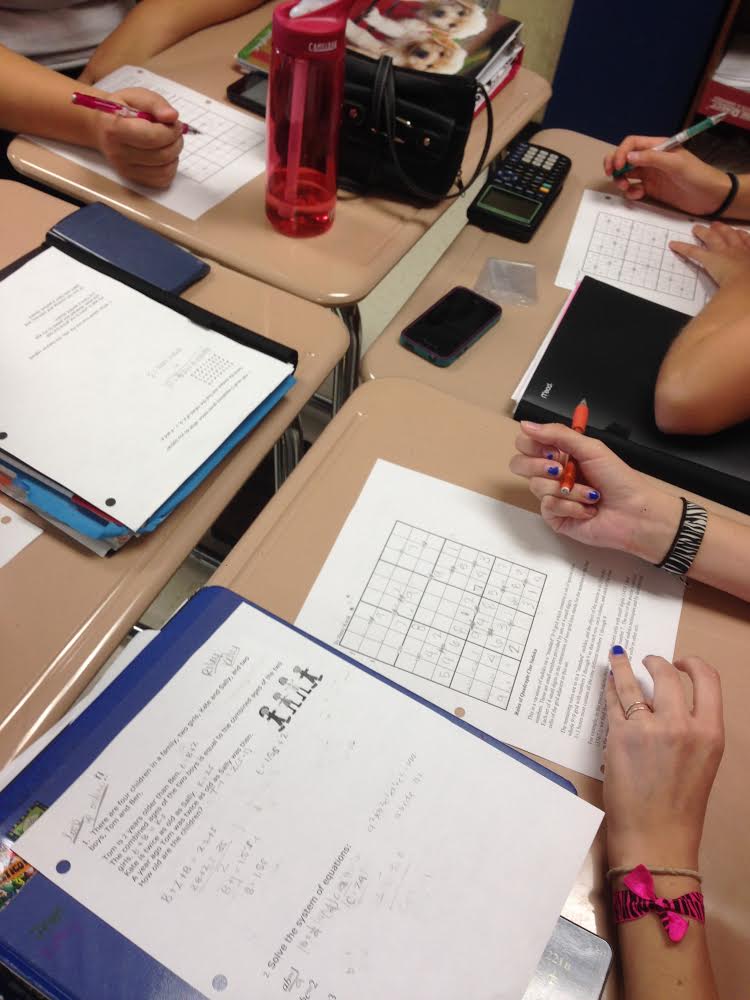
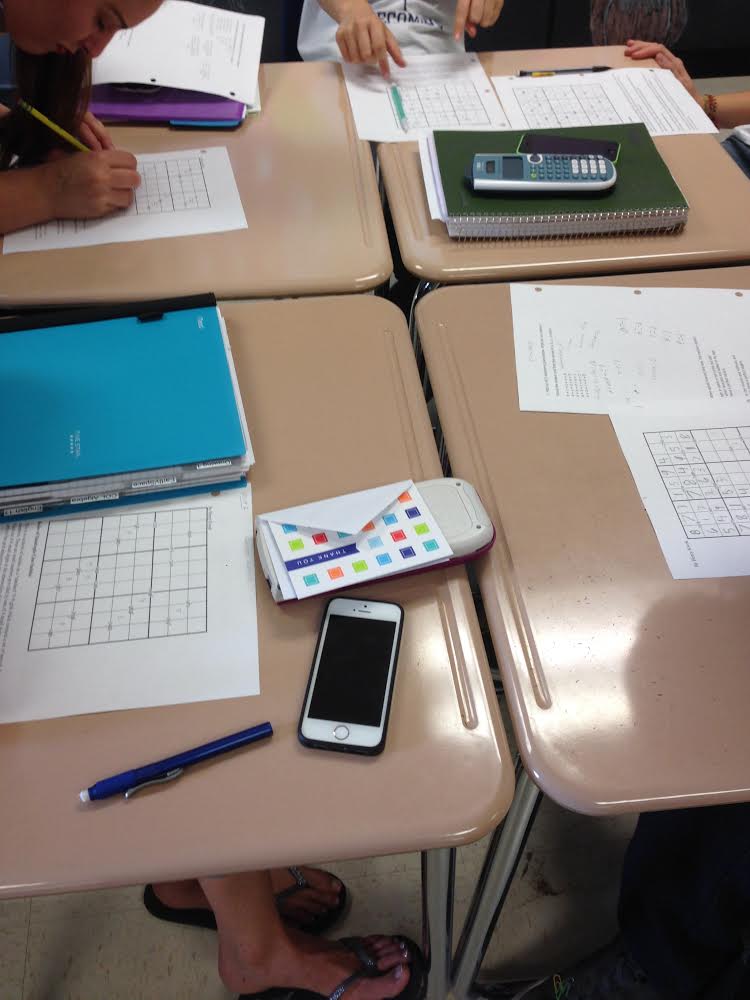
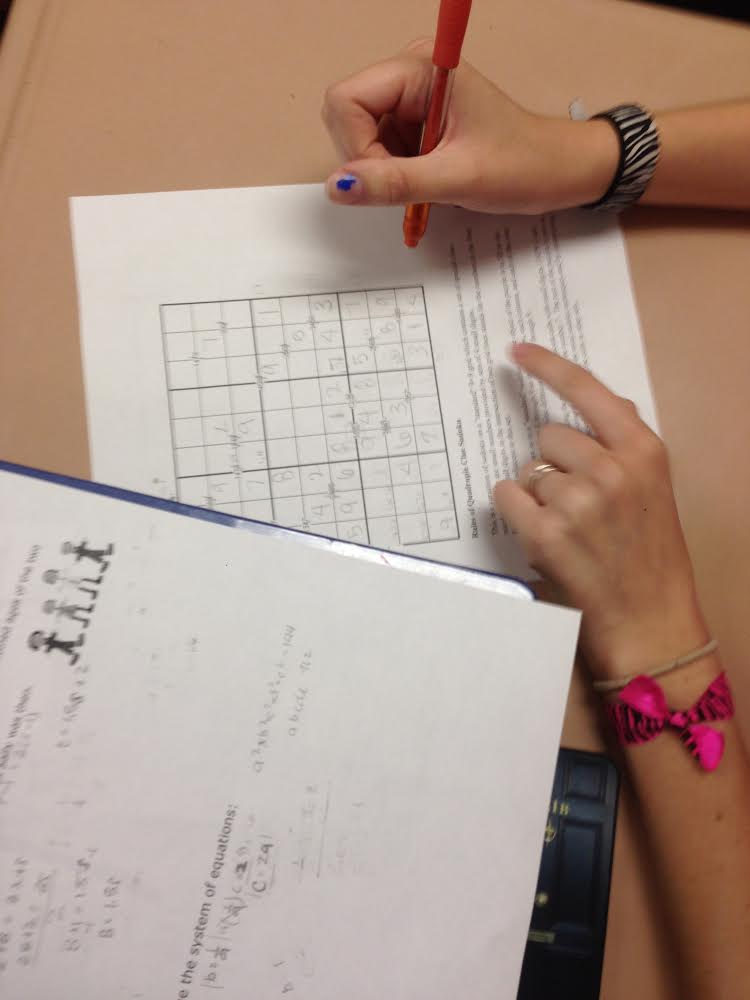
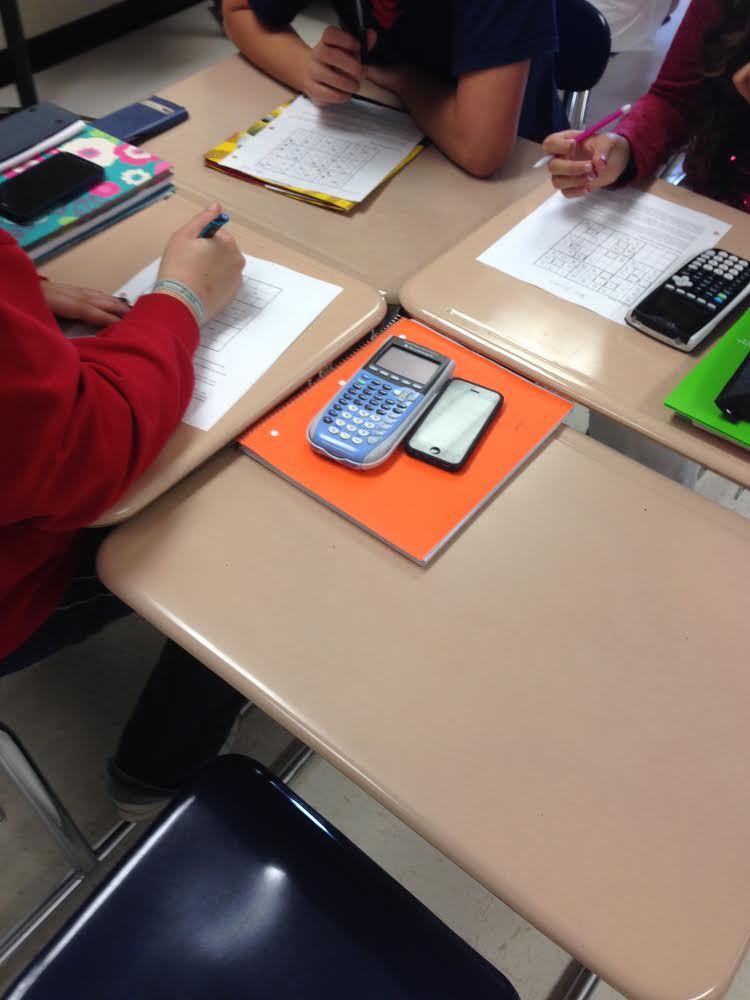
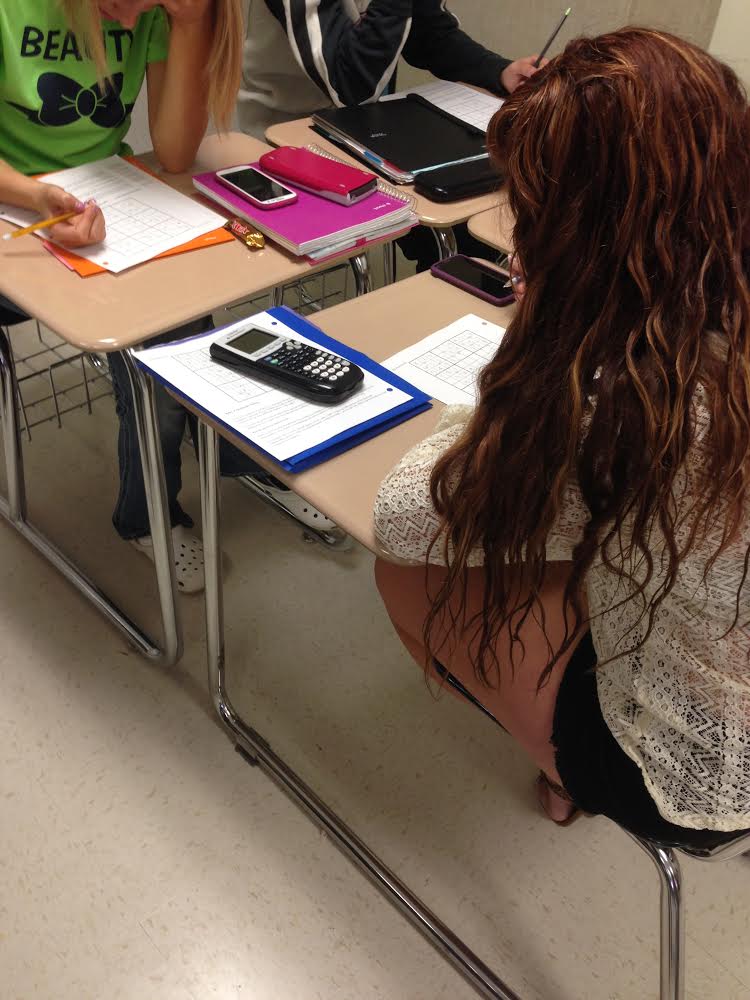
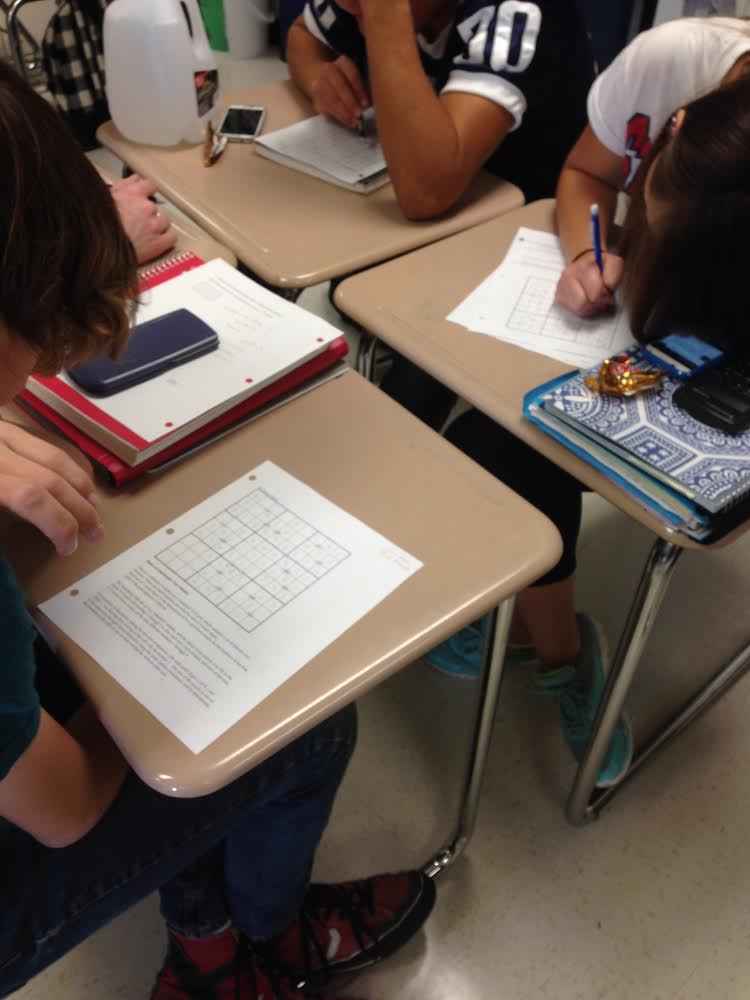
No, I’m not giving a test.  I gave them a puzzle called Quadruple Sudoku:

QuaClueSudoku

In short, besides regular Sudoku rules applying, the four small numbers are clues as to what goes into the boxes touching them.

And both classes, all period, the brain sweat was palpable.  Why, on such a wild, exciting school day would these kids be so focused and so engaged?  The answer I come up with every time is puzzling and unpuzzling.  unnamed (7) unnamed (6) - Copy unnamed (1) - Copy unnamed (2) - Copy unnamed (3) - Copy unnamed (4) - Copy unnamed (5) - Copy

By the way, Nrich has tons of these fun, puzzling, engaging variations on Sudoku.  Check them out.

A Twist on Old Venn

How many of you went nuts over the Google Doodle for John Venn’s 180th Birthday?  I have no shame in admitting I spent more than a few minutes messing around with it.

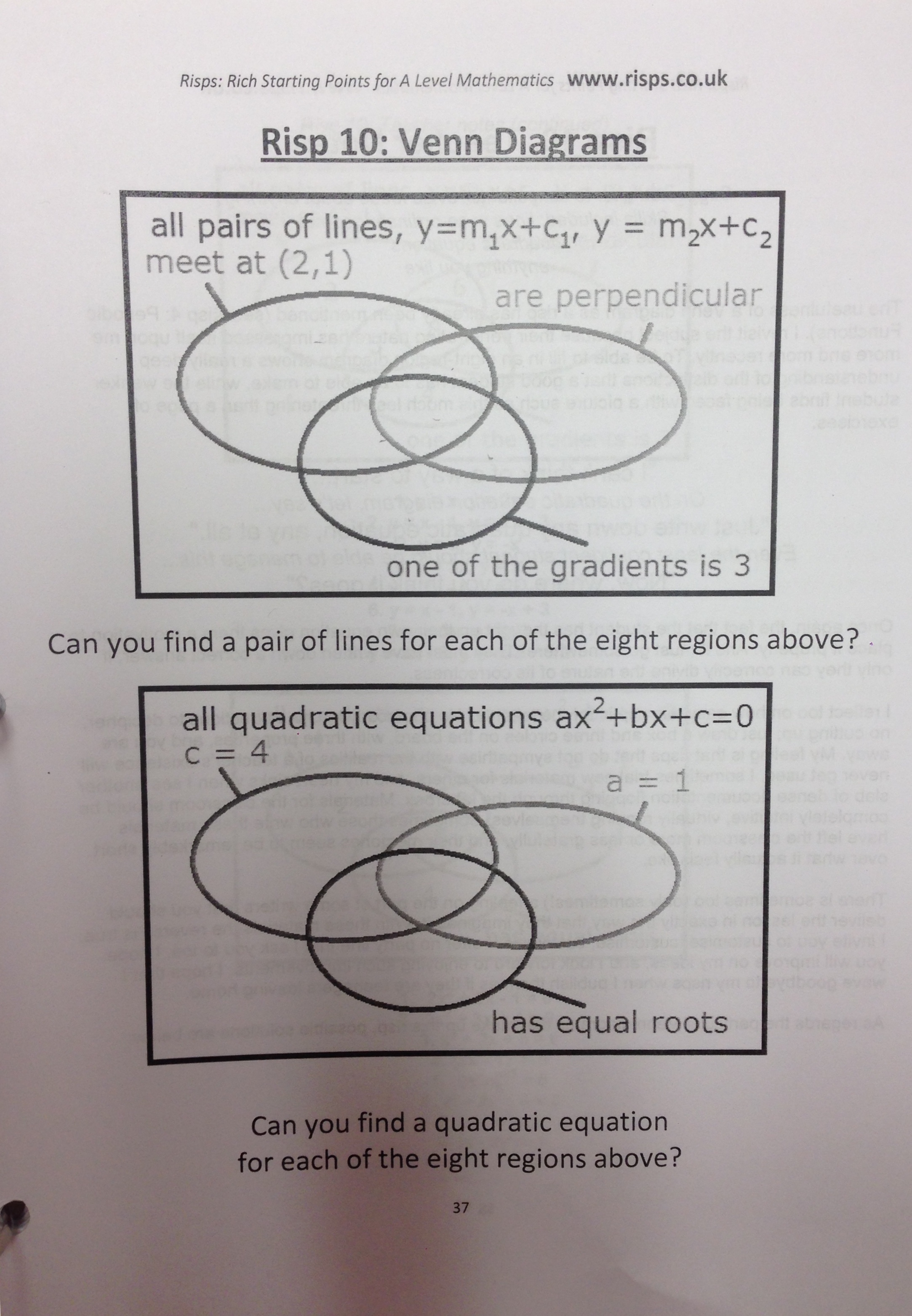
These not-so-modern overlapping circles of wonder have fascinated mathematicians, scientists, and even linguists alike.  When searching for rich tasks for my college algebra classes, I came across this new twist on the traditional Venn diagram:

FullSizeRender

This activity can be applied to all kinds of topics with the main task being to find an equation to fit into all eight of the Venn diagram regions.  Since we are working with systems of equations, I offered this challenge to my classes:

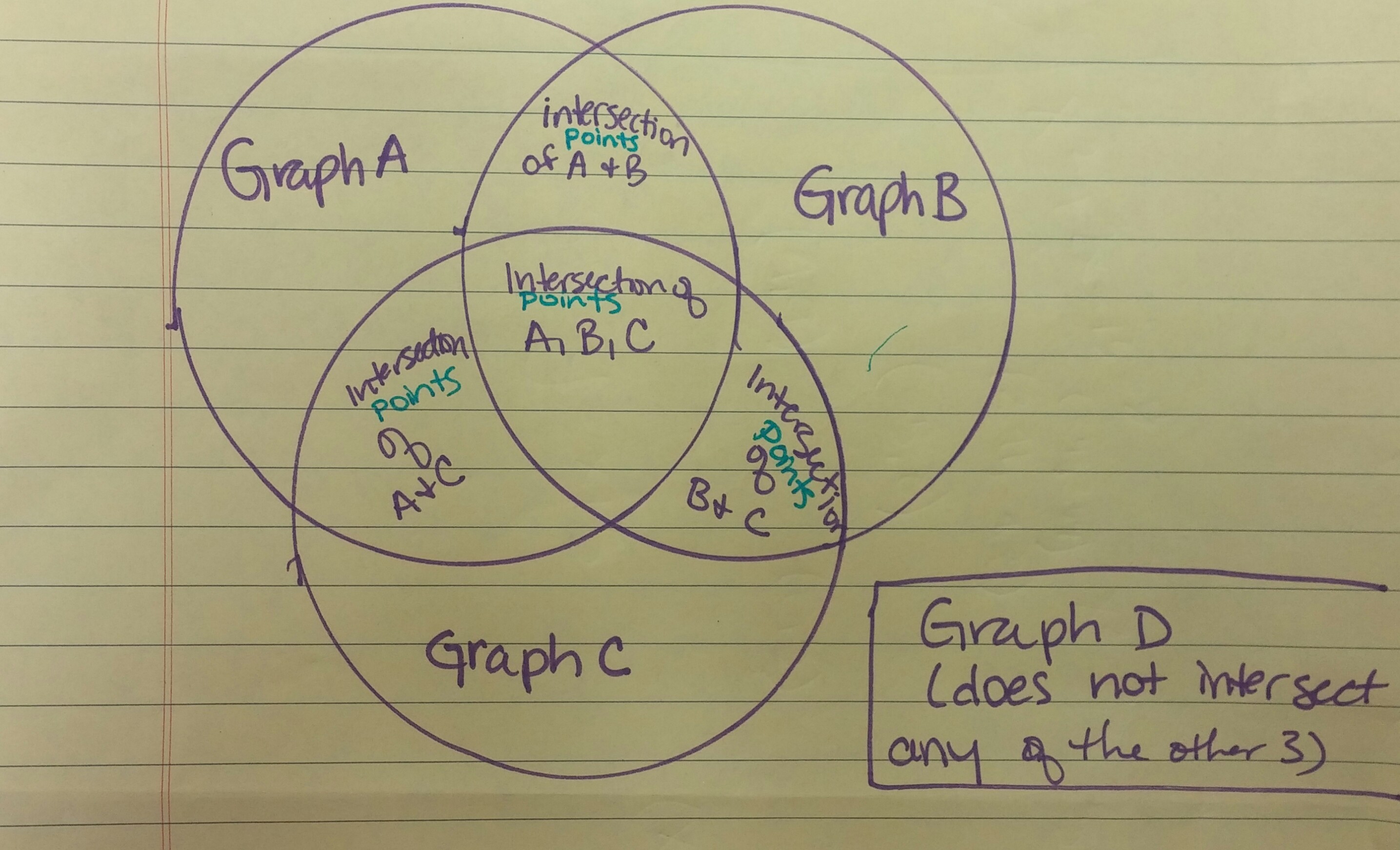
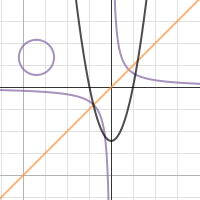
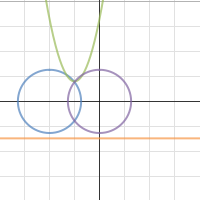
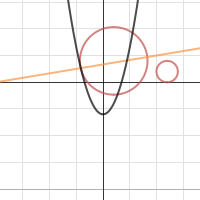
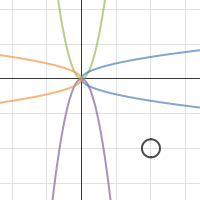
Can you find three graphs that all intersect and also each intersect one another at unique points?  Also, is there a 4th graph that does not intersect the first three?  

0923141345-1

Out came the iPads and Desmos.  Here are a few highlights:

unnamed (1) unnamed (2) unnamed (3) unnamed (4) unnamedunnamed (5)

Some of my observations during their work time:

  • A few of them assumed we were creating an actual Venn Diagram with Desmos. I made sure the expectation was more clear the next period.
  • Attention to precision was important.  Some students assumed that if the three graphs appeared to cross one another, their task was complete.  They were mistaken when I zoomed in to examine the intersection points.
  • Students assumed that if a graph did not intersect another in their viewing window, it didn’t intersect at all.  We had some good conversation about where graphs might cross as the x and y approached infinity.
  • Using sliders in Desmos makes this task more doable in one class period.
  • I wonder if they would be able to solve for their intersection points algebraically.

Side note:  these RISPs (Rich Starting Points created by Jonny Griffiths) are all available on this website, and are excellent starters for college level mathematics.  

If You Give Homework, I’m Talking to You

Maybe it’s because it’s Friday and this has been one action packed week, but I am FIRED UP.  I’m fired up about the amount of out-of-school homework we give our students, especially in math class.

Casey Rutheford had a great idea the other night.  He did a Twitter search for “math homework” and examined the results.  Go ahead and take a look for yourself.  You may not be shocked at all, but reading tweet after tweet of math homework making students cry should make you, as an educator, want to sob.   Additionally, with impeccably good timing, John Stevens gave us all something to think about in regards to the homework debate.  The entire post is worth every second of time you can spend with it.  He highlights the student voices in this conversation.  Those voices are the ones we often aren’t really listening to.  He reminds us that there is a whole child to develop, not just a math brain.

The big question I have for my fellow educators is:  are you taking the time to listen to your students’ voices?   Are you considering the education of the whole child, especially during the hours when they aren’t in school?  What purpose does the homework serve?  Is it really fulfilling that purpose?  Do we really feel students do better as a result of homework, or are there other factors that play a much bigger role?

I’m not saying don’t ever assign homework.  I just don’t think homework needs to be a knee-jerk reaction to the end of a math lesson.


Nrich – For What It’s Worth

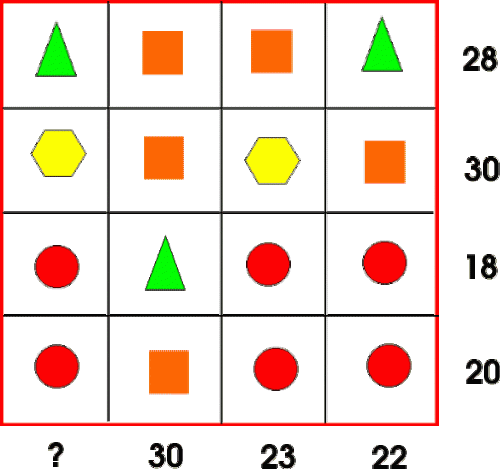
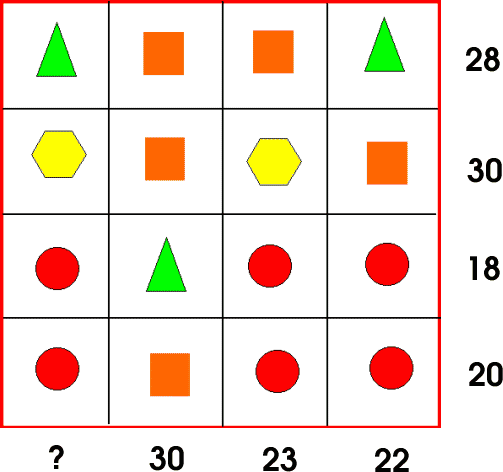
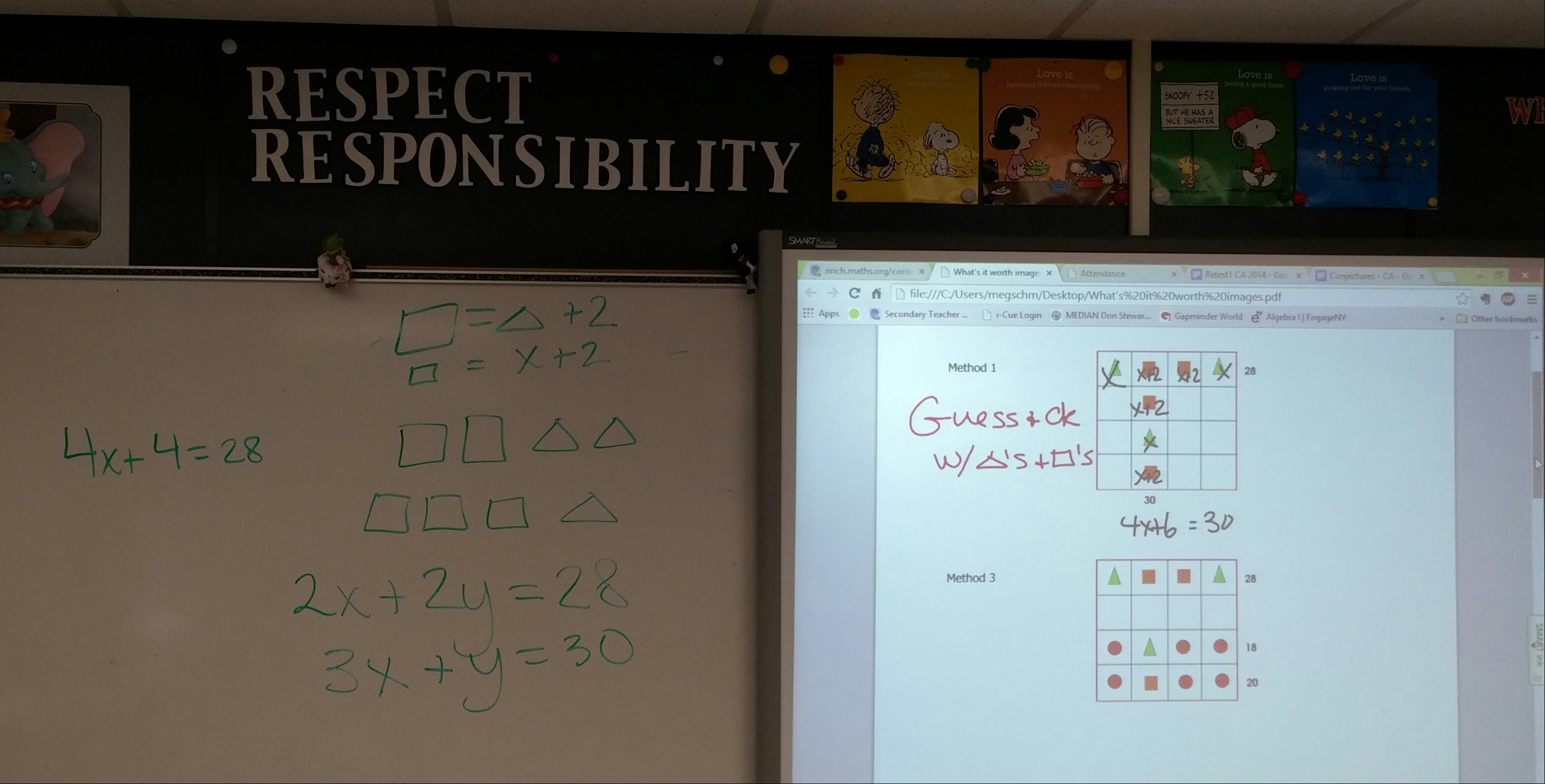
One of my favorite problems (and the one I presented at TMC this year) is What it’s Worth? from Nrich.  To say I “like” this problem would be like saying Sarah Hagan “likes” interactive notebooks.  Clearly an understatement.

Anyway, here’s the prompt:

board3


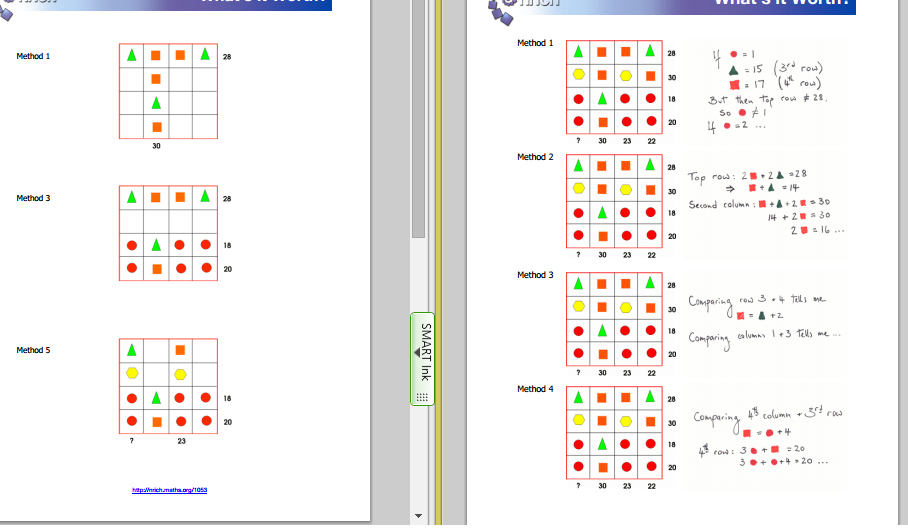
What I like most about this problem is that there are so many, OH so many, methods to solving it.  It is a FANTASTIC way to get students to focus on the pathways to the solution rather than the solution itself.  After the students figure out the value of the question mark, they go about discussing the numerous methods they used in order to arrive at their answer.  Furthermore, the problem includes 6 “beginnings” of solutions and learners then need to make sense of those as well as determine how a solution was reached along that path.

Untitled

Left: New format for discerning methods. Right: Old format for discerning methods.

To my surprise, along with Nrich’s site updates, this problem has improved as well.  Rather than showing a written start to the problem, provided are 6 visual introductions.

This allowed for an incredible amount of discussion involving each method.  And even those METHODS broke down into different methods.  It was method madness (awesome madness).  0917141216-1

Welding Math and Metal – Day 2

If I needed to choose the most productive portion of most students’ week, Monday morning, first hour would be pretty low on the hierarchy of engagement.  I was undeterred because making sure we had the correct solution was important.

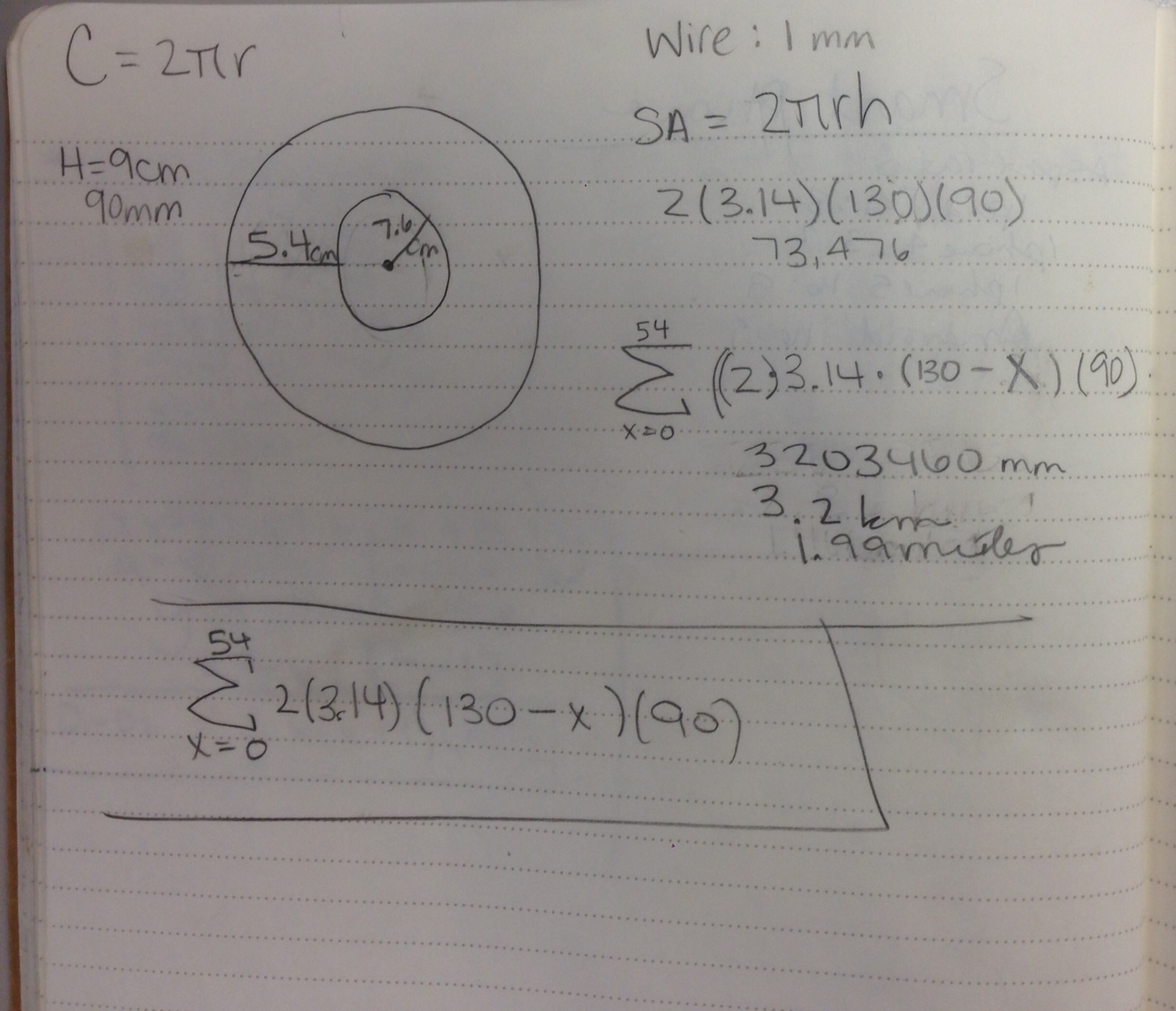
We discussed that the radius of the spool would decrease every time a layer of wire was used.  They began calculating the resulting wire as layers were removed.  This served as an excellent opportunity to introduce summation notation and a great practical use for the mathematics behind it.  It seemed like a much better option than to add up dozens of calculations anyway.

photo

When we arrived at our correct answer (with the desired units) of 1.98 miles, the questions and estimating didn’t end.  They wanted to know how far they could stretch such a wire.  Would it go to the edge of our campus and back?  Would it go from here to the middle school?  Could you go all the way to the grocery store?

They settled on taking the wire, running it out to the edge of the soccer practice fields and then running it all the way to the middle school sign.  It ended up being, to the hundredth, the exact amount of wire we had, provided that someone would stand and hold the wire at the edge of the soccer field.  I loved the attention to precision. I also loved that they were so savvy with Google Earth.

SFwire


The Welding of Metal Tech and Math

An early morning text from my brother prompted this tweet:

We estimated a little, but the Slinky didn’t yield much discussion until someone shared: I wonder how much wire is in one of those Mig welder spools!

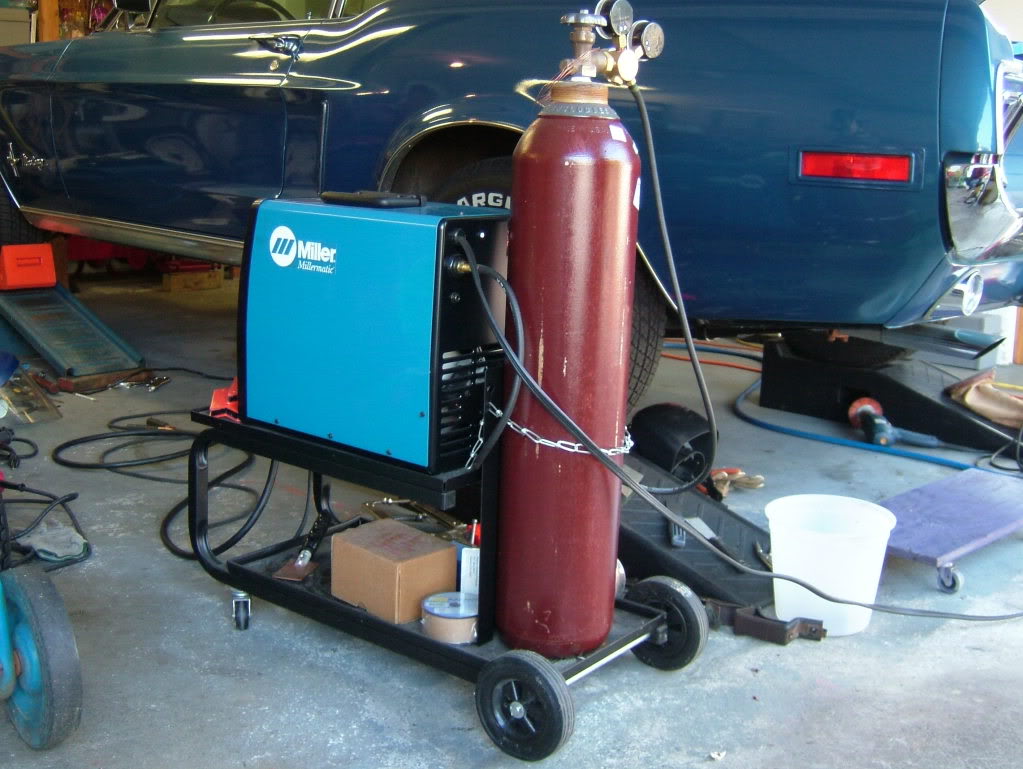
If you are like me and have no idea what a mig welder is, here’s a photo:mig_welder

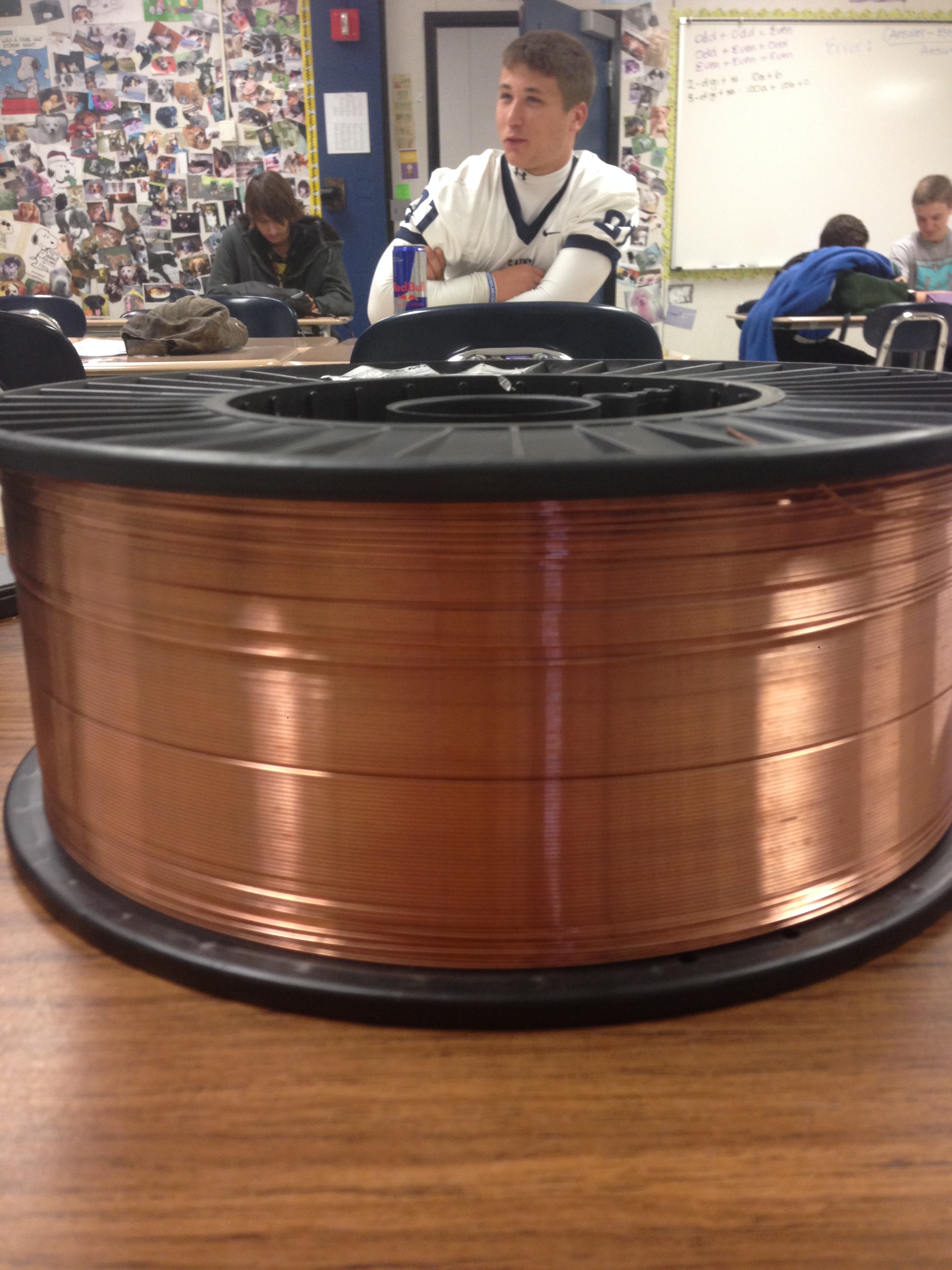
These things hold massive spools of 1 mm thick wire.

IMG_6536

Luckily, the welding instructor was willing to part with one of these for the hour.  Unluckily, the only information we had was the  1 mm thickness of the wire and the spool’s weight of 44 pounds.

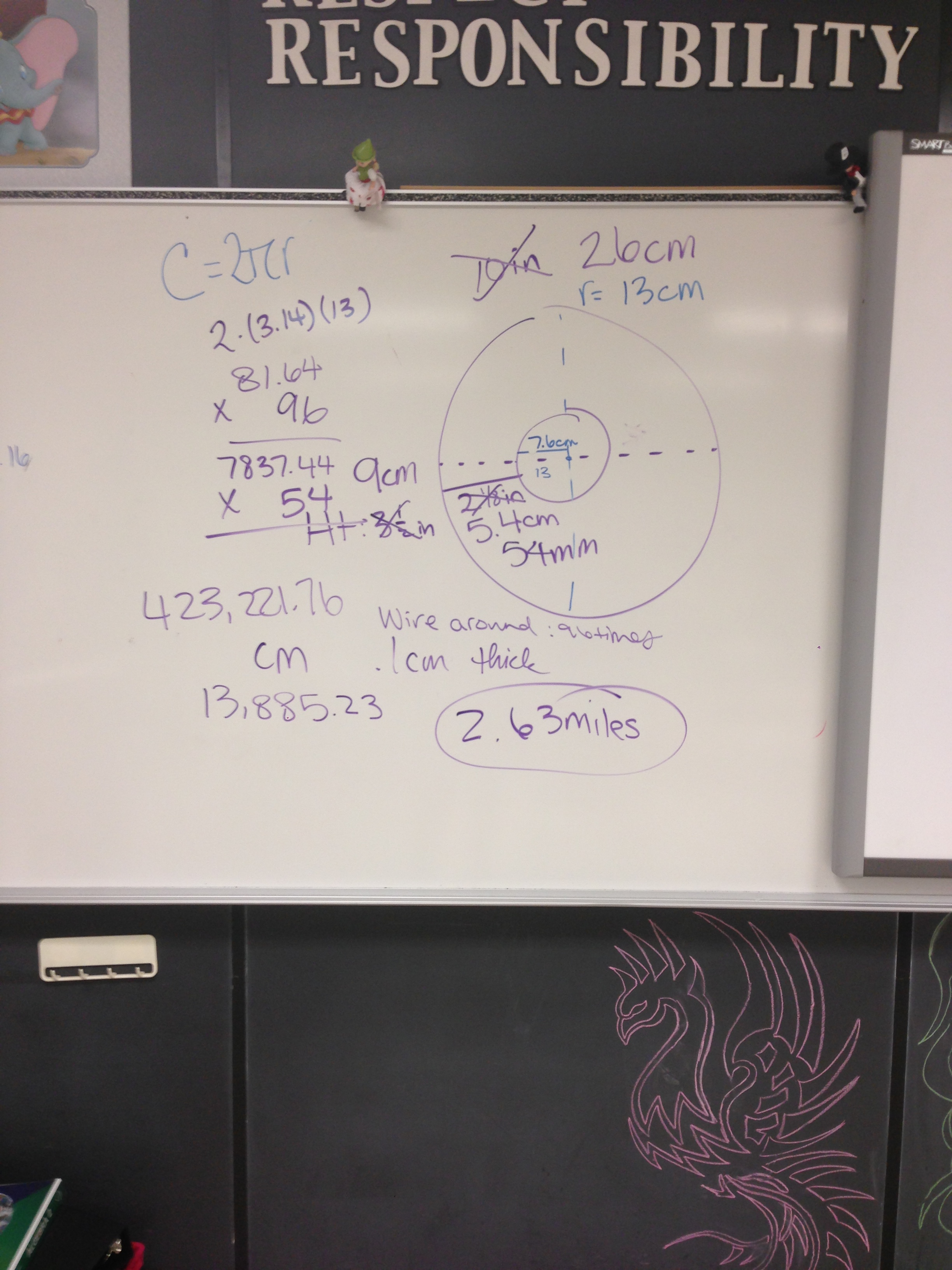
Our initial thought was to weigh a snippet of wire and then scale it to the entire spool, but I was sure that the welding teacher wouldn’t have appreciated the rogue math teacher messing with his supplies.   I praised them for the interesting method anyway.  They then began measuring:  height, diameter of the spool, diameter of the inner circle, diameter of the wired portion, number of wires going up the spool.  It was math-magical.

Here are their calculations:

IMG_6538

Now, I realize that these are a little off because we needed to take into account that the circumference of the spool is getting smaller as we move inward.  But I was very pleased with their work thus far and their vigor in posing this problem and then working to solve it.  I’m excited about where we can go with this type of problem posing.  There are only eight students in this class, all boys that have metal in their bloodstream.  I am hoping that with these sorts of ideas, I can engage them in math that excites them more often.  Maybe I can even get them excited about my Slinky question.