Talking about Black and White rather than X and Y

I was out of my classroom yesterday, attending an AP Stats workshop with my coworker and friend, Dianna Hazelton.  Upon my return, per the usual, I learned that students struggled with the assignment I left for them.  Naturally, it would seem that the most important task to be completed today was to address their issues with yesterday’s work.  But something much more important came up:  a discussion on racism and sexism.

The natural opportunities to discuss race in a mathematics classroom in rural Minnesota are not numerous.   I usually need to carefully weave them into the topics and diligently ensure that equity is valued when a student brings up situations of racism.   The minority population in our district is not high but being the only student of color in a classroom is challenging for them.  These students can’t be expected to just blend with their white classmates when their needs aren’t being addressed.

Somehow today, instead of practicing line graphing on whiteboards, we discussed race and gender when a student expressed her discomfort while attending a concert in Minneapolis.  Her comments were respectful, but her concerns legitimate.  As a teenage girl, when at social events in the city, she and her friends feel vulnerable and sometimes threatened by the sexual advances of men.  She started off pointing out black men specifically, but the conversation progressed to a point where she acknowledged that  first, her isolated experience shouldn’t shape a stereotype about all black men and secondly, white men engage in this behavior as well causing the same discomfort for her.  She quickly realized that her assessment of dealing with harassment shouldn’t be examined through the lens of race.

Rafranz Davis, a woman whose fearless, relentless advocacy of kids I highly admire and respect, summed this up perfectly on her blog:

Students carry unique perspectives about their experiences and until these issues, along with the countless others unaddressed, are met head on through discussion and action, these tensions and perspectives will never change.

I was very proud of this student  for acknowledging her initial prejudice, and as a result, we were able to have an equally productive conversation about gender as well.  And something I didn’t expect happened:  the boys just listened.  They just listened to the girls talk about cat calls and being whistled at.  “Just come and say hello, my name is so-and-so,” one girl said, “that’s much more of a turn on than being harassed.”  And at the end of the class period, one of the boys went up to that girl and said, “hi my name is…”  Bingo.

These conversations are difficult, but when a student is willing to admit their prejudice, the teacher doesn’t only have an opportunity, but a duty to help foster positive change.  Graphing 3x + y = 10 can wait until tomorrow.  The real problem of the day, and every day, is that these kids come to our schools for 7, 8, 9 hours a day and we spend such a small percentage of that time listening to their voices and giving value to who they are inside.


A Conceptual Victory

College Algebra, reviewing the graphs of polynomial functions.  Each student has a whiteboard.  We started with y=(x+2)(x-3) for simplicity.

Me:  What do we know about this graph?

Student(s): It has x-intercepts at -2 and 3 (or something along those lines)

Me:  What else do we know?

Student(s):  It’s a parabola (or some version of that)

Me:  What else do we know?

Student(s): [Crickets] (or owls or frogs or some other creature that makes noises when all else is silent.)

Me:  Does this parabola open up or down?

Student(s): Up. Down. no Up. no Down.

At this point I’m shocked that they do not remember the one polynomial coefficient that they all nail down in algebra 2:  The a value.  But I shouldn’t have been.  Rather than asking “What will the sign on the x^2 term be?” I decided to approach it differently to see if I could garner some conceptual understanding.

Me:  If x is a really big positive number, like a million, what kind of number will we get for y?

Student(s):  A really big number.

Me:  Similarly, if x is a really big negative number, like negative a million, what kind of number will we get for y?

Student(s): [After much thought and group deliberation] A really big positive number…OH, then it opens up.

This wasn’t a huge victory, but it was satisfying.  Because not a single student mentioned an a value even if they were thinking it.  Additionally, when we moved to cubic functions like y=(x-2)(x-3)(x+4), they used the idea of substituting really big negative and positive numbers for x to determine which way the graph was trending in each direction.  We were then able to have a nice discussion about why a graph like y=(8.5-2x)(11-2x)(x) looks similar to y=(x-2)(x-3)(x+4) when the equations have so many differences.

When students learn a procedure, it’s very difficult for them to deviate from the steps in order to solidify their conceptual knowledge.  I’m very glad that on this Friday, their forgetfulness of the “steps” allowed us to have a nice discussion.

Procedure in the Driver’s Seat

I’m fired up today.  I’m going to quasi-vent on my blog, and hopefully I will not offend too many people in the process.  You’ve been warned.

When I walk into another teacher’s room and all of the students are silently working individually, I get sad.  Forget the monotonous drudgery of textbook procedural homework.  When students don’t talk to one another about mathematics, they most likely are not experiencing math as richly as they could if they were working together.

I had two separate and seemingly unrelated incidents today that frustrated me extensively so I’m hoping that the online community can give me some perspective in these areas.

First, Algebra 2.  Solving equations.  We were doing some practice on the whiteboards.  We haven’t talked explicitly about solving quadratic equations but I wanted to do a little experiment.

Me:  Solve x^2 + 1 = 37.  [writing on the board]
Class: [Crickets]

A few were able to work to a solution, but it was the same students that I would have expected to do so regardless of how the question was presented.

Me:  Ok, let’s try this a different way.  I think of a number.  I square it, then I add 2.  My result is 27.  What number was I thinking of?

Every single kid in the room was able to arrive and understand that the answer was 5.  Some did this very quickly.  Maybe you’re thinking “well, they didn’t know that -5 was also an answer.”  News Flash!  None of the kids remember that.  None.   They know the procedures they used before:  quadratic formula, factoring, taking the square root, completing the square.  But they have no idea why, they have no connection for what x really means and they have no conceptual understanding of a quadratic equation.

Christopher Danielson said it so beautifully yesterday:

THE STEPS WIN, PEOPLE! The steps trump thinking. The steps trump number sense. The steps triumph over all.

Here’s a second example, equally as frustrating.  I’m helping a student get caught up on his algebra assignments for another teacher’s class.  I don’t teach this class, and I like this kid, so I don’t mind helping him at all.

So systems of linear equations.  8x + 9y = 15 and 5x – 2y = 17 (or some bolonga like that.)

Kid:  I don’t get this, I mean, what is x?  II know I can substitute numbers for it and get y, but what does it connect to?

Me:  Read this word problem:  You work two jobs.  One you make $6/hr and the other $8/her.   Last week you worked 14 hours and made $96.  How long did you work at each job?

Kid: [3 minutes and an ounce of brain-sweat later]   8 at the first job, 6 at the second.

Seriously, to see this kid mentally crunch these numbers was magical.  To him, that was common sense.  To another kid, it might be a table.  To a third, trial and improvement.  Why can’t most kids do that?  Because we (you) insist that they set up a system of linear equations every single time.  And because the title of the section in the book is 3.1 Solving Systems of Linear Equations.  And then we focus on the steps and the methods.  Substitution. Linear combination. Elimination. Graphing.   And then a year later, those are just fancy terms that math teachers use to make easy things difficult.

Procedural fluency is important, but it must be built on a foundation of conceptual understanding. The procedure should never lead the discussion, and in most high school math classrooms, it unfortunately is.


Welding Math and Metal – Day 2

If I needed to choose the most productive portion of most students’ week, Monday morning, first hour would be pretty low on the hierarchy of engagement.  I was undeterred because making sure we had the correct solution was important.

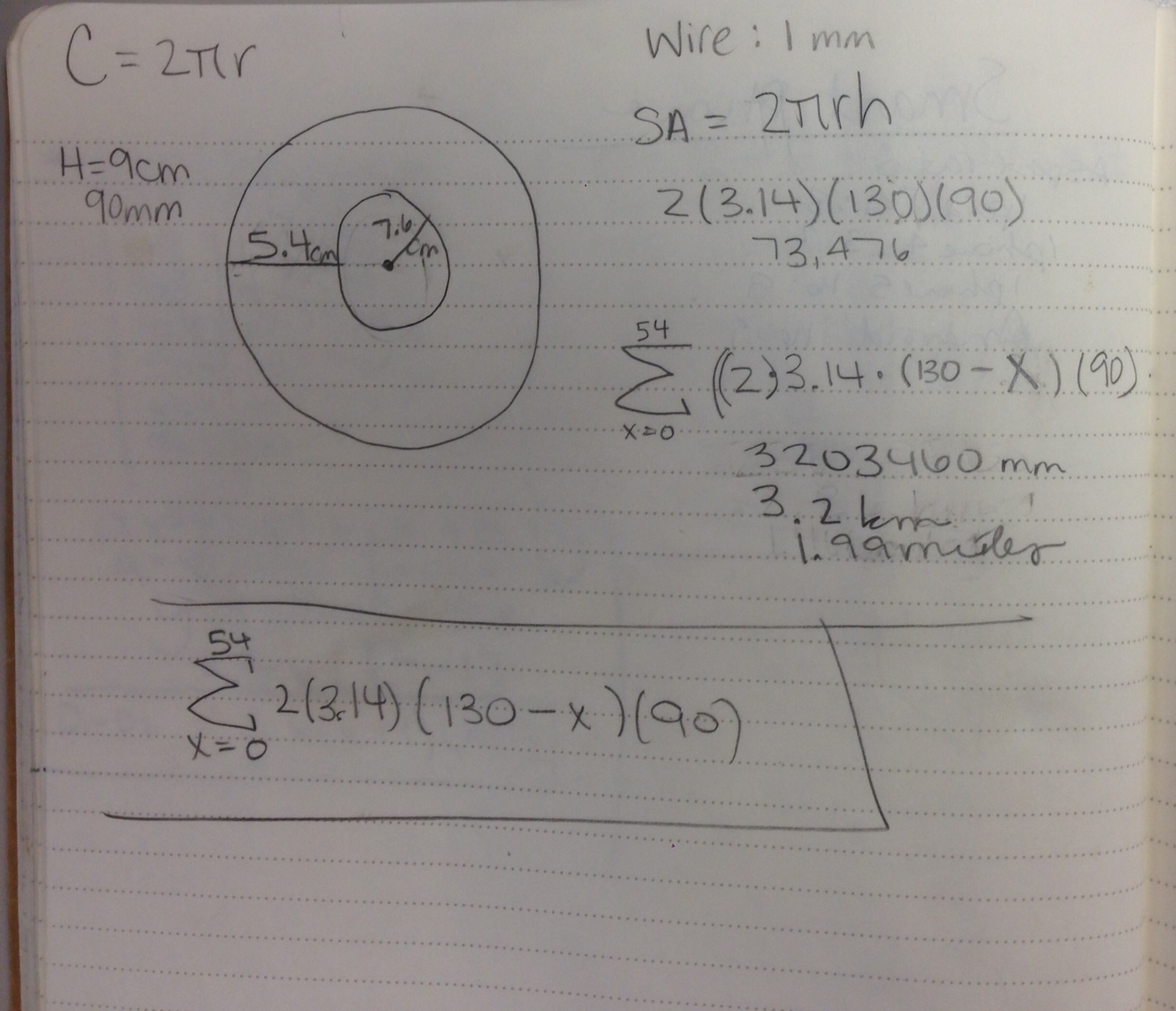
We discussed that the radius of the spool would decrease every time a layer of wire was used.  They began calculating the resulting wire as layers were removed.  This served as an excellent opportunity to introduce summation notation and a great practical use for the mathematics behind it.  It seemed like a much better option than to add up dozens of calculations anyway.

photo

When we arrived at our correct answer (with the desired units) of 1.98 miles, the questions and estimating didn’t end.  They wanted to know how far they could stretch such a wire.  Would it go to the edge of our campus and back?  Would it go from here to the middle school?  Could you go all the way to the grocery store?

They settled on taking the wire, running it out to the edge of the soccer practice fields and then running it all the way to the middle school sign.  It ended up being, to the hundredth, the exact amount of wire we had, provided that someone would stand and hold the wire at the edge of the soccer field.  I loved the attention to precision. I also loved that they were so savvy with Google Earth.

SFwire


The Welding of Metal Tech and Math

An early morning text from my brother prompted this tweet:

We estimated a little, but the Slinky didn’t yield much discussion until someone shared: I wonder how much wire is in one of those Mig welder spools!

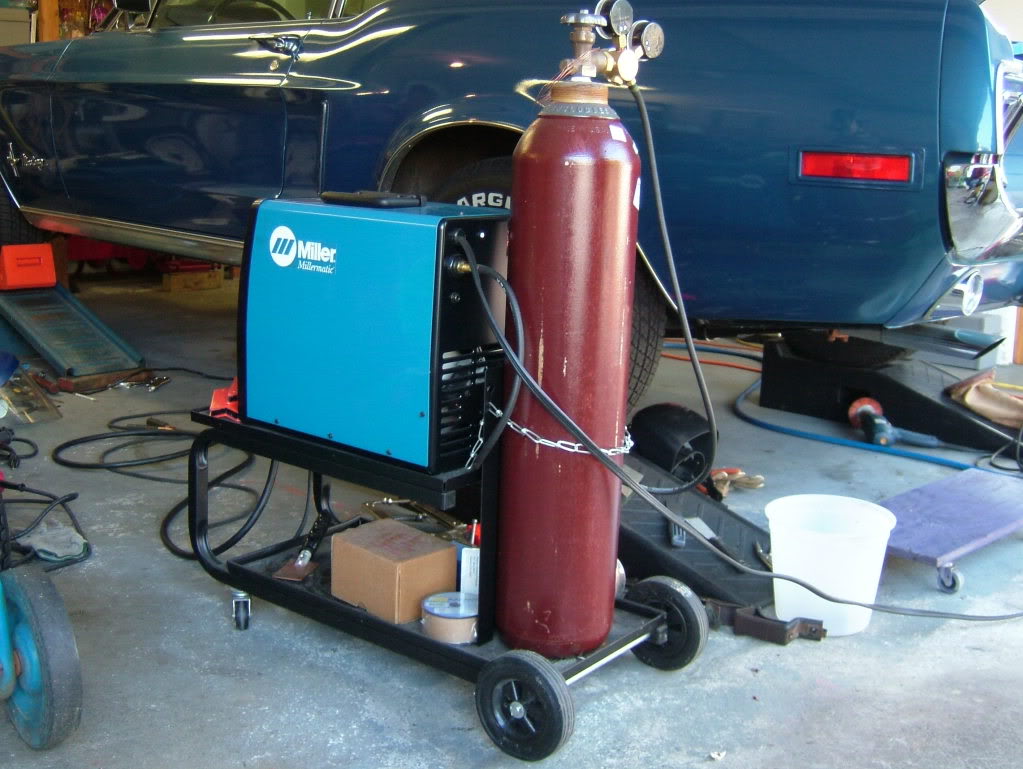
If you are like me and have no idea what a mig welder is, here’s a photo:mig_welder

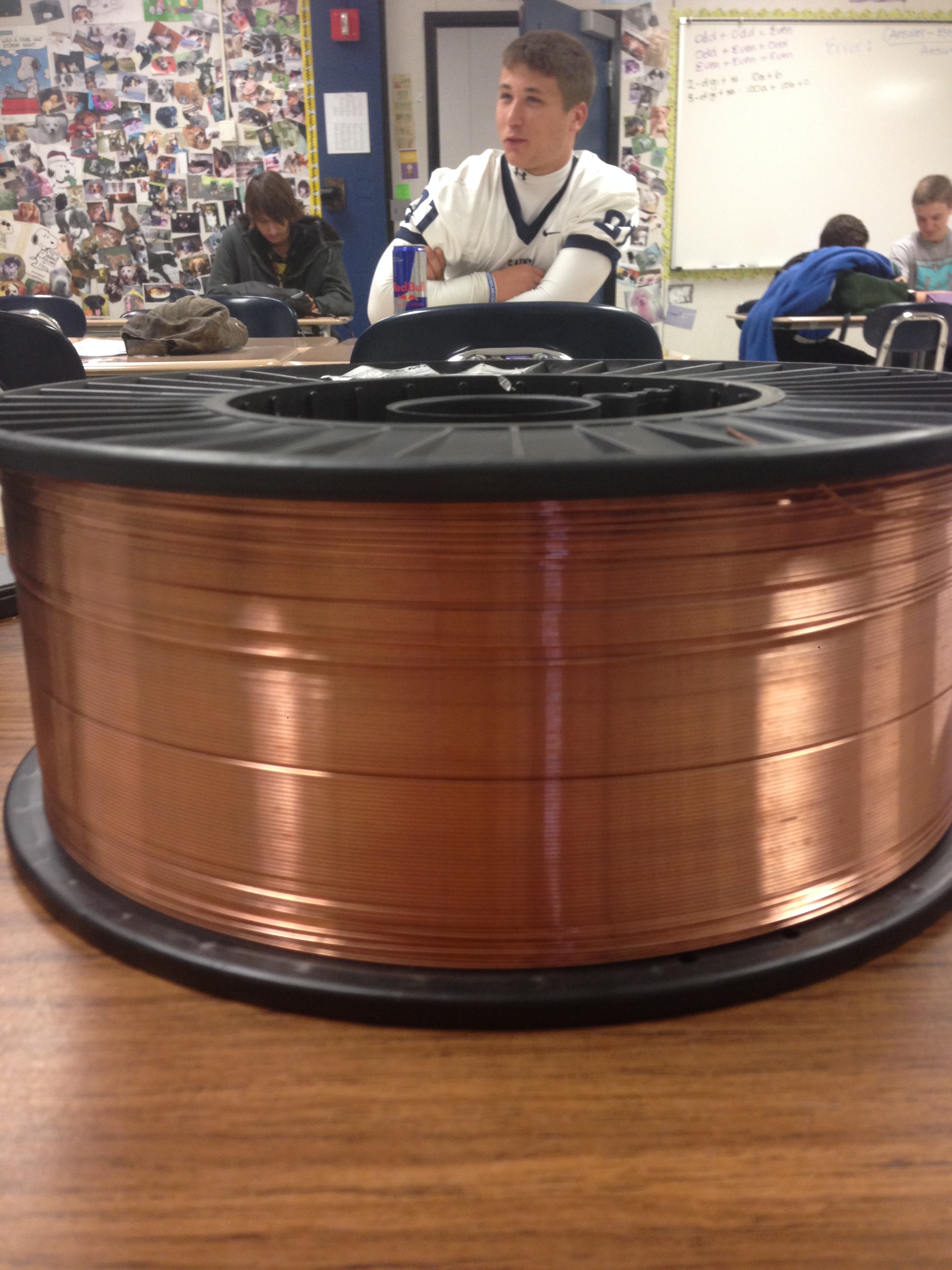
These things hold massive spools of 1 mm thick wire.

IMG_6536

Luckily, the welding instructor was willing to part with one of these for the hour.  Unluckily, the only information we had was the  1 mm thickness of the wire and the spool’s weight of 44 pounds.

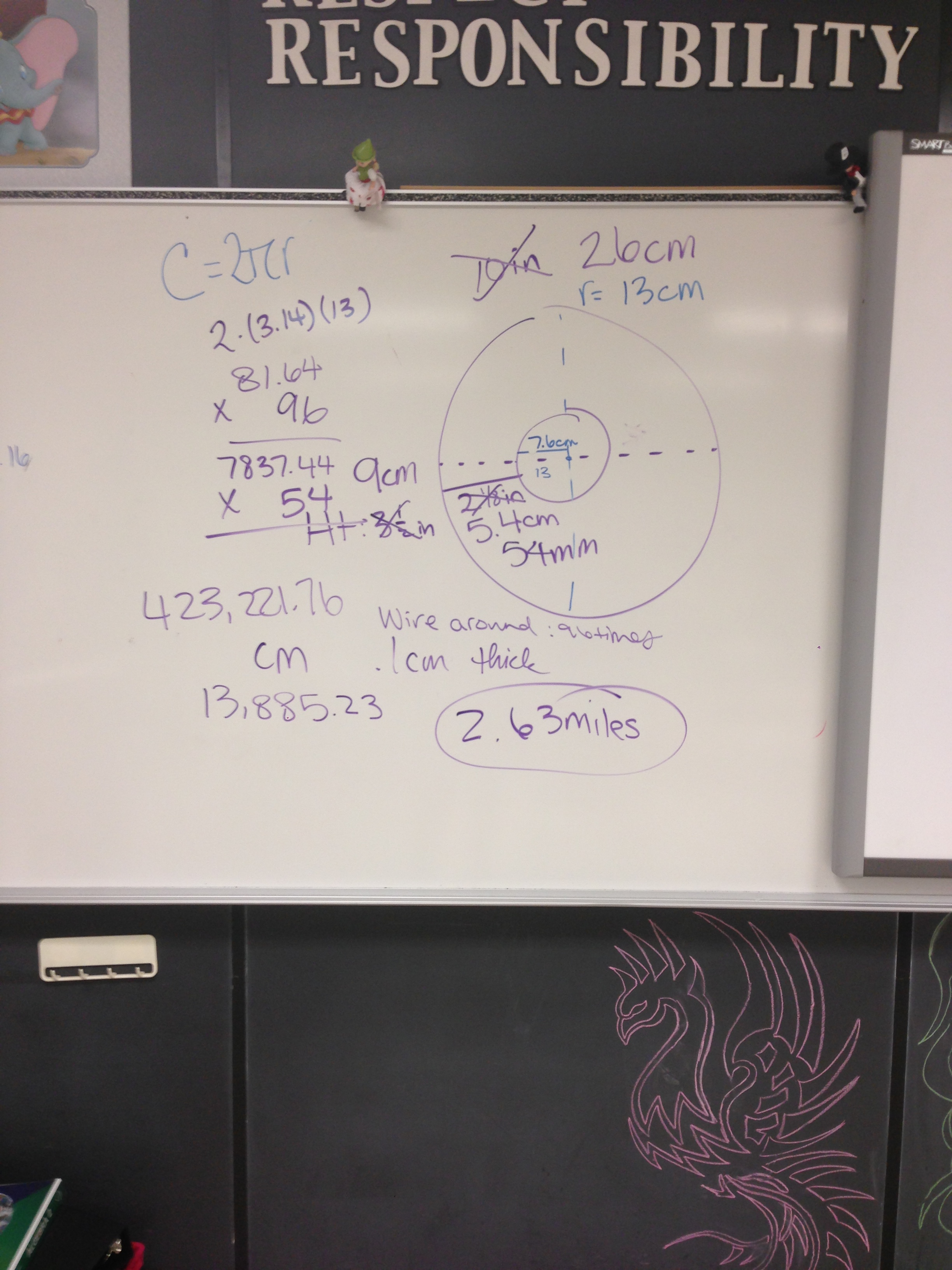
Our initial thought was to weigh a snippet of wire and then scale it to the entire spool, but I was sure that the welding teacher wouldn’t have appreciated the rogue math teacher messing with his supplies.   I praised them for the interesting method anyway.  They then began measuring:  height, diameter of the spool, diameter of the inner circle, diameter of the wired portion, number of wires going up the spool.  It was math-magical.

Here are their calculations:

IMG_6538

Now, I realize that these are a little off because we needed to take into account that the circumference of the spool is getting smaller as we move inward.  But I was very pleased with their work thus far and their vigor in posing this problem and then working to solve it.  I’m excited about where we can go with this type of problem posing.  There are only eight students in this class, all boys that have metal in their bloodstream.  I am hoping that with these sorts of ideas, I can engage them in math that excites them more often.  Maybe I can even get them excited about my Slinky question.

Facing Fear

It’s always fascinating to me to watch students step into a new classroom and immediately search for their social comfort zone.  Students aren’t unique in this phenomenon; they are just the group of humans in which I interact the most.  Today being the first day of school, the visible and invisible social boundaries that students draw between one another were clear as I silently observed.

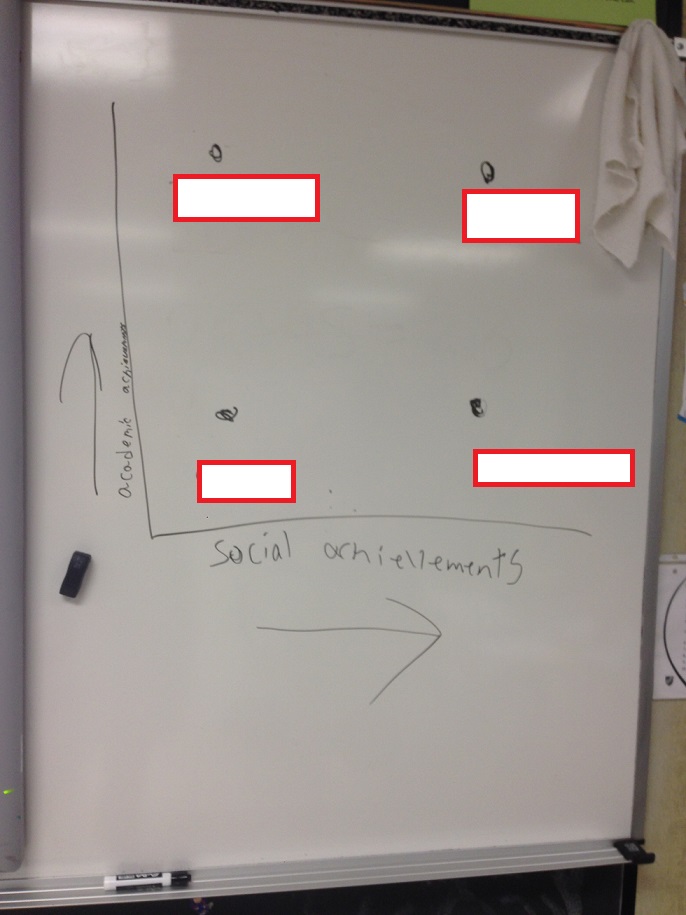
As someone who struggled fitting into a unique social group growing up, I’m most interested in encouraging kids to break away from their cliques. After reading much of what Ilana Horn has written on the subject, I also began to see links between being socially extroverted and status in the mathematics classroom.  For example, kids who are quiet and mostly keep to themselves don’t often have opportunities to display their “smartness,” whereas an outgoing kid willing to contribute voluntarily to class discussion would have their “smartness showcased regularly.  Interestingly enough, when doing the “personality coordinates” activity with my college algebra class today, one group created this graph:  IMG_6508

They defined social achievements as number of friends and academic achievements as GPA.  It allowed us to have a nice discussion about grades and overall intelligence as well as some lovely talk regarding different definitions of social achievement. I look forward to continuing these conversations over the course of the trimester and challenging them to let their popularity guards down.

On a similar note, I tried the Blanket Challenge in my Algebra 2 class.  If you have not read this chapter in Powerful Problem Solving, I’m not sure why you are still sitting here.  Go read it! What impressed me with this group of kids, was they were willing to step out of physical comfort in order to achieve the result they wanted.  IMG_6505 IMG_6506

On the first day of school, in a class that’s tough to adjust to, I can’t begin to express how proud I am of this group of kids for their willingness to work together respectfully and successfully.  I’m hoping to build on the results from this activity in the days to come.

Algebraic Anguish

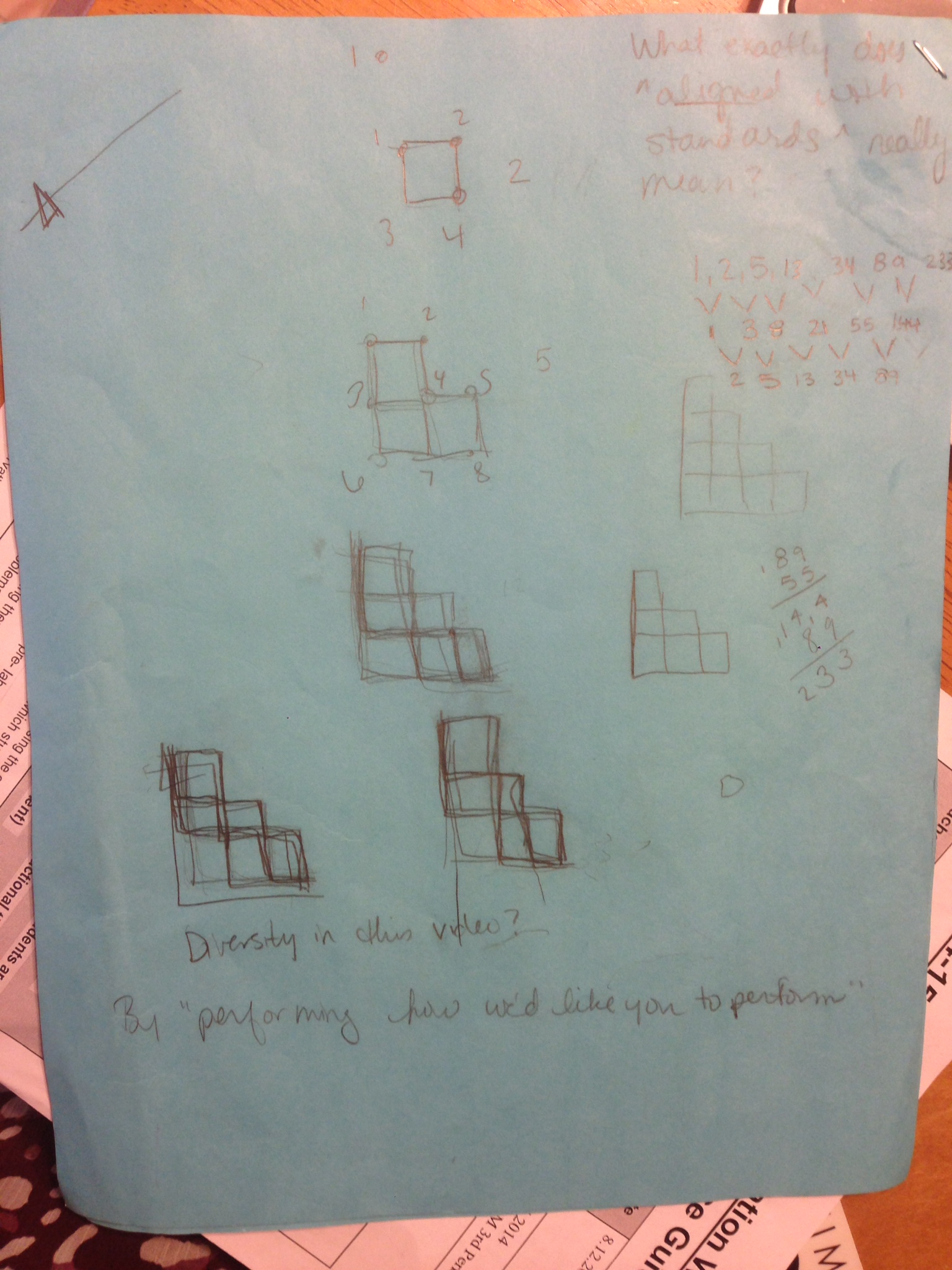
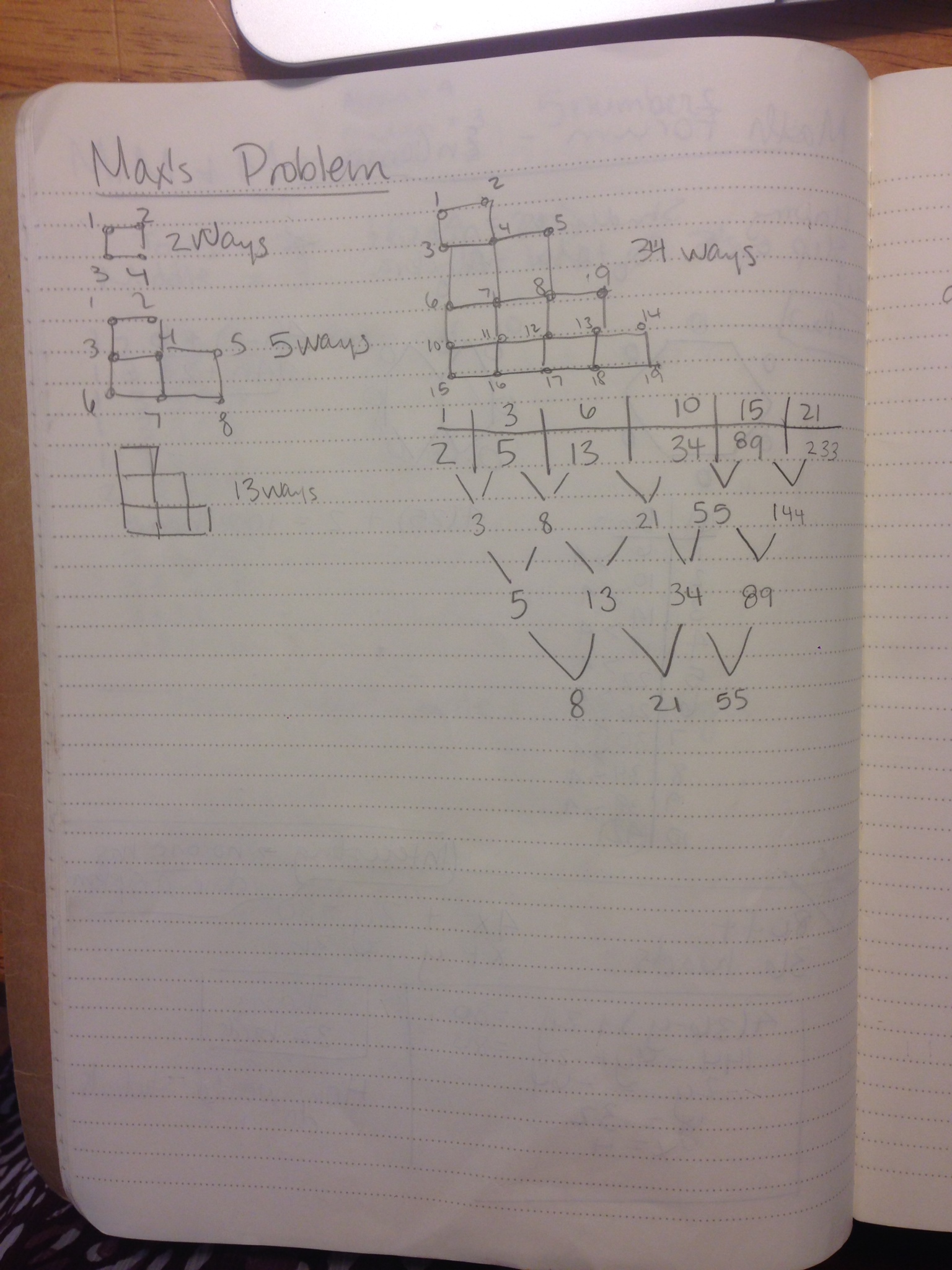
The following prompt presented at Twitter Math Camp by the Mighty  Max Math Forum (aka Max Ray) has been rattling around in my brain for the last few weeks.  Here a grid representing streets in Ursala’s town:

IMG_4814

The problem-solving session, masterfully orchestrated by Max, allowed each group of teachers to develop their own representation of the situation and think about what questions could be asked. For example, if Ursala is at point 1 and needs to get to point 19 along the line segments, without backtracking, how many ways are there for her to travel?  Lots of discussion ensued at our table including the definition of backtracking.

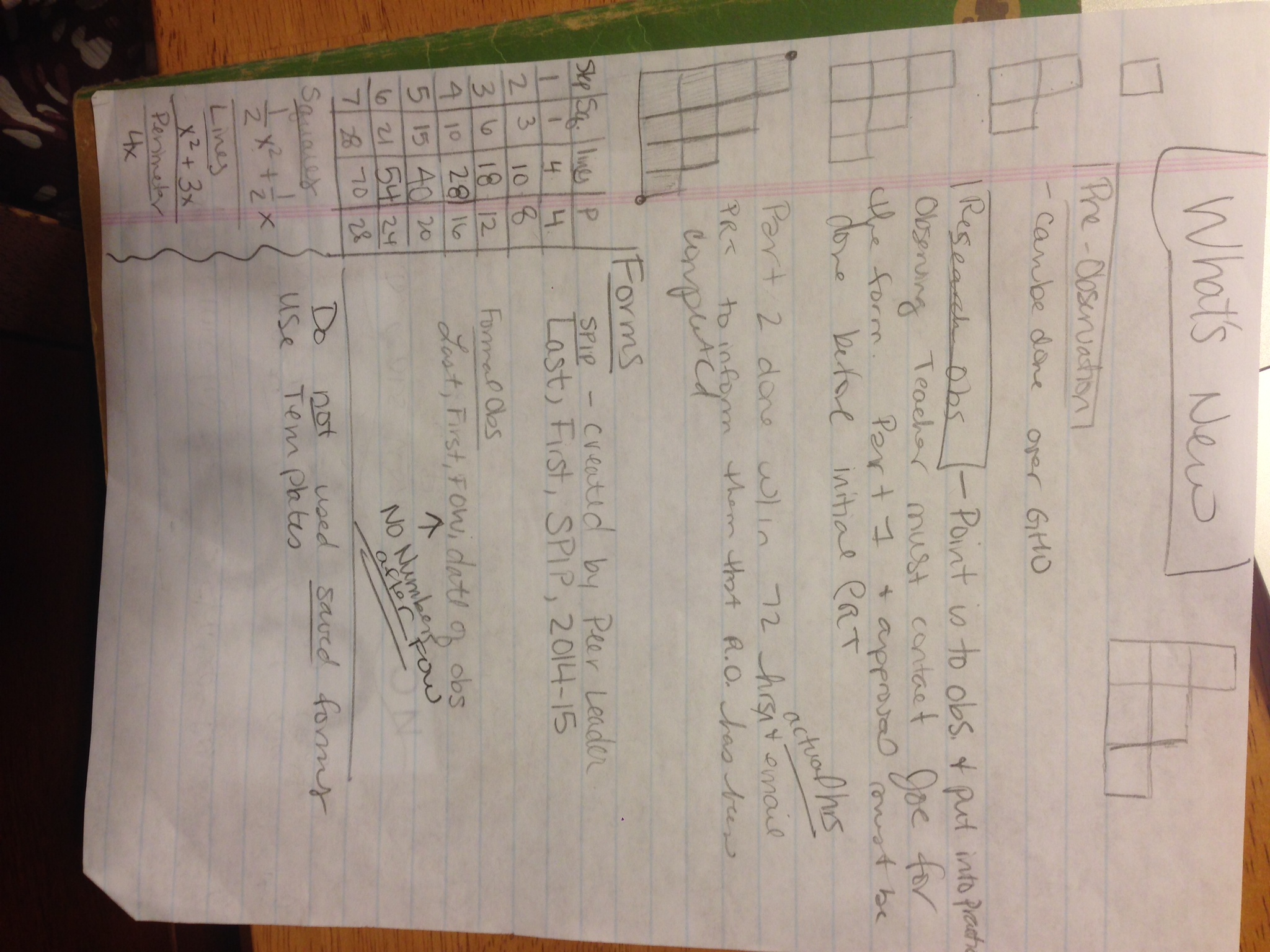
I’ve been at school the last few days and anyone who has sat near me at a meeting in the last few weeks has seen me doodle this scenario, I’m sure wondering what my nerdy math-brain was concocting:

IMG_4816IMG_4815IMG_4817


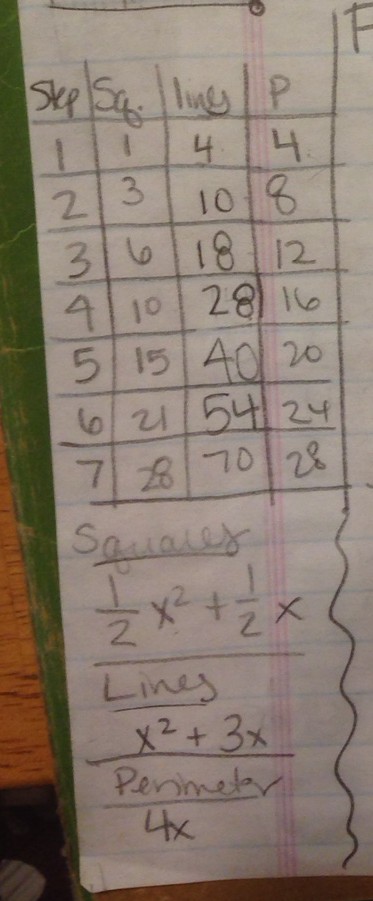
Simplifying the grid and turning it into a pattern expanded the questions that I wanted to ask.  For instance, how many line segments (or streets) in Ursala’s case) are used in step n?

IMG_4817


What I’m still grappling with is how to expand my wonder about this scenario past the algebraic representations.  In talking with other teachers recently, it seems as though many of us have been programmed to solve these, and many other problems algebraically.  I recognize that many students won’t reach for the algebraic aid.  So my next step is to try to see this situation in other ways, sans algebra to better understand how my students are likely to see it.


The Power of a Network

I joined twitter in 2008 and started tweeting more actively in 2009.  Thanks to my attempt at Justin Aion’s Twordle experiment, I was reminded that my first tweets were annoyed snark toward the women of the View.  They never responded.  Shocking.

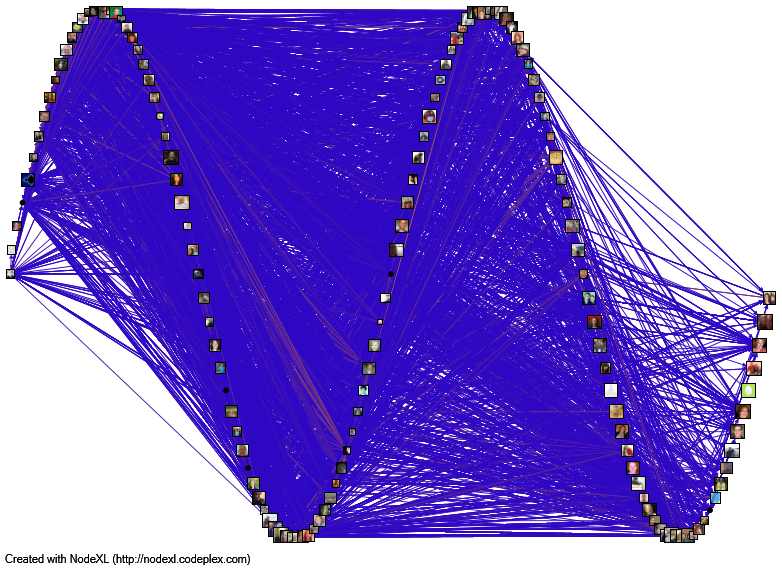
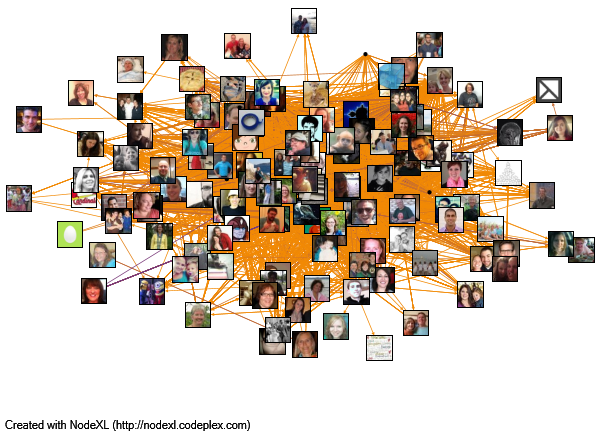
Five years later, my twitter usage has evolved into something that has helped transform my teaching.  Attending Twitter Math Camp last week provided some proverbial icing on the cake.   Glenn Waddell reiterated that Twitter Math Camp is 150 teachers who all believe they can change the world.  It’s hard to capture the magnitude of this incredible event and hard to explain in words how much positive impact these “friends in our phones” can have on the actual students in our classes.   I thought perhaps a picture could capture it. Over the last few days, I attempted to capture the essence of this twitter network.  I wanted to visually represent the inter-connectedness and strength of a group of math educators who feel that by interacting in person for four days in the summer, they’ll have the power to make their students’ world better.


sinecolor

#TMC14 Twitter interactions from May to July. (in a sine wave)

spiralmentions

Twitter mentions in a spiral

Random Interconnections

Random Interconnections

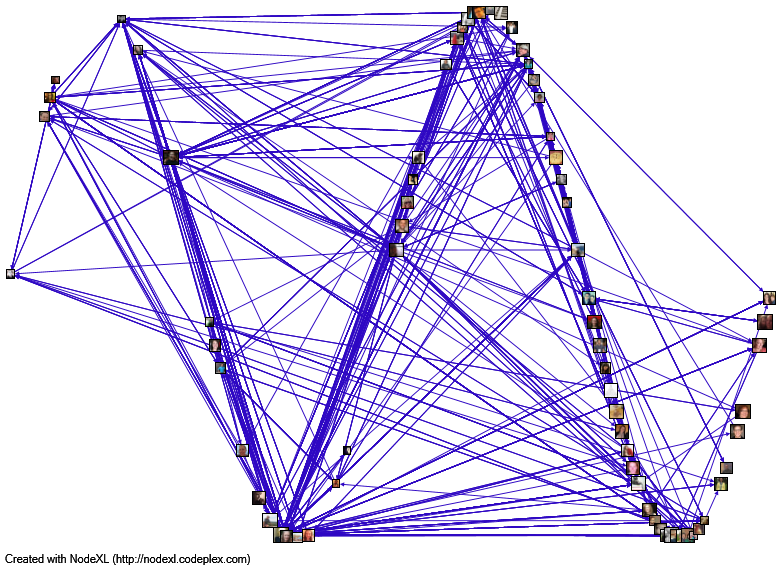
tweetssinceTMC


This last graphic is the most powerful to me.  These are the twitter interactions among the TMC14 participants SINCE the event.  Have you ever gone to professional development where you kept interacting with so many people from the conference?  Me neither.  There’s a ton more that I want to do with this network software, but I’ve poured over it for days, and I wanted to share what I had so far.

There were 36 teachers at TMC12, 110 at TMC13 and 150 at TMC14.  I know that these networks spread far beyond the attendees in Jenks, Oklahoma last weekend.  But a strong foundation has been built. It’s an unspoken commitment to one another that says, “when standards-based grading (or interactive notebooks, or problem-based instruction, or group communication) isn’t going as well as you’d hoped, I’ll be there to get you back on track.”  It’s a network of teacher’s across the country that come together over mathematics, but truly bond over their inherent desire to help all students succeed.  And it’s open to anyone who has the desire to be one of the connecting threads.

Confession: I’ve never really been good at math

Here’s a confession of mine:  I’ve never really thought of myself as ‘good at math.’  Yep, I’m a high school math teacher proclaiming my discontent with my mathematical abilities.  Ironic?  Sad?  Make you want to hide your children?  Read on, it’s not as bad as you think.

Being a math teacher was a second career for me, as my undergraduate degree is in accounting.  I dabbled in a minor in mathematics while at the University of Iowa but let a ‘C’ in Linear Algebra from a cold professor change my trajectory for the next 4 years.   When I went to graduate school to earn my masters in Mathematics Education, I was always intimidated by the math undergrads who were much more polished and current on mathematical theory.  Recently I came across this article which shed some light onto what often happens with girls in areas like mathematics. In short, women tend to give up on themselves more quickly because of their strong inner voice.   I know that I was never discouraged from pursuing difficult challenges by my parents, especially academically.  I came from a family that was very supportive of my education.  It was my own inner-voice telling me that I wasn’t as good at pure mathematics, which was the lingering after effect of that C grade.

Recently, Rafranz Davis wrote a blog post about the transformation of twitter admiration into palatable inspiration.   This post was timely for me since as summer conference season reaches its peak, I’ll be attending Twitter Math Camp starting on Thursday with dozens of other math tweeps with whom I’ve admired and been inspired by.  These positive interactions have projected me to a place where I’m comfortable with my mathematical abilities and completely humbled by my ability to participate with such a wonderful group of educators across social media.


Can There Be Quality PD for ALL Teachers?

This past week, I have the pleasure of attending Solution Tree’s PLCs at Work Institute along with 2200 other teachers, principals, superintendents, and other school leaders. My coworker did the quick math, and at $649 a head, that’s almost $1.4 million that Solution Tree collects in gross revenues just for the Minneapolis Institute alone. Attendees hailed from 17 states, however Minnesota, Iowa, and Wisconsin seemed to show up on the majority of name badges. Our district opted to send about 60 people to the conference, effectively emptying out our professional development fund for at least the time being.
I want to be fair and give this conference proper recognition. Despite the steep price tag, the keynotes and breakout sessions have definitely delivered as far as being relevant, engaging, and dynamic. The session presenters are highly accessible for questions and have been more than willing to provide quick access to resources, handouts, and templates. The building blocks/cornerstones/pillars of the professional learning community make it very clear that failure for students can no longer be an option and success past high school is mandatory to afford a middle class adult life. I saw many excited teachers and administrators alike as they envisioned how this collaborative culture can work within their own classroom setting. Research was resonating, pencils were feverishly copying quotables.

I thoroughly enjoyed Tim Kanold’s breakout sessions addressing PLC’s and the Common Core State Standards. It was refreshing and energizing to engage in discussions around mathematics-specific tasks. I was reassured when examining Dr. Kanold’s list of additional resources as they included many of the curriculum materials I’ve included in my instruction as of late – Illustrative Mathematics, Mathematics Vision Project, Engage NY, among others.

Ultimately I had a difficult time getting past the elephant in the room, or rather, the elephant NOT in the room. If the PLC model is as effective as the research suggests (and I believe that it absolutely is) than how does this valuable information get delivered to high-needs districts who cannot afford to send district staff to a conference costing over $600 per head? If this disparity in achievement between rich and poor students is widening and failure in today’s job market is truly not an option, then how do schools who don’t have flexible professional development funds get access to the quality expertise needed to effectively implement the PLC ideals? If we truly believe that ALL students can learn and PLCs are the best chance we have to do that, then isn’t it vital that our neediest districts have the proper training to carry this out? I’m grappling with this subtle silent theme prevalent in this conference that ‘We believe that teachers need to ensure that all students learn, but we are only going to ensure that those districts willing to fork over $650 per participant have the proper tools to make that happen.”  Instead, those schools, like the Chicago Public Schools are subjected to cringe-worthy professional development that makes us wonder why anyone would subject teachers to that kind of monotony.

When teachers have the opportunity to have conversations with other teachers from other districts, everyone learns.  Unfortunately, there is an entire segment of teachers, representing a huge number of students, absent from the conversation.  And in order to improve education for all of our students, we must include all teacher voices in the discussion.