Use All the Methods!


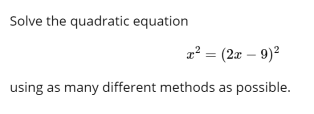
This is from Illustrative Mathematics (the people over there do wonderful work.  Plus they are lovely.) The problem I posed to my college algebra class was this:
Capture

I had them try it on their own and as I circulated the room, I noticed about 3 methods:  taking the square root, putting the problem in standard form and then factoring, or putting in standard form then applying the quadratic formula.  After clearing up errors and misconceptions, I was confident we understood that the answers were x = 3 and x = 9.

What now?  We could gather up all of the methods they came up with and make a lovely list.  Or we could take a look at the method that students almost 100% of the time ignore/forget/dismiss:  graphing.

Step 1:  Understand what a “solution” looks like graphically.

0108161549-1.jpg

We separated the equation into two quadratic functions which both were equal to y.  Now we had a system of equations and this group knows that systems of equations have solutions at points of intersection.


Step 2:  Without a graphing calculator, sketch each of these two functions to approximate how they cross. “Expect to be wrong and give it a go anyway so that we can all learn from each other.”

Step 3: Examine some of our solutions.  As I expected, only about 2 students had a solid understanding of where y = (2x-9)^2 sat on the xy-plane.

I categorized the errors into three groups:

A.  The negative 9 means the graph is shifted down.  0108161551-1-1.jpg

B.  Our answers when we solved were x = 3 and x = 9, so this graph must cross there. 0108161551-1-2.jpg
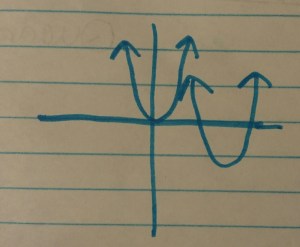
 

C.  I don’t want to be wrong so I’m only graphing y = x^2. 0108161551-1-3.jpg
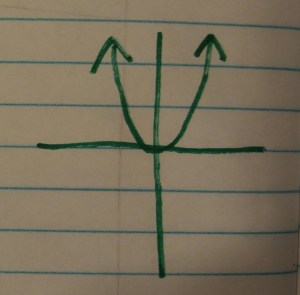
Step 4: Look at the graphs of some similar quadratics like y=(x – 3)^2 and see if that thinking applies here.

*I feel like here is where understanding happened.

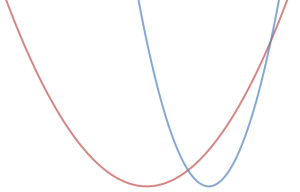
Step 5:  Take the gridlines and axes off of the Desmos graphs and find the points of intersection.
Capture

Interesting to see them “know” that x=3 and x = 9 from solving this equation algebraically somehow applied here, but they weren’t sure how.

Eventually we arrived at (3,9) and (9,81).


My Take-Away(s)

We explored a method that most (if not all) students don’t think of when asked to solve an equation:  Graphically.  But I think it’s an important one when trying to figure out how the pieces of functions and algebra fit together.  Yes, we could practice factoring, the quadratic formula, and completing the square all day long.  But in the end, know those individual methods doesn’t give my students an idea of how those solutions connect with the actual functions they represent.


This problem made me think about what we tell students when we explain methods of solving equations.  Any time we show a student a method, we are inexplicitly stating that this method has higher status than any other.  Giving students an opportunity to solve a problem using their prior knowledge is important to the learning process.   Their way of solving isn’t always going to be algebraic and building from where they are at is vital to creating a foundation of understanding.  If they start with “guess and check,” help them build structure from that rather than insist that the algebraic method of solving is superior.  In the case of the Problem above, any algebraic method was probably the most efficient but it isn’t always.

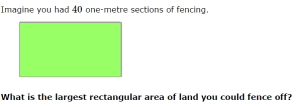
For example, what about this problem from Nrich.  Would your students approach it algebraically first?  Or is there foundation elsewhere?
Capture2


App Review: Osmo Numbers #tmwyk

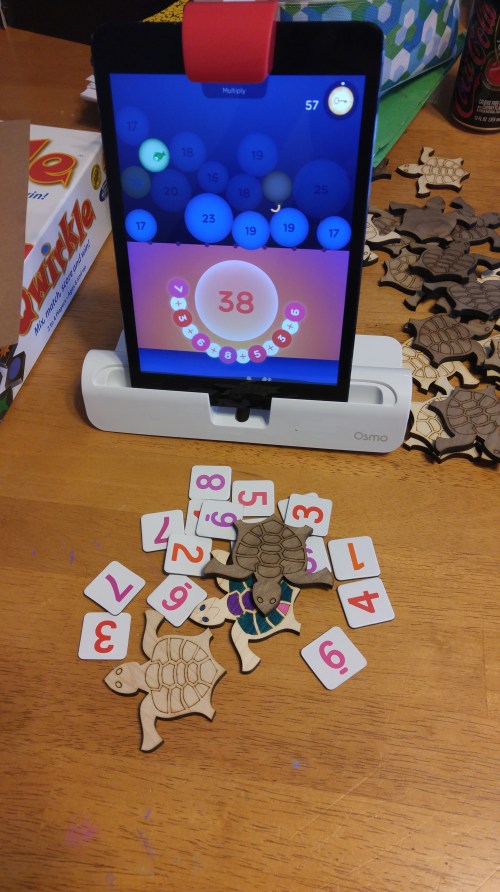
Since it was Christmas, and we finally had some free time, I decided to bust out something she had gotten earlier this month: Osmo Numbers.  I have a feeling that given the success of other Osmo products, the popularity of this one might surge.  We had tried Newton, Masterpiece, and Tangrams and kinda liked them.  I was hopeful.  Optimistic even.  (I think you see where this post is going).

Their contains the following video, which addresses math anxiety and illustrates the power of turning math into a game.

Here are some quotes from reviewers:


I couldn’t agree more:  we (educators and parents) create math anxiety in our students/children by insisting that math has one right answer. Often we convey that there is one right way to arrive at that answer as well. Consequently, children grow up believing math is about rules and procedures rather than creativity and exploration.

Reviewing the App

Description (from website): Kids arrange physical tiles, including dots and digits, to make numbers and complete levels. Add by putting more tiles, subtract by removing tiles and multiply by connecting tiles together. Experimenting becomes fast and intuitive.

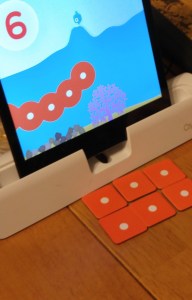
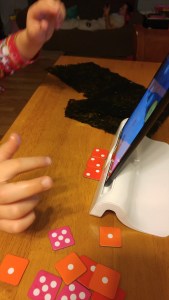
The first section (Count) is decent.  Children have multiple dot tiles (like dice) that contain either 1, 2, or 5 dots.  They need to arrange tiles to total the numbers in the bubbles to make them pop.  It was interesting to me to see my daughter, Maria, make sums in different ways.  img_-2neqp0.jpgimg_20151226_131603.jpg

I was also intrigued that she always made numbers between 10 and 20 using two fives and then the remainder.

img_20151226_131912.jpg

Things went downhill quickly.

In the “Add” section this is 1 + 4:

1226151324.jpg

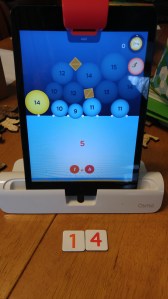
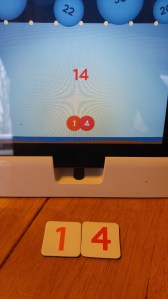
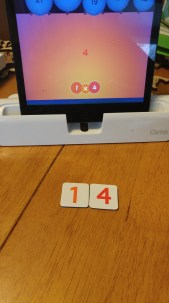
However, in the “Connect” section, this is 14:


1226151339

Furthermore, in the “Multiply” section, this is 1 x 4:

1226151343a

Why is this a (HUGE) problem?  The design of each of these stages reinforces the belief that mathematics is about isolated rules rather than connected ideas.

That’s worth reiterating:  Math should be about connecting ideas and not about isolated rules.  

The app boasts “when kids get the idea that there are multiple good ways to solve a problem, math becomes creative and fun.” I’m fighting my knee-jerk sarcastic-response mode big time in order to keep this professional.  All kids are really doing here is finding different ways to recall facts.  And as they progress through the app, the meanings of their representations change.  This doesn’t help build math confidence and break down math anxiety.  It sturdies the foundational thinking that math concepts don’t relate.

Here’s a great example of that.  Maria is frustrated that this doesn’t equal 10 like it did yesterday. But there isn’t anything to differentiate addition from multiplication besides the fact the tiny title (that she can’t read anyway) says so.

1226151405-1

There is no visual representation of 5×5 being 25.  No arrays, no area models, no dots.

Why am I making this such a big deal?  This app, and many like it are being touted as game-changing, revolutionary, and brilliant. But when I search through the Osmo Makers page, I see no teachers.  In fact, I see five years of actual classroom experience, none of it in a public school and none math-specific.

I admire the goal to “revamp the unimaginative worksheet.” But I’d rather it replaced with a better worksheet than with something that tears down conceptual foundations of how numbers build and replaces it with fact-fluency.  Sorry, Osmo.  This product is a giant fail.  I’m returning to Talking Math with Kids where math doesn’t just claim to be creative. It actually is.


Somewhere between Concrete Sequential and Abstract Random

It occurred to be relatively early in during the trimester this past fall that my college algebra students (generally) have no idea what I mean when I say “quadratic function.”  This isn’t because they have never heard it, learned it, or used it.  But that technical of a term simply has not stuck around in their long term memory.

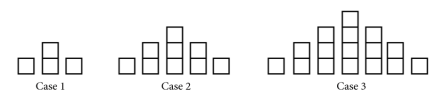
So, similar to linear functions, we start with a pattern:

circle

from youcubed.org and visualpatterns.org

I then had them make posters including how it is growing, what the 10th, 100th, 0th, and -1st cases would look like, table, graph, expression, and relationship to the pattern.  Instead of one large poster, they use 4 smaller pieces of paper and tape them together.  That way each group member can contribute simultaneously.

I noticed:

  • It is difficult for students to describe how an irregular shape is growing.
  • It is even more difficult for them to describe something abstract like the -1 case.
  • Many of them expressed the overall growth as “exponential.”
  • Most could easily see the two rectangles formed and determine the dimensions with respect to “n.”

I wondered:

  • If they could connect the work with patterns to other quadratics.
  • How to have a meaningful discussion around the “exponential growth” issue.

Their homework was to answer similar questions for this pattern from You Cubed’s Week of Inspirational Math:

growing

Spoiler alert: the rule for the pattern is f(n) = (x + 1)^2 or f(n) = x^2 + 2x + 1

So where do we go from here, two days before Winter Break?  My goals are to review some specifics on quadratic functions and simultaneously help the students make connections between different representations.  I know what I must do.  I must channel my inner Triangleman.

[Backstory:  Christopher Danielson and I go way back. At least to 2014. Maybe even 2013.  Seriously though, I strive to organize my college algebra class the way Professor Danielson describes in his blog.  I have picked his brain on more than a few occasions and he is gracious enough to give me advice in certain curricular areas. In short, his philosophy titled “They’ll Need it for Calculus” is the foundation of my College Algebra course. ]

Ok, back to room C118.

Me: Write down everything you know about the function y = (x+1)^2

(Most write down the expanded form, some start to graph, but not many)

Me: What other ways can we represent this function?

Students: Tables! Graphs! Pictures! Words! Patterns! Licorice!

Me: Sweet!  Let’s do all of that, minus the Licorice.

(I give them a few minutes to create a table and a graph.)

Me: NOW, write down everything you know about this function.

I circulate and hand each group a half sheet of paper.

Me: Write down the most important thing on your groups list.

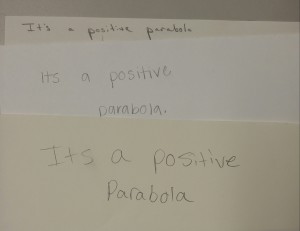
At first I wasn’t really concerned what exactly they wrote down, but how they defended their choice. Then I came across this in all of my classes:

1223151442-1.jpg

We came up with a pleasing list of attributes of a positive parabola that included vertex placement, end behavior, leading coefficients, and rate of change.

Next up for discussion: Parabolas grow exponentially.

Me: Turn to your partner and tell them whether you agree or disagree with this statement and defend your choice.

Students: Yes, words, words, words.

Me: Ok, now the other partner, say how you know something grows exponentially.

Students: Multiplied every time, more words, blah blah blah.

So we agreed that 2, 4, 8, 16, 32, 64… is an example of something that grows exponentially.

Me: Numerically, how can we tell how something is growing?

Students: (eventually) Rate of Change!

We came up with this table and agreed that these two functions were definitely NOT growing in a similar way.

1224151308-1.jpg

Now on to helping them understand what it means for something to grow quadratically…


Making Groups Work

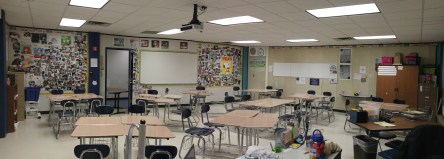
For about a year now, I’ve positioned my desks in groups of four. This trimester, my largest class is 35 students, but I was determined to make the groups fit.  I think I nailed it.

1201150642_pano.jpg

My room isn’t really this big. This is a panoramic photo.

For a lot of students, group work has consisted of a couple of things:

  1. We compare answers, but  when in doubt, write down what the smart kid has.
  2. We work in close proximity to one another, but for the most part, individually.

I’ve been reading Jo Boaler’s new book Mathematical Mindsets which address productive group work and have also read Strength in Numbers by Ilana Horn which surrounds similar issues. (Ilana has blogged on status in math class here) Both texts highlight the importance of addressing status in the mathematics classroom.  Because today was the first day of the new trimester, I thought it was a great opportunity to model and discuss what great group work looks like in order to level out the social status of students in my class.

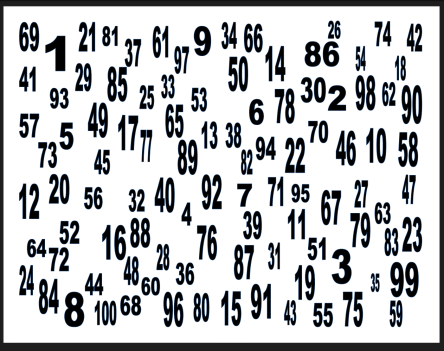
1 – 100 Group Task (adapted from Sara Vanderwerf)

screenshot_2015-12-01-16-18-17-1.png

  • Make sure students are in groups of 4.  Groups of 3 or less should join another group and partner with another member of that group.
  • Give students highlighters or markers.  Make sure each group member has a different color.
  • Distribute one handout per group face down.
  • Have students decide who will go first and then continue in a clockwise direction.
  • First student will highlight or cross off the number 1.  The next student will cross off number 2.  The following student 3 and so on.
  • Give students a fixed amount of time (I did 2 minutes) to get as far as they can.

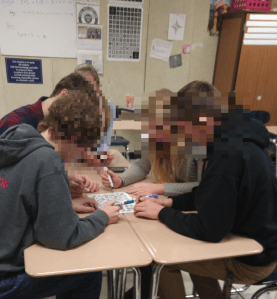
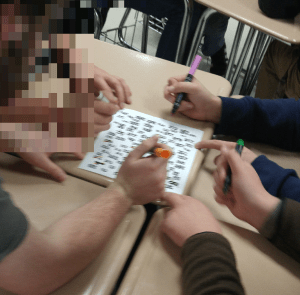
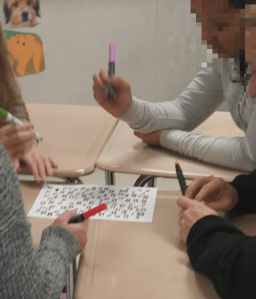
While students are feverishly crossing off numbers, discretely walk around and take pictures of each group as they work.  Be sure to capture models of group work you would like to highlight. For example, note students helping one another find numbers.  Also, include students all looking at the paper no matter whose desk it is on.

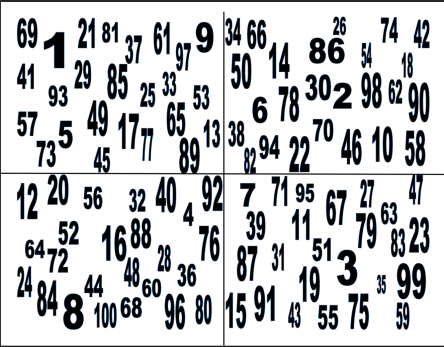
When time has elapsed, have groups make note of where they left off.  I asked, “if I had you discuss strategies, would you be able to improve the number you were able to cross off?”  Most will (obviously) agree, but then I give them a minute or two to examine their paper and discuss some strategies.  If your students are paying close enough attention, they should notice that the numbers are divided into quadrants.

screenshot_2015-12-01-17-36-21-1.png

Redistribute a new sheet, face down and start the time again for 2 minutes.  Again, circulate and take pictures, this time capturing the increased determination represented by putting their heads together and keeping the paper on one desk.  For fun you may want them to record their new number.  I had students record their number for the first round compared to the second round.  We then discussed how we could rank the groups based on the results which ended in a nice conversation about rate of change.  If I were more savvy, I might take the data from all three of my classes and put them on a scatterplot in Desmos to see if there is a relationship between their first round score and their second round score.  Alas, that was not to be.  Afterall, the purpose of the activity was not to “win.” It was to talk about what great group work looks like.

I revealed to them that while they were working I was taking pictures.  I had them predict what we would see on the pictures that would demonstrate a productive group.  We made sure to clarify that groups won’t always physically put their heads together to work. But that the idea of all group members focusing on the same task at hand was essential.  This allowed us to lay the foundation for future meaningful group work so that the students benefit from it.
December 1, 2015 53759 PM CST December 1, 2015 53859 PM CST December 1, 2015 54007 PM CST

Link to PDF of handouts

TMC 2016 Proposals

We are starting to gear up for TMC16, which will be at Augsburg College in Minneapolis, MN (map is here) from July 16-19, 2016. We are looking forward to a great event! Part of what makes TMC special is the wonderful presentations we have from math teachers who are facing the same challenges that we all are.


To get an idea of what the community is interested in hearing about and/or learning about we set up a Google Doc (http://bit.ly/TMC16-1). It’s a GDoc for people to list their interests and someone who might be good to present that topic. The form is still open for editing, so if you have an idea of what you’d like to see someone else present as you’re writing your own proposal, feel free to add it!


This conference is by teachers, for teachers. That means we need you to present. Yes, you! In the past everyone who submitted on time was accepted, however, this year we cannot guarantee that everyone who submits a proposal will be accepted. We do know that we need 10-12 morning sessions (these sessions are held 3 consecutive mornings for 2 hours each morning) and 12 sessions at each afternoon slot (12 half hour sessions that will be on Saturday, July 16 and 48 one hour sessions that will be either Saturday, July 16, Sunday, July 17, or Monday, July 18). That means we are looking for somewhere around 70 sessions for TMC16.


What can you share that you do in your classroom that others can learn from? Presentations can be anything from a strategy you use to how you organize your entire curriculum. Anything someone has ever asked you about is something worth sharing. And that thing that no one has asked about but you wish they would? That’s worth sharing too. Once you’ve decided on a topic, come up with a title and description and submit the form. The description you submit now is the one that will go into the program, so make sure it is clear and enticing. Please make sure that people can tell the difference between your session and one that may be similar. For example, is your session an Intro to Desmos session or one for power users? This helps us build a better schedule and helps you pick the sessions that will be most helpful to you!


If you have an idea for something short (between 5 and 15 minutes) to share, plan on doing a My Favorite. Those will be submitted at a later date.


The deadline for submitting your TMC Speaker Proposal is January 18, 2016 at 11:59 pm Eastern time. This is a firm deadline since we will reserve spots for all presenters before we begin to open registration on February 1st.


Thank you for your interest!

Team TMC – Lisa Henry, Lead Organizer, Mary Bourassa, Tina Cardone, James Cleveland, Cortni Muir, Jami Packer, Megan Schmidt, Sam Shah, Christopher Smith, and Glenn Waddell

Stringing Students Along

If I’ve done one thing consistently this year, it has been Number Talks in my Probability and Statistics classes.  I have seen students who, at the beginning of the trimester, told me flat out, “I can’t do math in my head.” Now that Trimester 1 is coming to an end, those same kids are volunteering multiple strategies in these mental math challenges.

During the trimester, we started with the dot image below and have moved through the four operations, onto decimals, and even dabbled in fractions and percents.

Capture

How many dots are there?  How did you count them?
 

What’s important to me with these number talks is the visible improvement I saw in my students’ confidence and flexibility with numbers.

I’ve shared before about my experience with number talks and I plan to continue these throughout the rest of the school year.  But at the NCTM Regional conference in Minneapolis a couple of weeks ago, I had the pleasure of attending Pam Harris’s session on Problem Strings.  I found that problem strings are very useful when wanting to elicit certain strategies or move toward generalization of a strategy.

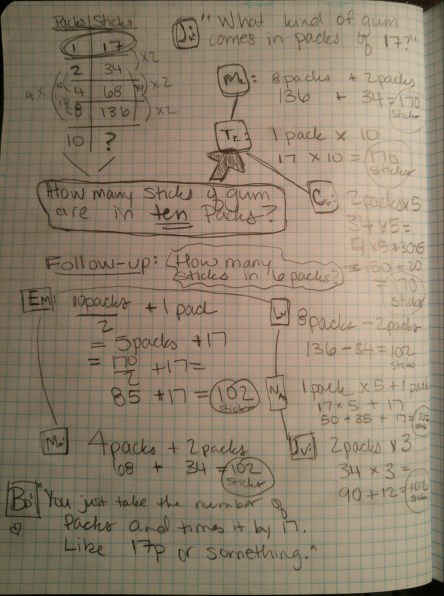
Here are my notes from a problem string I did recently with the same group of students I have been doing number talks with.

wpid-1120152051-1-1.jpg

I noticed:

  • Many students did not use “17 sticks in a pack” to figure out sticks in 10 packs
  • Many more strategies than expected were shared to find the number of sticks in 6 packs of gum.
  • Most students were able to generalize about number of sticks in n packs.
  • Participation increased with the multiple opportunities to volunteer their strategies.
  • Students could see relationships between the numbers and find the solution in multiple ways because of that relationship.
  • There are many implications of these problem strings in secondary mathematics. In this example, the slope formula can be easily elicited through further exploration of the table we made.

I’ve read all of Pam’s books, but getting to see her present problem strings in person really illuminated how these can be useful in my classroom. Thanks, Pam, for opening my mind to this and letting me fangirl you.  I’m looking forward to doing more of these, including recording them.  Stay tuned.

Regional Reflection – Releasing my Grip

As humans, our complex brains are able to create such detailed visions of the future.  We build things up (or down) in our minds that reality can’t possibly compete with.  Until we let go of what we believe should happen, we are unable to fully experience the beauty of what actually is.

Proposals for the NCTM Regional Conference here in Minneapolis were due in September of 2014.  This means I have had over a year to continue to wind the anxiety yarn into one giant ball of stress.  But sweet relief occurred when I released my iron grip on my expectations and began to appreciate the phenomenal power of educators coming together.

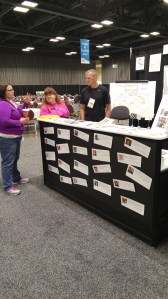
First off, thank you, from the bottom of my heart, NCTM, for  your support of the MathTwitterBlogosphere at the NCTM conferences. I spent much of my time at the #MTBOS booth in the exhibit hall.  Sharing this wonderful, supportive, organic community with other math educators has been as fulfilling as it has been fun.

wpid-1112151407_hdr.jpg

East Coast meets Minnesota Nice

wpid-1113151303.jpg

You guys have something called the “Trap Team?”

wpid-1113150957.jpg

Woman: You didn’t say there would be math. Christopher: Actually, I said there would be nothing BUT math.

wpid-1113150851.jpg

When Nicole Bridge gets fired up, the magic happens.

When asking people in the Exhibit Hall “are you on Twitter?” the most common response was “yes, but I don’t tweet.  Think of the student in your class that thinks very deeply, submits very thoughtful work,but doesn’t raise his/her hand in class to volunteer his/her thinking.  I’d hope that most teachers would agree that these students are still valuable members of the classroom community.  It works the same with the online edu-community.  Plus, I’d venture to guess that many people who actively tweet with other math educators started by diving down the rabbit hole of math blogs.

Max Ray-Riek led a panel where we discussed this problem and blog post of mine.  Next week we venture into rational functions in college algebra and I anticipate good times to be had once again.

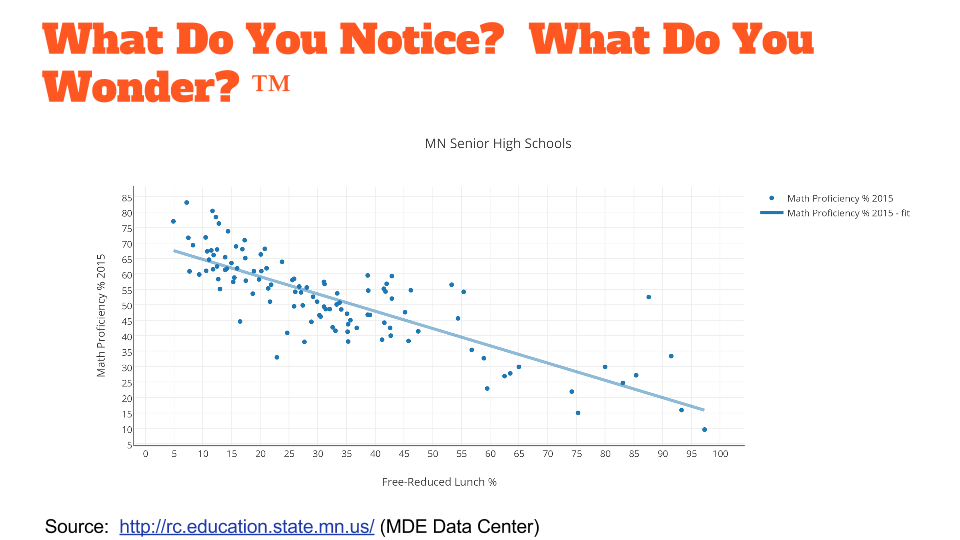
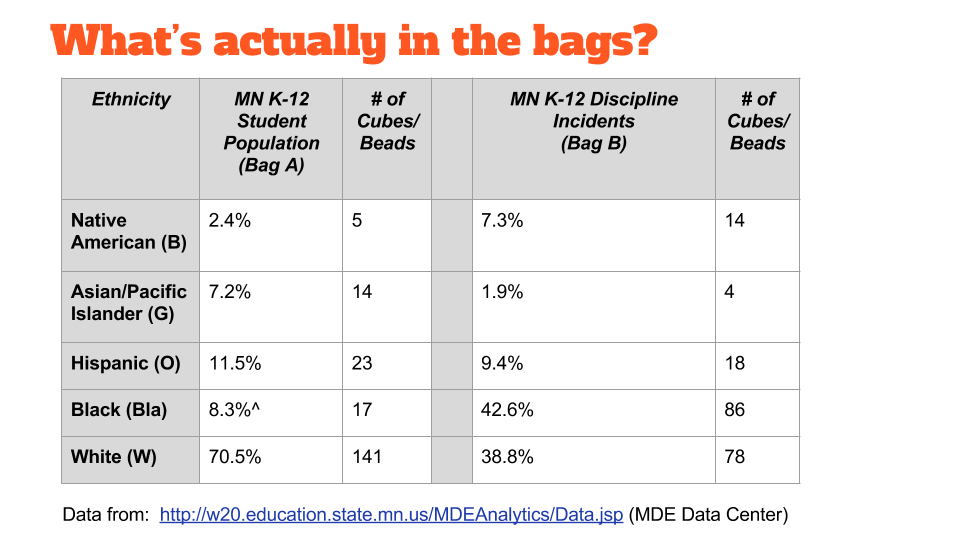
An hour later, Carl Oliver and I spoke on statistics, social justice, and how to have safe, productive conversations with students around the issue of race and equity. Here is the link to the slides.  The discussion centered around these data sets:

Using Local Data to Teach Statistics

Using Local Data to Teach Statistics (1)

I really enjoyed giving our presentation and a lot of great discussion ensued.  But ultimately, I’m thankful to the MathTwitterBlogosphere for being the catalyst of the great discussion we get to take part in, day in and day out.  I had never met Carl Oliver in person before Wednesday.  But the powerful connections we (all of us) have made with one another, make it possible for an algebra teacher in New York and a stats teacher in Minnesota to get together and share their passions with fellow educators. It allowed a teacher in Massachusetts to spread the fire she started in Boston on to Atlantic City, Minneapolis, and Nashville.  And that fire is continually kindled as we welcome, share, engage, and support over and over and over again.  Thank you, #MTBoS for being the genuine, authentic community that has naturally produced so much awesome for so many teachers.

But Would You Put Money On It?

I have felt one of two extremes every day this school year:

  1. My students aren’t learning anything meaningful, it’s impossible to do everything I need to do well, and my brain is on fire.
  2. Cheers!  My students had fun while making meaningful mathematical connections.

Today was the latter kind of day so I thought I’d take a few moments to embrace it.

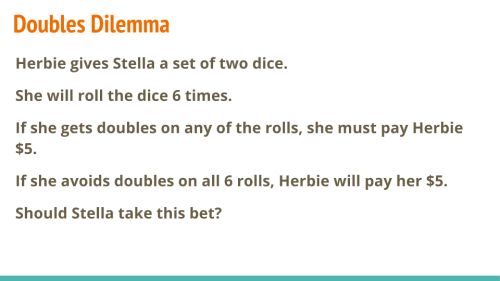
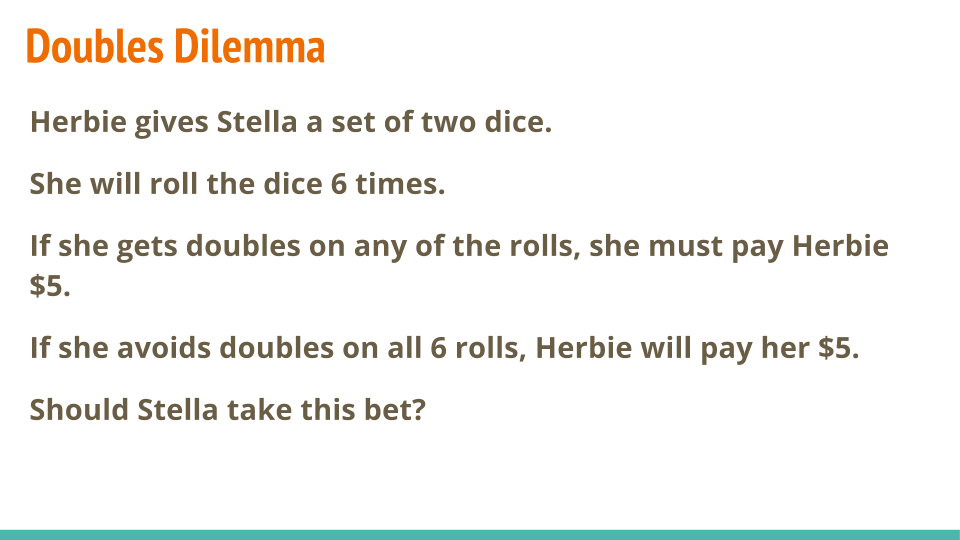
I proposed this scenario to my non-AP probability and statistics class:

Doubles Dilemma (1)

I had students discuss their initial reactions.  Many of them mentioned specifics like “1 out of 6” and “36 possibilities” but for the most part, the students were willing to put their hard earned money on the line for a chance at avoiding doubles.  (To be clear, no actual betting went on in my classroom)

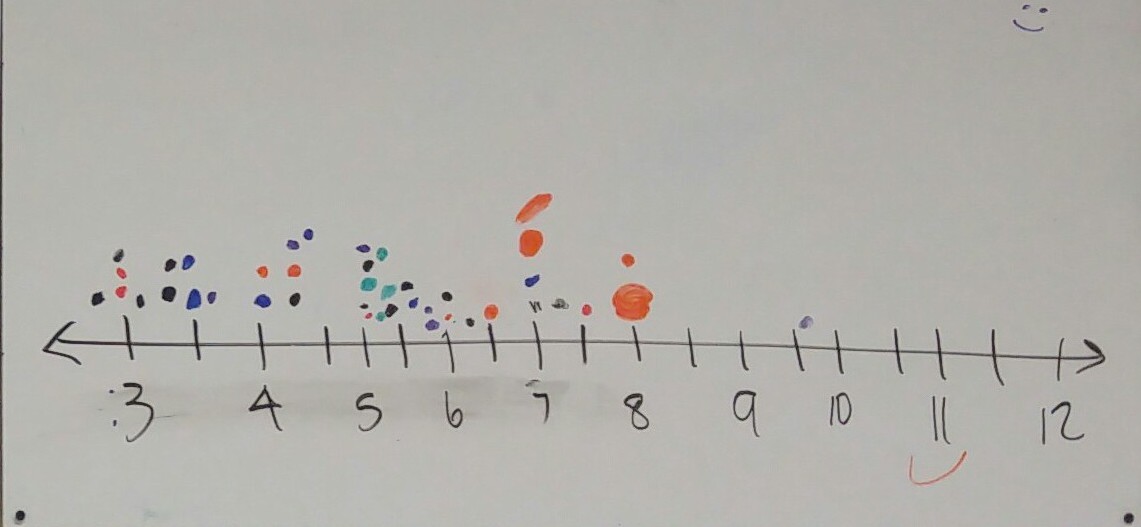
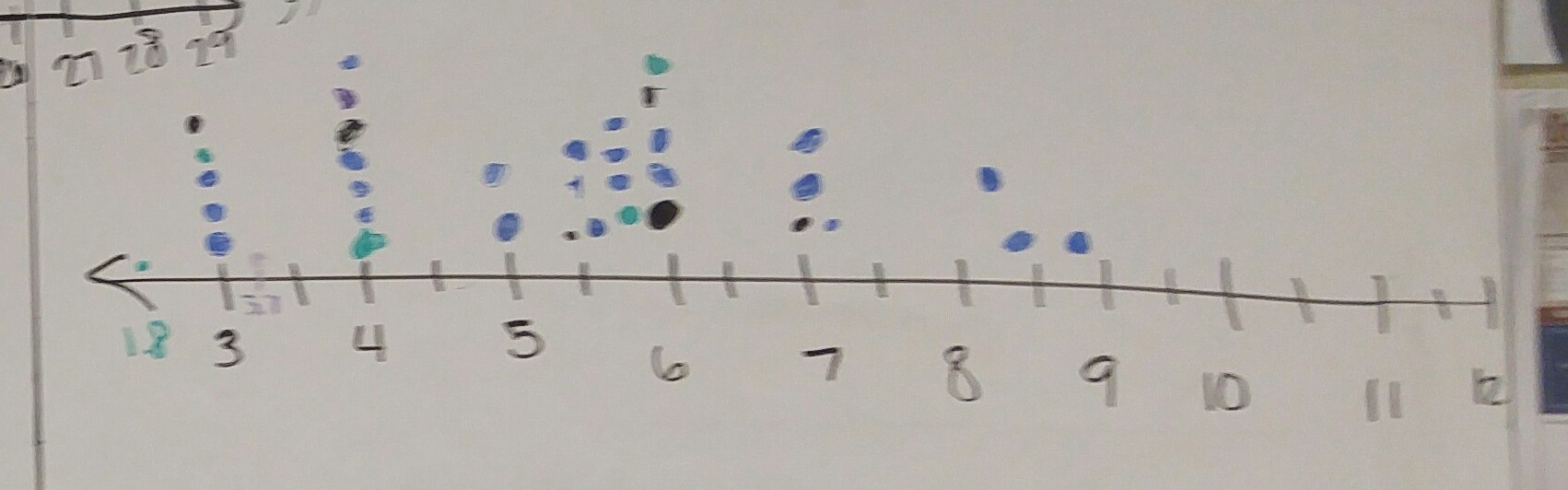
Then we rolled until we got doubles.  And rolled again and again and again.  I have one computer and a class set of TI-84s.  So, naturally, we made a class dot plot of our average number of rolls to get doubles.

wpid-1029151423-1.jpgwpid-1029150825-1.jpg


Now that our data was collected, I asked them again if they would take the bet.  Since $5 didn’t seem to be enough money for them to really consider the probability, I upped the wager to $100.  That seemed to be enough money for them to consider the results of the experiment and think twice about putting up $100 because they feel lucky.

Thanks to Chris True, Mathematics Professor at the University of Nebraska, who proposed this scenario at an AP Statistics training I attended this summer.


We are Better Together

We are better together.  Say that out loud.  Go ahead.  I’ll wait.

We are better together. 

I just returned home from Edcamp Math and Science at Eden Prairie High School.  (Beautiful campus, by the way.  Thank you for hosting us.)  I’ve made a conscious decision over the last year or so to only attend conference sessions on topics I’m already using so that I can refine and improve.  It’s too easy for me to get swept away in the glitz of new classroom tools that draw me in with edu-buzz-agogy like “classroom engagement” and “streamlined feedback.”  Instead, I focused on two things:  Number Talks and Desmos.

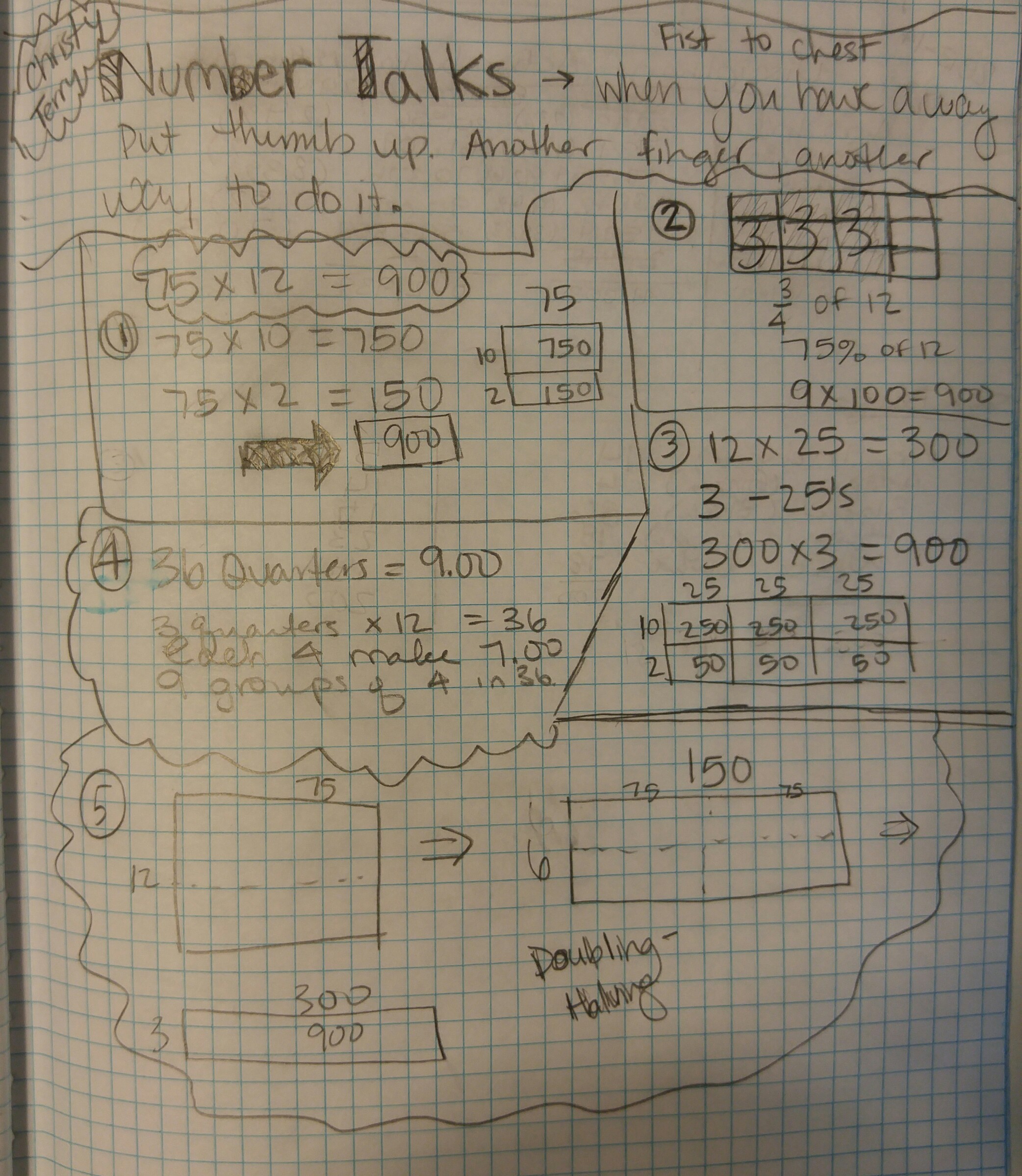
I attended Christy Pettis and Terry Wyberg’s session on Number Talks at the state math teacher conference last May and learned a lot, so you didn’t have to twist my arm to get me to listen to them again.  A quick survey of the room revealed that the group ran the gamut of novice to expert when it came to experience with this transformative classroom routine.  I’ve used these in my classroom regularly and was still able to gain many useful strategies to make this process even better.  I loved how Christy was able to turn the strategies into area models so that students make that connection.  That was something I had not thought of but will definitely be implementing starting Monday.    Again, it’s worth repeating:  We are better together.   Here are my notes:

wpid-1016151642-1.jpg

Next up:  Desmos.  The program speaks for itself but it was lovely to have someone on their payroll available to demonstrate its flexibility.  Thanks, Christopher.  Who knew projector mode was so amazing! And I never knew how to create a dragable point.  Child’s play, I know, but new to me.

1016151421

Right before lunch, I joined Seth Leavitt for a conversation on race in math and science.  An overarching theme was that students of color are over-represented in remedial math classes.  Seth encouraged a continued conversation with leaders from our school districts on equity and access in mathematics and science.  I’m committed to this ongoing discussion in St. Francis and to ensuring our students of color have opportunities to take high level mathematics.

Thanks, Casey Rutherford, for organizing this again this year and allowing us to get together and get better.  Teaching is hard, but we are better together.


Conceptual Function Foundation

I’ve taught College Algebra for a number of years.  This course and College Trigonometry replace Pre-Calculus at our school.  I’ve struggled with helping kids with functions because of the variety of background knowledge they have on the topic.  I have tons of good activities, but never one that really built a conceptual foundation of the important features of functions in general.  It’s not that it’s impossible to create a conceptual foundation after procedures have been introduced.  It’s just really difficult to do.  (Remember this post from Christopher Danielson?)Enter New Visions for Public Schools.  Unit One of their Algebra 2 course allows kids to make sense of families of functions in their own way.

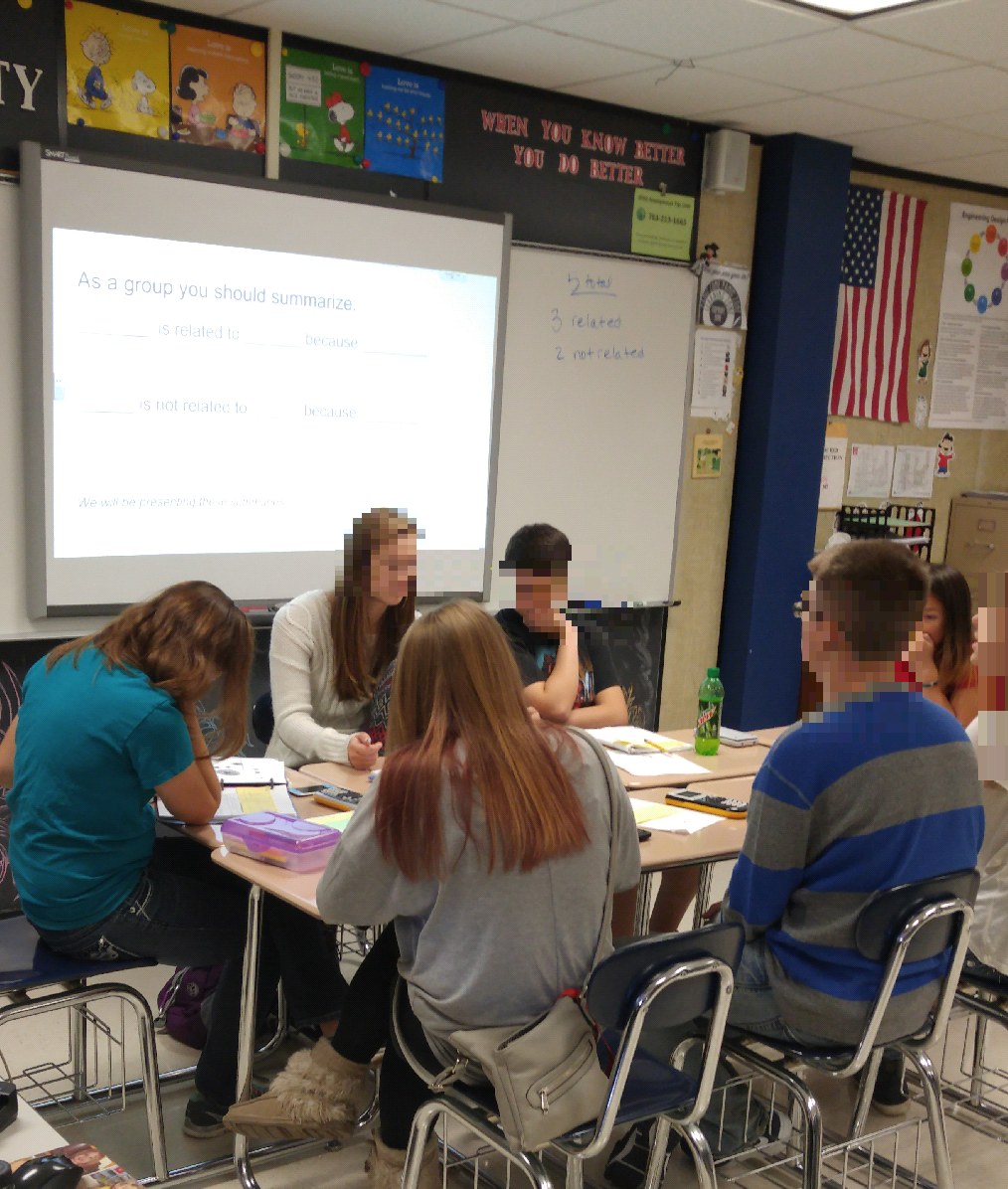
You can see the details yourself on the link, but in summary, kids sort graphs according to their own criteria and then build a definition of a key graph feature and re-sort accordingly.  Students then form new groups and share their key feature with their classmates.  Finally, the group as a whole creates statements that link the key features together.

Dan Meyer states that math is the process of confusing and unconfusing.  This progression does that perfectly.  Conceptual Understanding Achievement unlocked!

Highlights:

  • Students are asked to make sense of graphs based on their prior knowledge.
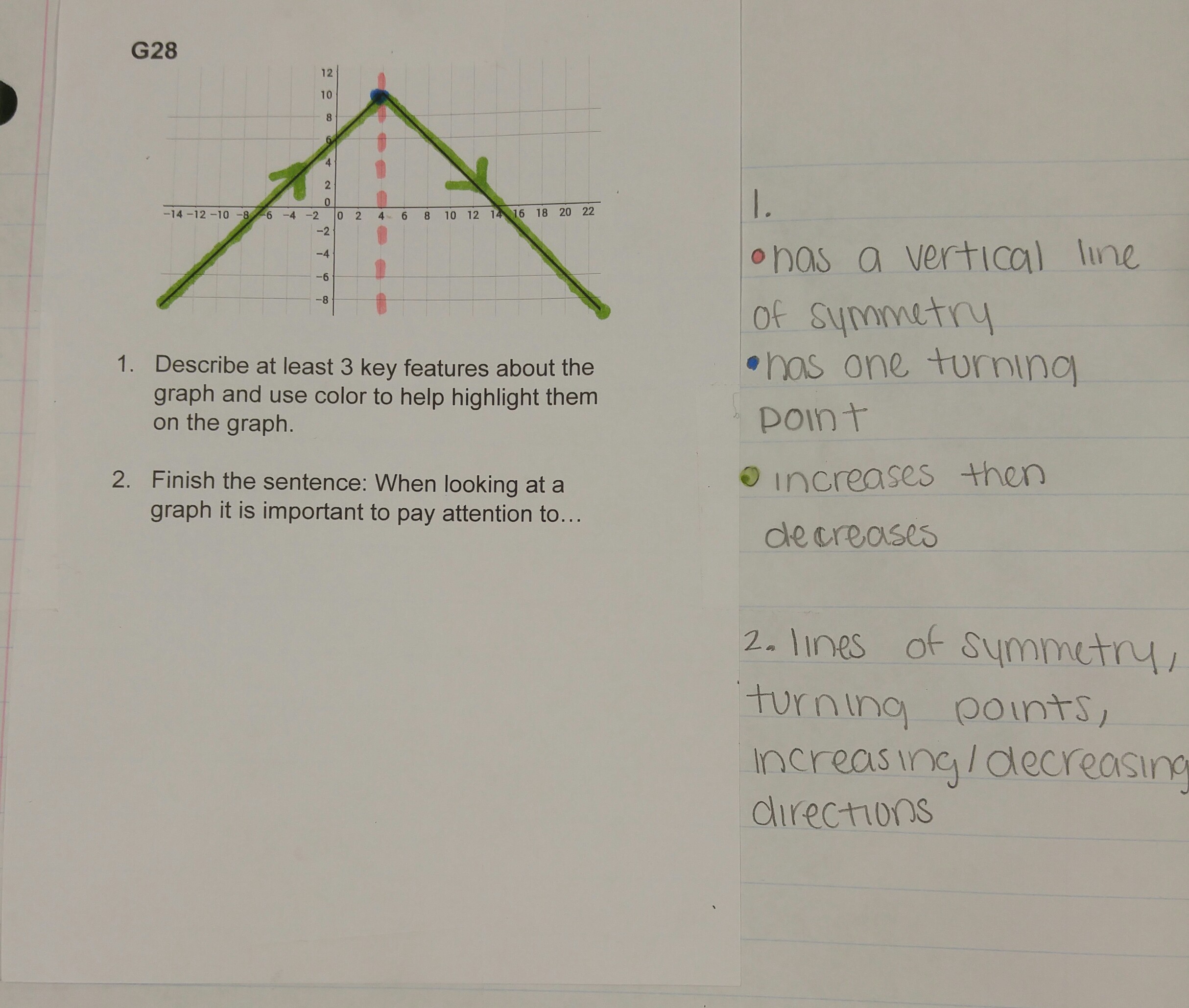
  • They develop a need for certain vocabulary such as “turning points” as they discuss key features of the graph. For example: https://twitter.com/Veganmathbeagle/status/651451109387730944
  • They need to take responsibility for their learning because they need to teach it to other students during the “jigsaw” portion.
  • They have to ask clarifying questions of each other rather than of the teacher creating student-centered discussion.

The real beauty was watching three days of making sense of graphs come together with the vocabulary.  The students are asked, with their groups, to find how the key features are related and how they are not related.   I wish I had an audio recording because it was some of the most beautiful student discussion I may have ever heard.  I captured this moment just so I could remember it:

Students discussing how function features are related and how they are not related.

Students discussing how function features are related and how they are not related.

Also, here is one of the reference graphs a student made:

wpid-1007151235-1.jpg