Surgery for Function Operations

My college algebra course boasts one of the driest textbooks on the planet. It’s one of those versions that has exercises from 1 to 99 for each section…brutal.   Can you relate?
The topics for college algebra are very standard and cover little more than what students should have encountered recently in their algebra 2 course. I therefore decided that this class would lend itself quite nicely testing out the theory that a high-level, rich question questioning can be facilitated from a traditional, drill-and-kill style textbook.

Previously, I recall that Operations on Functions was a particularly awful topic for both me and my students.  The textbook presents this concept in exactly the way you might think:

f(x) = [expression involving x]  and g(x) = [similar expression involving x]

Find f(x) + g(x), f(x) – g(x), f(g(x), f(x) *g(x), f(x)/g(x)…f(snoozefest)…you get the point.  It’s boring, they’ve done it before, and there’s not much high-level thinking involved.

Fortunately, it’s fixable by asking new questions from the same problems.  For example, have students choose a pair of functions from the book.  We have 99 choices after all!  For example, something quadratic and something linear,  like f(x) = x^2 + 1 and g(x) = 2x+4.

Here come the questions:

  • Which of these function operations are commutative and which are not?  How do you know this?
  • Does this work for all functions, or just the ones that you chose?
  • For what values of x are the non-commutative function operations equal?
  • What do you notice about those values of x for the different operations?
  • Can you prove any of your results?
  • How do the graphs of these new functions compare to the original graphs?

Compositions of functions are the most fun!  Here come some more:

  • For which values of x is f(g(x)) > g(f(x)) for your specific functions?
  •  Do your results hold true if both functions are quadratic?
  • Both linear?
  • How are the graphs of f(g(x)) and g(f(x)) related to both f(x) and g(x)?
  • Don’t forget about f(f(x)) or g(g(x))! How do those relate to our original functions?
  • What about g(g(g(x))) and g(g(g(g(x))))?
  • What do you notice happening each time we compose the function with itself again?
  • Can you generalize your conclusions based on the number of compositions and tell me what g(g(g…g(x)…)) would look like?
  • What do you notice about each of these compositions?
  • What do you notice about their graphs?

A personal favorite of mine is:  If 4x^2 + 16x + 17  =  f(g(x)), what could f(x) and g(x) have been?  This works really well with whiteboards and partners.

I might have students throw out any questions that they find interesting.  In fact, I’ll bet we can come up with at least 99 questions more intriguing than the ones given in the textbook.  Then let them choose which one(s) pique their curiosity.   Now hopefully we’ve taken the time that they would have spend doing 1-99 from a book and turned it into time better spent.



She Defines Resilience – One Year Later

We are defined not only by what we do, day to day, but also by how we react and utilize our seemingly random hand of cards in life.  I’ve found over 33 years of life, the mark of character that differentiates those who excel and succeed from those who do not is resilience.  I can point to former students as examples:  The college graduate who grew up with an absent mother and a drug addicted father? Resilience.  The home-care nurse whose parents didn’t value an education past high school?  Resilience.  The successful plumber whose best friend committed suicide his sophomore year of high school?  Resilience.

It seems fitting to give a Webster’s definition of resilience here, however, I think that we all can picture individuals who personify our meaning of the word.   For me, above all, those people are my brother, Matthew, and my sister-in-law Danielle.   This story isn’t about me, or my reaction to this event.  It’s about them and what they have taught the world about resilience and the power of hope.  I hope my intentions come across as I recap their story.

One year ago, January 30th, 2013, Danielle, while finishing up a nursing clinical suffered a massive hemorrhage resulting from a burst aneurysm on the right side of her brain.  She was rushed to the local hospital where she was taken into surgery and given a very bleak prognosis.  The sobbing ER doctor explained to my brother that his wife was probably going to die.  My younger brother, who I’d always joked as being “30 going on 19” now was faced with an incomprehensible, life-altering situation.  He captures his emotion poignantly on a Caring Bridge post about the account of the moment when he told that doctor, as well as the hospital chaplain to F-ing get his wife to Iowa City!  I think those words have defined his attitude on the situation that it does not matter what has plagued us in the past.  He knew she had much more to give this world, so let’s get out of her way so she can fight to give it.

Reflecting during anniversaries of events seems to be a cultural norm and a time to remind ourselves of where we came from and how much further we have to go. A year ago today, we watched in udder horror and shock as Danielle lay motionless, lifeless, with small tubes ushering blood from her brain.  Furthermore, we observed silently as every half an hour, a nurse would shine a light in her eyes and ask for a reaction that never came.  “No change,” became the most chilling words I’ve ever heard.  I didn’t say it at the time, but I went to bed that night believing our precious Danielle was most likely gone.

The next day brought new light, and a miracle.  The overnight nurse said she had never seen anything like it.  When prompted to wiggle her toes, Danielle obliged.  “Thumbs up if you hear me, Danielle?”  And it was the most beautiful thumb I’ve ever seen.  She began her recovery that day and has not stopped since.  In one year, Danielle has gone from “probably going to die” to thriving and living.  Her personality, again, lights up the room as it always had.  She walks with less and less assistance each day and remains poised and confident that she will walk in the Bix 7 this summer.  Every day my brother is there by her side, emotionally and physically.  From the hospital ICU to a rehabilitation center in Ankeny, Iowa.  And now back home, where he’d turn their house upside down if he had to in order to ensure her comfort.

One of Danielle’s doctors said, “When you’ve seen one brain injury, you’ve seen…one brain injury.”  I believe these words are not necessarily a testament to the brain alone but the person in control of it.  Danielle proved that her fate was not finalized and her husband stood by her side believing the same.  These two incredible people inspire me every day to be a better person and to remember that all people fight a battle, in their bodies and their minds.  And I am so thankful for their presence in my life, and the opportunity to learn from them.

Danielle with my daughter, Maria this Christmas.

Danielle with my daughter, Maria this Christmas.

Pattern Power

If you have little kids and you’ve been privy to an episode of Team Umizoomi, then perhaps the title of this post evoked a little jingle in your head. You’re welcome; I’m here all day.

My daughter, although she doesn’t choose Umizoomi over Mickey Mouse as often as I’d like, picked up on patterns relatively quickly after watching this show a couple of times.  She’s 3 years old, and she finds patterns all over the place.  Mostly color and shape patterns, but a string of alternating letters can usually get her attention as well.  These observations of hers made me realize that pattern seeking is something that is innate and our built-in desire for order seeks it out.

High school students search patterns out as well.  For example, I put the numbers 4, 4, 5, 5, 5, 6, 4 so that the custodian knew how many desks should be in each row after it was swept.  It drove students absolutely CRAZY trying to figure out what these numbers meant.  I almost didn’t want to tell them what it really was as I knew they’d be disappointed that it lacked any real mathematical structure.

I’m not as familiar with the elementary and middle school math standards as perhaps I should be, but I’m confident that patterns are almost completely absent from most high school curriculum.  Why are most high school math classes completely devoid of something that is so natural for us?

Dan Meyer tossed out some quotes from David Pimm’s Speaking Mathematically for us to ponder.  This one in particular sheds light on this absence of pattern working in high school mathematics:

Premature symbolization is a common feature of mathematics in schools, and has as much to do with questions of status as with those of need or advantage. (pg. 128)

In other words, we jump to an abstract version of mathematical ideas and see patterns as lacking the “sophistication” that higher-level math is known for.  To be completely honest, this mathematical snobbery is one of the reasons I discounted Visual Patterns at first.  Maybe it was Fawn Nguyen’s charisma that drew me back there, but those patterns have allowed for some pretty powerful interactions in my classroom.   I’ve used them in every class I teach, from remedial mathematics up to college algebra because they are so easy to  differentiate.

I think high school kids can gain a more conceptual understanding of algebraic functions with the use of patterns.  For example, this Nrich task asks students to maximize the area of a pen with a given perimeter.   The students were able to use their pattern-seeking skills to generalize the area of the pen much  more easily than if they had jumped right from the problem context to the abstract formula.  

I also notice that the great high school math textbooks include patterns as a foundation for their algebra curriculum.  For example, Discovering Advanced Algebra begins with recursively defined sequences.  IMP also starts with a unit titled Patterns.   I think these programs highlight what a lot of traditional math curriculums too quickly dismiss:  patterns need to be not only elementary noticings of young math learners but  also valued as an integral part of a rich high school classroom.

Engaging with Engagement

High school students are inherently unpredictable. I’ve been told it’s the condition of their pre-frontal cortex and they can’t help it. I’m sometimes baffled and confused by what intrigues and engages them. If you’ve seen their obsessions with Snapchat, you know what I mean.
Something that always gets teenagers riled up, however, is a statement that challenges their peer group. In fact, I found today, that they’ll engage at a much higher level when presented with data that questions their level of engagement.

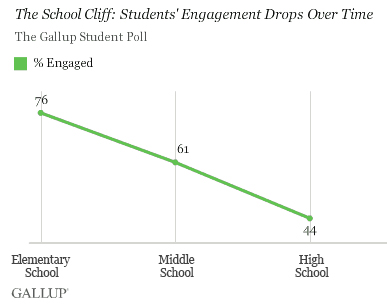
After a little guessing and estimating, I revealed this graph resulting from a recent Gallup poll on student engagement during my 9th grade statistics class today:

Gallup Graph

The kids were fired up right away.  Even if students agreed with the representation, it seemed as though every kid wanted to share his or her interpretation of how student engagement changes over time.  They shared their experiences from their formative years of education and respectfully expressed their frustrations for how much more difficult school gets each year.  Surprisingly, the students seemed to place blame for the overall decline in curriculum immersion on themselves.

Until one boy opened up the floodgates with the proclamation, “In elementary school we get to learn by messing around with stuff.  In high school, all we ever do is listen to the teacher talk and do boring worksheets.”  Expecting me to dismiss this kid’s comment for daring to suggest that the burden of student engagement also lies on the teacher, the class was relieved when I asked this student to expand on his thoughts. Almost simultaneously, multiple hands shot up in the air agreeing with this sad truth many of them were thinking and this young man had the courage to say out loud.  A rich, important, respectful discussion ensued about the difference between being busy in class copying, listening, and doing and being engrossed in activities that facilitate learning.

We continued the conversation by critiquing the methodology used to collect the data for this poll and the misleading representation in the graph.  Sorry, Gallup, my 9th graders spotted the flaw in the using in a self-selected study to represent all students right away.  They also debated the validity of broad categories such as “Elementary School” represented only by 5th graders rather than K – 5.

We discovered that the actual Gallup Student Poll is available online.  The students agreed that Friday was probably not a good day to do a survey about school engagement, but we’re really looking forward to collect and analyze the data on their classmates.

Puzzling Perseverance

School mathematics has a bad reputation for being intellectually unattainable and mind-numbingly boring for many students.  Proclaiming the falsity of these beliefs is usually not enough to convince kids (or people in general) of their untruth.  Students need to experience their own success in mathematics and be given the opportunity to engage in curiosity-sparking mathematics.  For me, one of the very best moments in a classroom is when a self-proclaimed math hater fully engages in a challenge and is motivated to work hard to arrive at a solution.

Enter January 2nd and 3rd.  Students are back for a two-day week which they view as punishment and a rude-awakening from a restful winter break.  To boot, the Governor Dayton announced today at about 11 am that all Minnesota schools will close Monday, January 6th due to impending dangerously cold weather.  You can imagine where the motivation level was in school today.

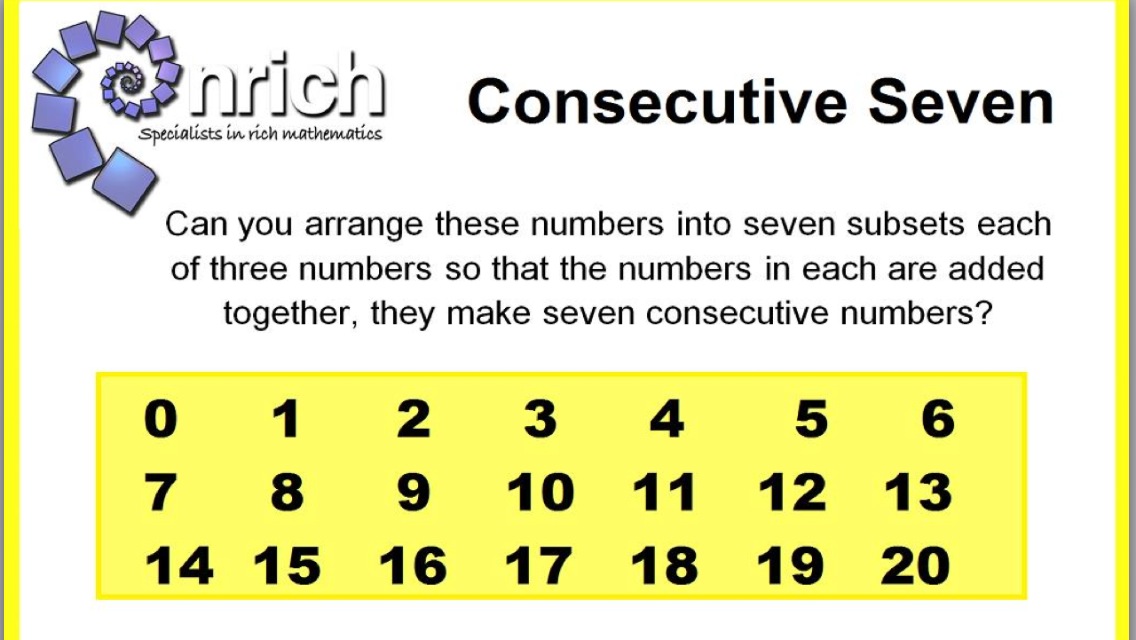
As the CEO of room 114, I decided to make an executive decision and do a puzzle from Nrich (shocking, I know) in my probability and statistics class.  Technically, the students could use the mean or median to help solve the problem, so I wasn’t veering too far off of what I had previously planned.

The Consecutive Seven puzzle starts like this:

IMG_2684 

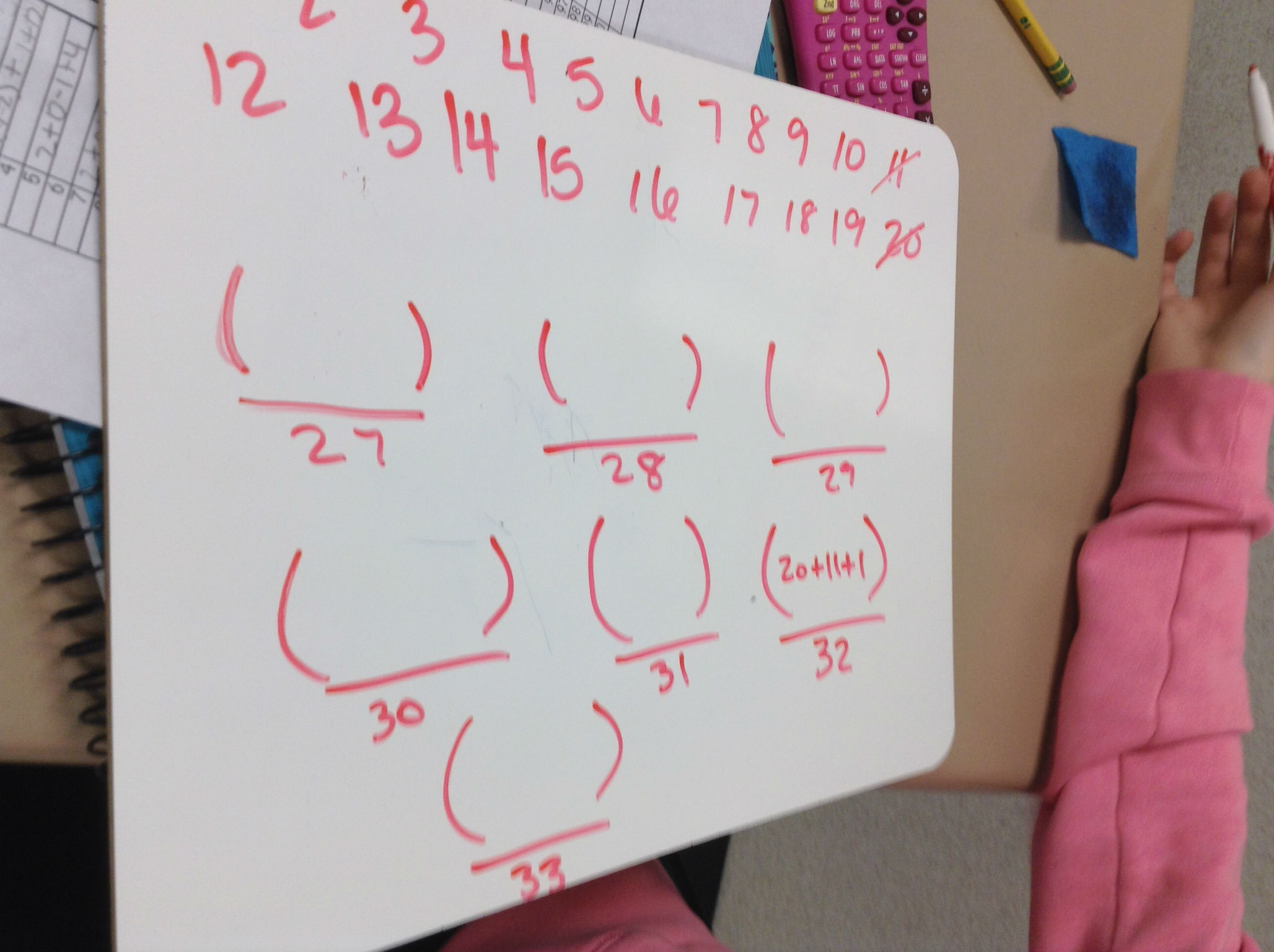
Initially, one student began by explaining to me that she took one number from the beginning of the set, one from the middle and one from the end.  Then she figured the other consecutive sums needed to be above and below that number.  (Spoiler alert:  These numbers actually end up being the seven consecutive sums, so I was very interested in her explanation of how she arrived at those particular answers.  )

IMG_2668

It’s worth noting that this student’s first words to me at the beginning of the trimester term were, “I hate math and I hate sitting in the front.”  So you can imagine my excitement when she dove in head first into this particular task, happily and correctly.

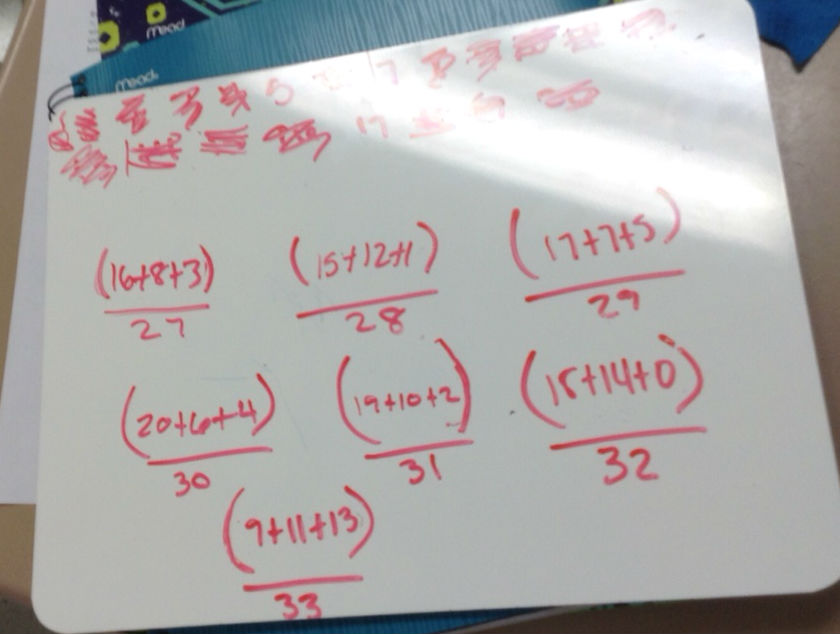
Adding to my excitement about the class’s progress, another girl (who was equally enthusiastic about math at the beginning of the term) was the first one to arrive at a correct solution.  And although she probably wouldn’t admit it, she was thrilled when I took a picture of her work.  And I am more than thrilled to display it here:

photo 2

If you were wondering about how math-love girl #1 fared in completing the task, she persevered and impressed her skeptical cohorts:

photo 1

This phenomenon fascinates and excites me that students, when confronted with a puzzle, highly engaged and motivated throughout the lesson.  Dan Meyer summarized this idea nicely on his blog recently:

“The “real world” isn’t a guarantee of student engagement. Place your bet, instead, on cultivating a student’s capacity to puzzle and unpuzzle herself. Whether she ends up a poet or a software engineer (and who knows, really) she’ll be well-served by that capacity as an adult and engaged in its pursuit as a child.”

And who knows.  Maybe one of the girls featured above will become a puzzling poet.

A Visual Comeback

Please excuse me while I geek out for a few minutes about Visual Patterns.  My love affair with this versatile website has made the transition from autumn to winter as I engage in select patterns with my Algebra classes.  I didn’t start using these until a unit on quadratics last trimester, so I was very pleased that a linear pattern could create just as much conversation and mathematical excitement.

For example, this is a replica of pattern #114 that we looked at in class today:

Lego 114

The equation y = 3x + 4 was not terribly difficult for these kids to decipher. But the fun began, as usual, when I asked them to relate their equation back to the figure.  Here are some of their findings:

1.  Students used the idea of slope and recognized that the slope is the change in the number of squares divided by the change in the step.  The y-intercept is the value when the “zero” step is determined.

2.  There are always 4 squares in the corner and each “branch” off of that square has a length of x.

3.  SImilarly, there is one square in the corner and each branch from that one square has a length of x+1

4.  There are always x “sets” of three squares, and four squares left over.

5.  The arithmetic sequence formula works nicely here, common difference of 3 and first term of 7.

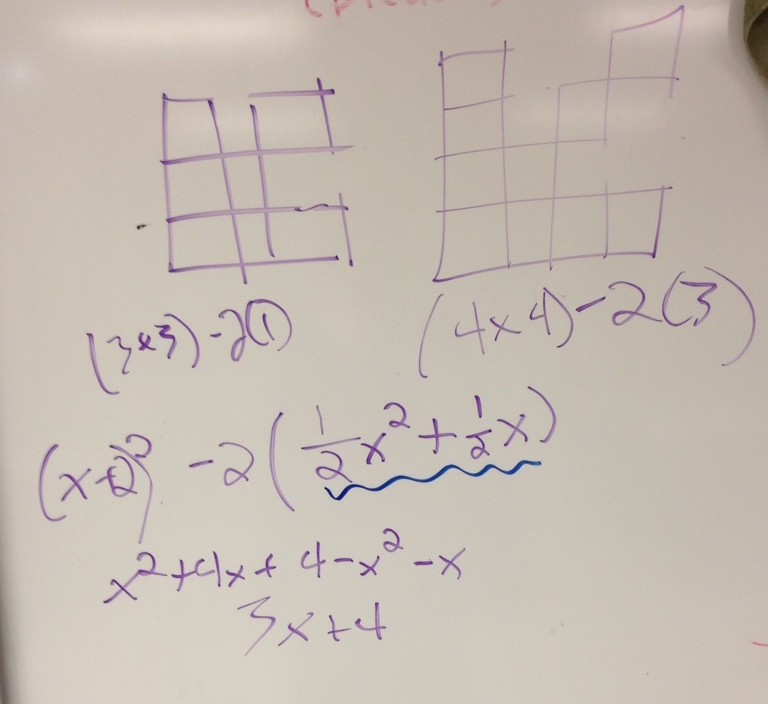
The final observation deserves its own paragraph, as I was completely blown away by the thought process.  The student noticed that if we made each step in the pattern a square, then the formula would be (x+2)^2.  He then noticed that the portions that were missing were two sections, each consisting of a triangular number.  Recalling the formula we worked out last week (by accident) for the triangular numbers, (.5x^2 + .5x) he took (x+2)^2 -2(.5x^2+.5x) and simplified it.  The result is, you guessed it, 3x + 4.  Below is a photo of this amazing insight:

Pattern 114 Triangle

What I like most about these visual patterns this time around is that it helps the kids get comfortable having a mathematical conversation.  Students build on each other’s thinking and discover new insights by listening to their classmates.  This was difficult to do last trimester with a similar group of kids.  I think that by starting with a linear patterns, rather than quadratic, the students have acclimated themselves to different ways of approaching the patterns.

Curiosity Driven Mathematics

In my very first years of teaching, I used to have students ask me, in that age-old, cliche teenage fashion, “When are we ever going to use this?”  I vividly remember my response being, “Maybe never.  But there are plenty of other things we do in life, like play video games, that have no real-world application. That doesn’t seem to bother us too much.”

In fact, if every moment of our lives needed to apply to the bigger picture, the REAL-world, when would we do anything for pure enjoyment? or challenge?  or even spite?  I know kids are capable of this because some of them spend hours upon hours a day engaging not only with a video game but also collaborating with other people through their game system.

And furthermore, where do we think this resentment for learning math really comes from?  I have a guess…probably adults who have realized that through the course of their lives, being able to solve a polynomial equation algebraically is not all that useful! News flash, math teachers:  Our secret is out! 

There are many kids across all levels of achievement that will not engage in the learning process simply because the state mandates it or the teacher swears by its real-world relevance.  Students (and arguably people in general) are motivated by immediate consequences and results and cannot easily connect that the algebra they are learning today will be the key to success in the future.  They do not care that if they don’t nail down lines, they’ll never have a prayer understanding quadratics.  If they are bored to death by linear functions, I can’t imagine that they have even an inkling of desire to comprehend the inner workings of a parabola.  

What does resonate with learners is the satisfaction of completing a difficult task, puzzling through a complicated scenario, or engaging in something for pure enjoyment.  Kids are naturally problem-solving balls of curiosity.   There are ways to provoke curiosity and interest while simultaneously engaging in rich mathematics.  I think many teachers assume that in mathematics, especially Algebra, curiosity and deep understanding need to be mutually exclusive, and I’m positive that mindset is dead wrong.  For example, show this card trick to any group of kids, and you’d be hard-pressed to find a group who isn’t trying to figure out how it works.  I also think you’d be hard-pressed to find the real-world relevance to a card trick.  It’s still no less amazing, as well as algebraic.  


A Top Down Approach?

A new trimester is upon us in St. Francis, MN which means a new group of advanced algebra students as well as two classes full of squirrely 9th graders.  I’m amazed that these sets of students can have things in common and a lesson for one class can serve as a bell-ringer for another.  I have said in the past that my favorite activities are the ones that can be used across multiple ability levels and this task is no exception.

This week, in advanced algebra, we’ve been working on problems that allow the students to connect specific patterns and examples to general formulae.  I feel that this trimester, I have done a much better job of sequencing the class problems in a way that has help build student confidence in the problem solving process.  As I’ve done in the past, I chose some nrich problems that have a low barrier to entry and a high ceiling.  These problems feel like number play:  Pair ProductsAlways a Multiple, Think of Two Numbers, and Calendar Capers.  Although I’ve had the occasional moan from students who prefer their math to be in lecture/practice format, I’ve seen much more willingness to engage in the problem-solving process this time around.

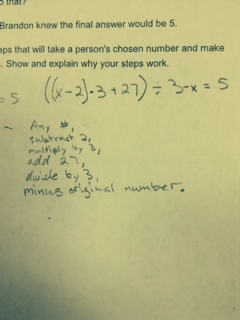
One particularly memorable day, we used a Math Forum problem called Baffling Brother in which a brother is attempting to amaze his younger sister by having her choose a number, perform some operations on the number and then telling her the result.  I’m disappointed that I didn’t think at the time to have the students act out this scenario.  That could have been spectacular!

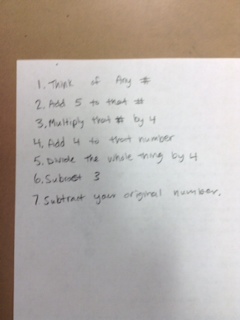
These being upper level students, I always encourage them to attempt the “extra” for these problems.  On this task, they needed to come up with a number puzzle of their own that resulted in an answer of 7 each time.  I told them that I would be giving these number puzzles to my 9th grade classes to amaze.

Here are some examples:

image (1) image

What happened next I could not have predicted and was not an iota shy of completely awesome!  I presented one of these number puzzles to my 9th grade class and stood in the back of the room as I read the steps to them.  When they arrived at their final answers, I had them compare with one another.  I wish I had a camera on the room to capture the amazed look on their faces when they realized they all got an answer of 7.  Icing on the cake:  the advanced algebra students were very satisfied that they were able to amaze 9th graders with problems that they created.  I’ll call that one a win for engaging kids in “boring” old, non-applicable, relevant Algebra.

Motivating with a Math Story

I’ve observed over my career that as a high school teacher, 9th graders are amongst the most challenging yet most rewarding groups of students.  Challenging in the sense that they never stop talking or moving, but rewarding nonetheless because of their naivety and innocence. This combination makes engagement and relevance easier to create day to day.  

For example, today in my 9th grade probability and statistics class, I adapted an IMP activity involving sample size and the ratio of mixed nuts.  I literally had these 9th graders believing that I counted all of the nuts in a container of mixed nuts and compared it to a fictitious “nut ratio” from Planters’ website. It’s worth noting that my intention was to tell a story about mixed nuts, but they seemed to believe that this must be true, so I just played along. They think I’m a little crazy for counting the number of nuts in a can, but they were bound to reach that conclusion at some point, nuts or no nuts.  This little “fib” served me very well today as the students now wanted to figure out if I was short-changed on the number of cashews in my can of mixed nuts and whether I had enough evidence here to sue Planter’s Peanuts.  I don’t plan on making up stories of this nature all trimester, but the fact that changing the character in the problem from Mr. Swenson to Mrs. Schmidt played out in my favor was satisfying.

I felt a little guilty having mislead them, however, so I scoured the internet for anything relating to Planters nut ratio.  I found this interesting post about a similar (albeit smaller) bag of mixed nuts. The entire blog was actually pretty intriguing as its entire purpose is to critique gas station food fare.  I’ll probably show this to my students tomorrow just to see where their brains go with it.  

Pushy vs. Persistent

“Sharing is caring” does have a nice rhymey ring to it. Although lately, I’ve felt a little bit like my version comes off as ‘sharing is pushing and over-feeding’.  I’ve had teachers in my department inquire about problem solving and desire to get kids to invest and engage.  I like sharing what I’ve discovered and what I have found that works, but sometimes I get so excited about sharing resources that I end up like Tommy Boy and his pretty new pet.  I sometimes fail to realize that trying new approaches can be uncomfortable, unpredictable and downright scary and not all teachers want to dive into the change head first as I did.

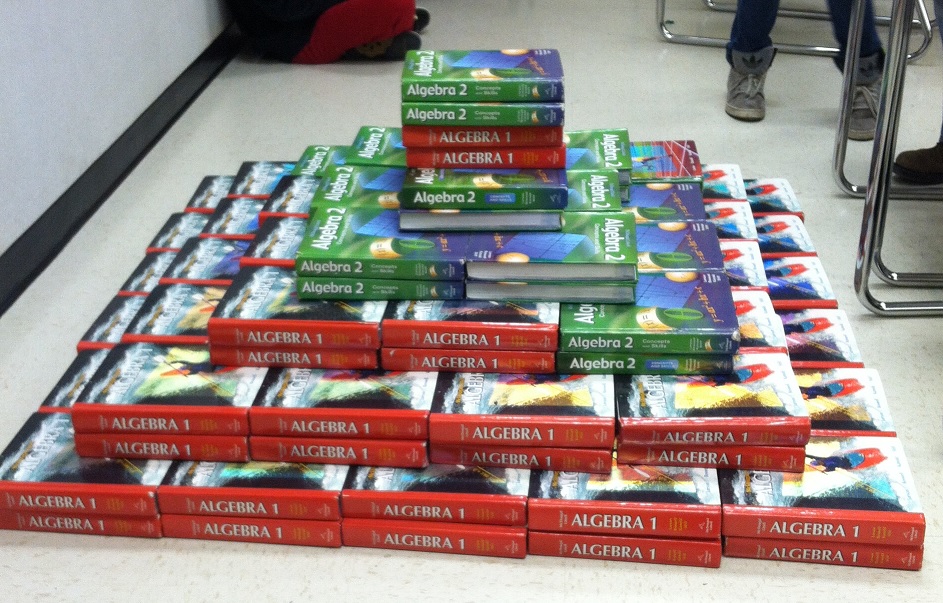
Here’s a great example: we had final exams in 2-hour blocks right before Thanksgiving break.  To say that the kids get “restless” by the middle of the second day is sugar-coating it.  A new teacher in our department, (let’s call her Sheryl) sent this picture with the caption, “My algebra kids were bored after their final and built this with their textbooks.” booktower

Of course, my brain couldn’t just let that one go and say, “Nice book tower, Sheryl.” Dan Meyer calls this perplexity and modeling this behavior is a key to getting students curious. Instead, my eyes lit up and I thought, “what a great math problem!”  As we looked at this photo, I said, “what do you think kids will notice and wonder about this photo? Do you think you could get them to come up with how many books are in the 10th row or the nth row?”  Of course the question that’s raised, legitimately, is “what do you do when students say ‘there are green books and red books’ or ‘some are faced forward and some are faced backward’?”  This is the part that I believe is scary for a lot of teachers is relinquishing control of the immediate direction of the lesson and not being so certain about how students will respond.  At least when we give them a quadratic to factor, we have a pretty good idea of the limited number of directions they can move to arrive at a singular correct answer.

But what I believe is imperative here is validating and acknowledging those seemingly math-less observations and creating a math opportunity with it.  With the instance of “some are red and some are green,” we can now extend that declaration of color to ideas like percentages, ratios, and so forth.  But by first validating this red/green response, we’ve invited this student to the conversation and made them part of the creation of the problem we are about to solve.  Now they are empowered by the process and more motivated to step in to the problem-solving ring.  Whereas before, this same student might have disengaged completely.

A recent example of this from my own classroom:  We were beginning Dan Meyer’s 3-act task using the Penny Pyramid.  When collecting wonderings, one student asked how many 1996 pennies were in the pyramid. He was born in 1996, and was probably just fascinated by that year, but I didn’t want to dismiss that from the discussion.  I have a bucket of pennies in my room that I use occasionally for probability experiments, and I hoped that this kid could draw from his knowledge about samples to make a reasonable estimation of how many 1996 pennies were in that pyramid.  As it turns out, that students off-hand question turned into a great math discussion about random sampling.

But back to this book tower:  After I’m sure that I’ve thoroughly freaked out this new teacher with my enthusiasm over a book tower, something awesome happens.  This new teacher, races into my room after 1st period on Monday and says, “I did it!  I did the book tower, and it was AWESOME!”  I’ve had some great moments with other teachers, but that one is going to rank pretty high on my list for a long time. At lunch, she was STILL raving about it. She even said that the students were so engaged, that they ran out of time talking about it during class. Maybe there’s hope for Tommy Boy after all.