She Defines Resilience – One Year Later

We are defined not only by what we do, day to day, but also by how we react and utilize our seemingly random hand of cards in life.  I’ve found over 33 years of life, the mark of character that differentiates those who excel and succeed from those who do not is resilience.  I can point to former students as examples:  The college graduate who grew up with an absent mother and a drug addicted father? Resilience.  The home-care nurse whose parents didn’t value an education past high school?  Resilience.  The successful plumber whose best friend committed suicide his sophomore year of high school?  Resilience.

It seems fitting to give a Webster’s definition of resilience here, however, I think that we all can picture individuals who personify our meaning of the word.   For me, above all, those people are my brother, Matthew, and my sister-in-law Danielle.   This story isn’t about me, or my reaction to this event.  It’s about them and what they have taught the world about resilience and the power of hope.  I hope my intentions come across as I recap their story.

One year ago, January 30th, 2013, Danielle, while finishing up a nursing clinical suffered a massive hemorrhage resulting from a burst aneurysm on the right side of her brain.  She was rushed to the local hospital where she was taken into surgery and given a very bleak prognosis.  The sobbing ER doctor explained to my brother that his wife was probably going to die.  My younger brother, who I’d always joked as being “30 going on 19” now was faced with an incomprehensible, life-altering situation.  He captures his emotion poignantly on a Caring Bridge post about the account of the moment when he told that doctor, as well as the hospital chaplain to F-ing get his wife to Iowa City!  I think those words have defined his attitude on the situation that it does not matter what has plagued us in the past.  He knew she had much more to give this world, so let’s get out of her way so she can fight to give it.

Reflecting during anniversaries of events seems to be a cultural norm and a time to remind ourselves of where we came from and how much further we have to go. A year ago today, we watched in udder horror and shock as Danielle lay motionless, lifeless, with small tubes ushering blood from her brain.  Furthermore, we observed silently as every half an hour, a nurse would shine a light in her eyes and ask for a reaction that never came.  “No change,” became the most chilling words I’ve ever heard.  I didn’t say it at the time, but I went to bed that night believing our precious Danielle was most likely gone.

The next day brought new light, and a miracle.  The overnight nurse said she had never seen anything like it.  When prompted to wiggle her toes, Danielle obliged.  “Thumbs up if you hear me, Danielle?”  And it was the most beautiful thumb I’ve ever seen.  She began her recovery that day and has not stopped since.  In one year, Danielle has gone from “probably going to die” to thriving and living.  Her personality, again, lights up the room as it always had.  She walks with less and less assistance each day and remains poised and confident that she will walk in the Bix 7 this summer.  Every day my brother is there by her side, emotionally and physically.  From the hospital ICU to a rehabilitation center in Ankeny, Iowa.  And now back home, where he’d turn their house upside down if he had to in order to ensure her comfort.

One of Danielle’s doctors said, “When you’ve seen one brain injury, you’ve seen…one brain injury.”  I believe these words are not necessarily a testament to the brain alone but the person in control of it.  Danielle proved that her fate was not finalized and her husband stood by her side believing the same.  These two incredible people inspire me every day to be a better person and to remember that all people fight a battle, in their bodies and their minds.  And I am so thankful for their presence in my life, and the opportunity to learn from them.

Danielle with my daughter, Maria this Christmas.
Danielle with my daughter, Maria this Christmas.

Pattern Power

If you have little kids and you’ve been privy to an episode of Team Umizoomi, then perhaps the title of this post evoked a little jingle in your head. You’re welcome; I’m here all day.

My daughter, although she doesn’t choose Umizoomi over Mickey Mouse as often as I’d like, picked up on patterns relatively quickly after watching this show a couple of times.  She’s 3 years old, and she finds patterns all over the place.  Mostly color and shape patterns, but a string of alternating letters can usually get her attention as well.  These observations of hers made me realize that pattern seeking is something that is innate and our built-in desire for order seeks it out.

High school students search patterns out as well.  For example, I put the numbers 4, 4, 5, 5, 5, 6, 4 so that the custodian knew how many desks should be in each row after it was swept.  It drove students absolutely CRAZY trying to figure out what these numbers meant.  I almost didn’t want to tell them what it really was as I knew they’d be disappointed that it lacked any real mathematical structure.

I’m not as familiar with the elementary and middle school math standards as perhaps I should be, but I’m confident that patterns are almost completely absent from most high school curriculum.  Why are most high school math classes completely devoid of something that is so natural for us?

Dan Meyer tossed out some quotes from David Pimm’s Speaking Mathematically for us to ponder.  This one in particular sheds light on this absence of pattern working in high school mathematics:

Premature symbolization is a common feature of mathematics in schools, and has as much to do with questions of status as with those of need or advantage. (pg. 128)

In other words, we jump to an abstract version of mathematical ideas and see patterns as lacking the “sophistication” that higher-level math is known for.  To be completely honest, this mathematical snobbery is one of the reasons I discounted Visual Patterns at first.  Maybe it was Fawn Nguyen’s charisma that drew me back there, but those patterns have allowed for some pretty powerful interactions in my classroom.   I’ve used them in every class I teach, from remedial mathematics up to college algebra because they are so easy to  differentiate.

I think high school kids can gain a more conceptual understanding of algebraic functions with the use of patterns.  For example, this Nrich task asks students to maximize the area of a pen with a given perimeter.   The students were able to use their pattern-seeking skills to generalize the area of the pen much  more easily than if they had jumped right from the problem context to the abstract formula.  

I also notice that the great high school math textbooks include patterns as a foundation for their algebra curriculum.  For example, Discovering Advanced Algebra begins with recursively defined sequences.  IMP also starts with a unit titled Patterns.   I think these programs highlight what a lot of traditional math curriculums too quickly dismiss:  patterns need to be not only elementary noticings of young math learners but  also valued as an integral part of a rich high school classroom.

Engaging with Engagement

High school students are inherently unpredictable. I’ve been told it’s the condition of their pre-frontal cortex and they can’t help it. I’m sometimes baffled and confused by what intrigues and engages them. If you’ve seen their obsessions with Snapchat, you know what I mean.
Something that always gets teenagers riled up, however, is a statement that challenges their peer group. In fact, I found today, that they’ll engage at a much higher level when presented with data that questions their level of engagement.

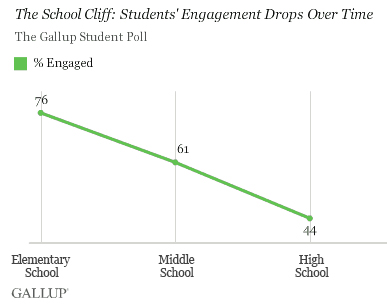
After a little guessing and estimating, I revealed this graph resulting from a recent Gallup poll on student engagement during my 9th grade statistics class today:

Gallup Graph

The kids were fired up right away.  Even if students agreed with the representation, it seemed as though every kid wanted to share his or her interpretation of how student engagement changes over time.  They shared their experiences from their formative years of education and respectfully expressed their frustrations for how much more difficult school gets each year.  Surprisingly, the students seemed to place blame for the overall decline in curriculum immersion on themselves.

Until one boy opened up the floodgates with the proclamation, “In elementary school we get to learn by messing around with stuff.  In high school, all we ever do is listen to the teacher talk and do boring worksheets.”  Expecting me to dismiss this kid’s comment for daring to suggest that the burden of student engagement also lies on the teacher, the class was relieved when I asked this student to expand on his thoughts. Almost simultaneously, multiple hands shot up in the air agreeing with this sad truth many of them were thinking and this young man had the courage to say out loud.  A rich, important, respectful discussion ensued about the difference between being busy in class copying, listening, and doing and being engrossed in activities that facilitate learning.

We continued the conversation by critiquing the methodology used to collect the data for this poll and the misleading representation in the graph.  Sorry, Gallup, my 9th graders spotted the flaw in the using in a self-selected study to represent all students right away.  They also debated the validity of broad categories such as “Elementary School” represented only by 5th graders rather than K – 5.

We discovered that the actual Gallup Student Poll is available online.  The students agreed that Friday was probably not a good day to do a survey about school engagement, but we’re really looking forward to collect and analyze the data on their classmates.

Curiosity Driven Mathematics

In my very first years of teaching, I used to have students ask me, in that age-old, cliche teenage fashion, “When are we ever going to use this?”  I vividly remember my response being, “Maybe never.  But there are plenty of other things we do in life, like play video games, that have no real-world application. That doesn’t seem to bother us too much.”

In fact, if every moment of our lives needed to apply to the bigger picture, the REAL-world, when would we do anything for pure enjoyment? or challenge?  or even spite?  I know kids are capable of this because some of them spend hours upon hours a day engaging not only with a video game but also collaborating with other people through their game system.

And furthermore, where do we think this resentment for learning math really comes from?  I have a guess…probably adults who have realized that through the course of their lives, being able to solve a polynomial equation algebraically is not all that useful! News flash, math teachers:  Our secret is out! 

There are many kids across all levels of achievement that will not engage in the learning process simply because the state mandates it or the teacher swears by its real-world relevance.  Students (and arguably people in general) are motivated by immediate consequences and results and cannot easily connect that the algebra they are learning today will be the key to success in the future.  They do not care that if they don’t nail down lines, they’ll never have a prayer understanding quadratics.  If they are bored to death by linear functions, I can’t imagine that they have even an inkling of desire to comprehend the inner workings of a parabola.  

What does resonate with learners is the satisfaction of completing a difficult task, puzzling through a complicated scenario, or engaging in something for pure enjoyment.  Kids are naturally problem-solving balls of curiosity.   There are ways to provoke curiosity and interest while simultaneously engaging in rich mathematics.  I think many teachers assume that in mathematics, especially Algebra, curiosity and deep understanding need to be mutually exclusive, and I’m positive that mindset is dead wrong.  For example, show this card trick to any group of kids, and you’d be hard-pressed to find a group who isn’t trying to figure out how it works.  I also think you’d be hard-pressed to find the real-world relevance to a card trick.  It’s still no less amazing, as well as algebraic.  


Pushy vs. Persistent

“Sharing is caring” does have a nice rhymey ring to it. Although lately, I’ve felt a little bit like my version comes off as ‘sharing is pushing and over-feeding’.  I’ve had teachers in my department inquire about problem solving and desire to get kids to invest and engage.  I like sharing what I’ve discovered and what I have found that works, but sometimes I get so excited about sharing resources that I end up like Tommy Boy and his pretty new pet.  I sometimes fail to realize that trying new approaches can be uncomfortable, unpredictable and downright scary and not all teachers want to dive into the change head first as I did.

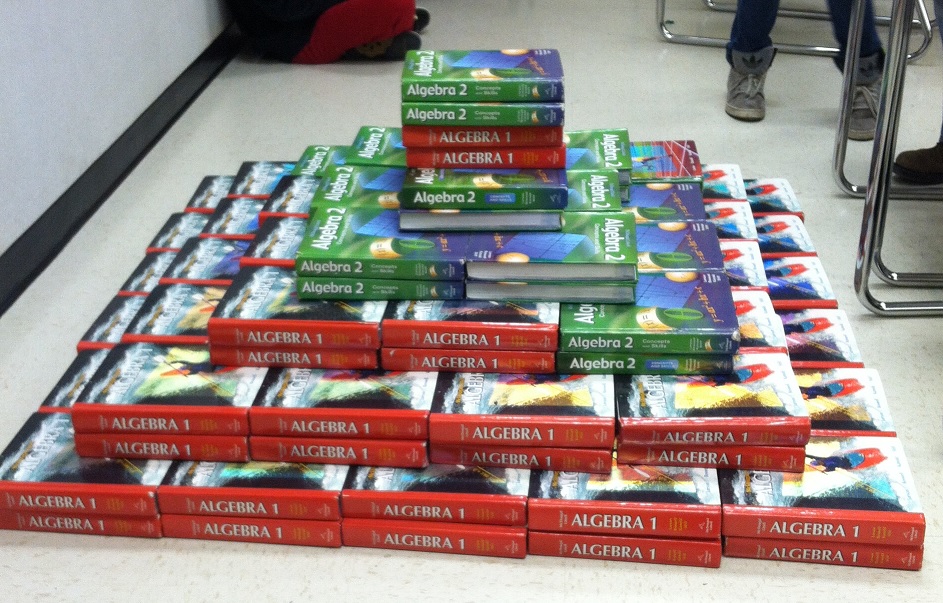
Here’s a great example: we had final exams in 2-hour blocks right before Thanksgiving break.  To say that the kids get “restless” by the middle of the second day is sugar-coating it.  A new teacher in our department, (let’s call her Sheryl) sent this picture with the caption, “My algebra kids were bored after their final and built this with their textbooks.” booktower

Of course, my brain couldn’t just let that one go and say, “Nice book tower, Sheryl.” Dan Meyer calls this perplexity and modeling this behavior is a key to getting students curious. Instead, my eyes lit up and I thought, “what a great math problem!”  As we looked at this photo, I said, “what do you think kids will notice and wonder about this photo? Do you think you could get them to come up with how many books are in the 10th row or the nth row?”  Of course the question that’s raised, legitimately, is “what do you do when students say ‘there are green books and red books’ or ‘some are faced forward and some are faced backward’?”  This is the part that I believe is scary for a lot of teachers is relinquishing control of the immediate direction of the lesson and not being so certain about how students will respond.  At least when we give them a quadratic to factor, we have a pretty good idea of the limited number of directions they can move to arrive at a singular correct answer.

But what I believe is imperative here is validating and acknowledging those seemingly math-less observations and creating a math opportunity with it.  With the instance of “some are red and some are green,” we can now extend that declaration of color to ideas like percentages, ratios, and so forth.  But by first validating this red/green response, we’ve invited this student to the conversation and made them part of the creation of the problem we are about to solve.  Now they are empowered by the process and more motivated to step in to the problem-solving ring.  Whereas before, this same student might have disengaged completely.

A recent example of this from my own classroom:  We were beginning Dan Meyer’s 3-act task using the Penny Pyramid.  When collecting wonderings, one student asked how many 1996 pennies were in the pyramid. He was born in 1996, and was probably just fascinated by that year, but I didn’t want to dismiss that from the discussion.  I have a bucket of pennies in my room that I use occasionally for probability experiments, and I hoped that this kid could draw from his knowledge about samples to make a reasonable estimation of how many 1996 pennies were in that pyramid.  As it turns out, that students off-hand question turned into a great math discussion about random sampling.

But back to this book tower:  After I’m sure that I’ve thoroughly freaked out this new teacher with my enthusiasm over a book tower, something awesome happens.  This new teacher, races into my room after 1st period on Monday and says, “I did it!  I did the book tower, and it was AWESOME!”  I’ve had some great moments with other teachers, but that one is going to rank pretty high on my list for a long time. At lunch, she was STILL raving about it. She even said that the students were so engaged, that they ran out of time talking about it during class. Maybe there’s hope for Tommy Boy after all.

Ever-loving Evernote – #ExploreMTBoS 6

When I started discovering the math teacher amusement park that is the MathTwitterBlogosphere, I quickly found myself so excited about what I had discovered and so overwhelmed about what I had discovered.

My first instinct was to bookmark, bookmark, bookmark.  I made bookmark icons on my ipad, bookmarks on my web browsers and bookmarks on my desktop.  I had bookmarks inside bookmarks inside bookmarks. The problem:  I couldn’t find resources when I got ready to use them and I now had more bookmarks on my ipad than I had actual apps.

Then an angel appeared in the form of Kate Nowak at a Global Math Department session last spring.  Kate suggested Evernote as a method of organizing all of the resources I had found.  I had a few things in Evernote and had used it very infrequently as a medium for holding a few PDF files or interesting articles.  Kate Nowak uttered the words I was waiting to hear when deciding how to organize my mountain of resources:  Tagging and Searchable PDFs.

Many of you might be thinking “there are plenty of sky drives that are searchable.”  (Maybe you are now wondering what a sky drive is.)  Anyway, none of the online storage platforms have been as versatile, flexible, and easy to use.  I’ve tried Adobe Reader, Dropbox, Google Drive, iCloud, the works.  Evernote surpasses them all.

A bonus:  Evernote and Adonit joined forces and created Jot Script, a one-of-a-kind stylus for note-taking.  Now, I can handwrite notes into Evernote and they are searchable as well! It’s like Christmas and my birthday!

Vegan Teacher Crazy about Cheeseburgers

A year and a half ago, I made the best dietary decision of my life and decided to try a vegan diet for 30 days.  Fast forward to now, I love the vegan lifestyle and I’d never go back to a diet filled with animal products.  I know too much.  But that’s a story for another post.

A couple of weeks ago, I logged into Robert Kaplinsky’s presentation on Global Math Department.  He started off with a visual, which is usually good to draw listeners into the presentation.  However, this visual was a cheeseburger.  And he went through more and more visuals, and the cheeseburgers kept getting bigger and bigger until finally I’m face to screen with 100×100 cheeseburger from In N’ Out burger.  I try very hard not to be one of those ‘enlightened and superior’ vegans who constantly judge the dietary choices of others, but these burger pictures were not how I envisioned spending my Tuesday evening.  His methodology had my attention however.

After explaining his problem solving process and distributing his problem solving template, he threw this photo into the mix and asked,

“How much would that 100×100 cost?

Now I was hooked and needed to figure out how much that 100 x 100 cost.  I didn’t care if it was a cheeseburger or a truckload of kale.  The wizardry of Robert Kaplinsky drew this vegan teacher into the problem solving process and made me care how much this monstrosity of a cheeseburger cost.  Brilliant.

Then Robert Kaplinsky threw down the dynamite:

That’s right.  The actual receipt of this 100×100 cheeseburger.  A boatload of kudos to Mr. Kaplinsky for presenting something that was simple, with some great mathematics to go with it.

I’m glad this weeks ExploreMTBos mission was LISTEN and learn.  This was a great presentation, a great lesson, and a great resource.  I’m glad I took the time to listen to Robert Kaplinsky’s presentation, even if it wasn’t so appetizing on the outside.

The Mr Barton Gem

Over the last year, I’ve looked at hundreds of awesome math resources that have truly helped transform my teaching practice into something I’m really proud of.  I’m so grateful to the truckload of great math teachers out there who willingly, freely, and eagerly share the wonderment that happens in their classroom.  One of my favorite things to do is to talk to other teachers about what they are doing in their classes.  How fortunate am I that I get to also do this collaboration with teachers across the globe.

One of the most fantastic collection of resources that I’ve have the pleasure of stumbling upon is that of Mr Barton.  The link is easy to remember, and I’ll post it again because you won’t want to miss this guy’s stuff:  www.mrbartonmaths.com.  He’s compiled websites, activities, and videos exploring all kinds of fun math stuff for all levels of the classroom.

One of my absolute favorite things that Mr Barton does every month is his TES Maths Podcast. This podcast is where I first learned of Nrich, and I’ve been in love ever since.  He’s done many excellent interviews with math professionals across the globe, and it’s my favorite day of the month when the podcast becomes available.

I hope you’ll take some time to check out his stuff.  He really does a great job of compiling some of the best resources out there.


Olympians, Tweagles, & Friends in my Phone

I started tweeting in 2008, around the Beijing Olympics. It was cool that actual Olympians would respond to my tweets.  When Summer Sanders responded to one of my tweets, I about fainted. Twitter was new, they probably didn’t know any better.  

I followed a few celebrities. I found some of their off-color honesty hilarious and sad at the same time.  In the meantime, my hilarious brother managed to rack up tens of thousands of twitter followers. (@sucittam if you are looking to add some hilariousness to your timeline). Here’s one of his tweets being featured on Ellen:

He opened my eyes to the idea that following actual REAL people is more entertaining and fulfilling. He was absolutely right.

I went through a phase where I followed a bunch of people who tweet as their beagle.  I’m pretty sure I was the first one to use the term Tweagles, although I have no proof of that. 

Then in January 2013, my indifferent view of people on twitter changed forever. My 29-yr old sister in-law, Danielle, suffered a massive brain aneurysm and it wasn’t certain she would recover.  She was in the ICU at the University of Iowa for almost 6 weeks, and while my brother stayed by her side every day, his twitter followers rallied support that went viral. All of these people, most of which he’d never met, wanted to reach out to help. Benefits were organized, gifts were donated, and memorabilia was auctioned all to benefit Danielle whose recover was slow, but steady. 

Rex Huppke (@RexHuppke) wrote a beautiful article illustrating that the people we interact with on twitter are not just cyber-acquaintances.  Danny Zucker makes the best point:

 “We’re willing to accept the concept that cyberbullying is real, and it is. But if you can accept the idea that the negative is real, then you have to accept the idea that the positive is real. If strangers can hurt you, they can be friends as well.”

And just like that I leaped head first into the T of the MBToS. I realized that people like Fawn Nguyen, Andrew Stadel, Kate Nowak, and Christopher Danielson were real teachers just like I was.  They had great blogs, and they were on twitter too. And if I wanted to get a real benefit from all of the resources I had found online, I needed to start posting feedback of how I incorporated them into my classroom.  And then tell the creator of the activity about how it went. Through this I’ve really been able to experience the genuine human behind all of these @ symbols. These are not only great teachers who don’t just shine on their own. They want to freely share what they’ve done so that others can shine just as brightly. 

A Visual Patterns Trifecta

This is my third (and most exciting) post about my new found love for Visual Patterns.  My enthusiasm stems from a growing appreciation of how these patterns can be used in such a wide range of grade-levels, including advanced algebra.  The use in an elementary or lower-level secondary classroom is easy to see.  However, the teacher and student need to dig a bit deeper into the make-up of these patterns in order to generalize them.

For example, here is Pattern #8.  Kudos to Fawn Nguyen on this one.

It’s not immediately apparent what step 4 should be.  But even more so, the quadratic nature of this pattern is not necessarily simple to comprehend.  From yesterday’s pattern #5, the students had a method for finding the number of penguins in the nth step by converting the penguins into a table and creating a system of equations.  I didn’t want to encourage this method, as it is very procedural and tedious.  However, it was a good place for students who liked to work in a more algebraic way to feel successful.

Also, the table allowed them to explore what the difference of differences really told them.  I had a student, let’s call her Kay, ask “I wonder what the constant difference of differences represents in our equation for the nth step.”  She came up with a conjecture by comparing it to our problem from pattern #5.  Kay concluded that the “a” value in the equation ax^2 + bx + c = y is half of the constant difference of differences.  I challenged Kay to continue to examine these values in future problems to see if her conjecture holds true.  I had another student, Em, wonder if that meant that the “a” value in a cubic function is equal to one third of the difference of difference of differences.  This she will investigate as well.  What is very exciting about these questions is that they were non-existent 5 weeks ago.  It wasn’t that the students didn’t WANT to be mathematically curious, they just didn’t know HOW.  It was a huge thrill for me as a teacher to see these kids move from looking at a math problem with a single solution to being able to ask new questions.  A nod to Christopher Danielson for helping me realize that learning is having new questions to ask.

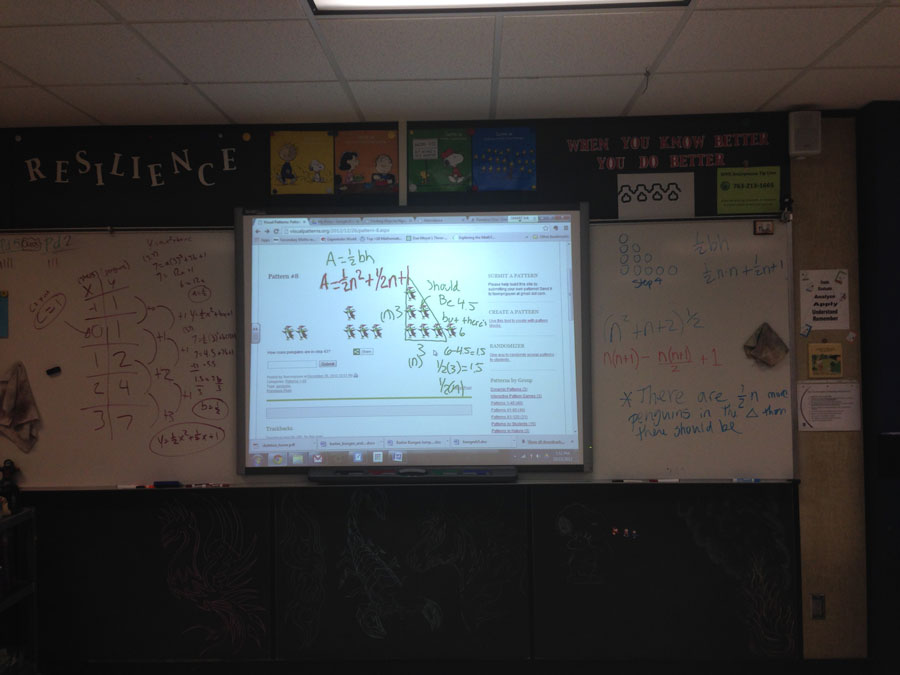
  Back to the problem at hand:  How many penguins are in step n?  A few of the students were able to get the answer without using a table.  These were mostly the students who like to do things in their head.  The ones who want to fully process the problem in their brain, but not write any of it down.  [Side note:  these are usually the ones who are brilliant with numbers but get lower grades in traditional math classes because they don’t want to “show their work.”] Anyway, I wanted to challenge those who used the table method and set up a system of equations to relate their model back to the picture.  Spoiler alert!  The answer is 1/2n^2 + 1/2n + 1, but I wanted my students to be able to relate that back to the picture.  What do the individual pieces of the expression represent in penguins? This way, the students were able to make that connection of a picture or pattern that didn’t seem quadratic to begin with and flesh out its quadratic properties.

When the students figured this out, it was a magical moment.  I had to capture it:

IMG_2993

Another cool experience with this problem:  the same evening that I did this problem, our school hosted parent-teacher conferences.  One of my students came into conferences with her parents and her three little sisters, ranging in age from about 5 to 10.  One of the little sisters sat down and wanted to be part of the conference.  I pulled up the visual pattern and asked her how many penguins would be in the next step.  It was a validation of my initial thoughts of how open and accessible these problems are to all levels of mathematics.  Here was an 8? year-old looking at the same pattern that her 17 year-old sister explored earlier that day.  And it was mathematically applicable to them both.  Beautiful.