Alright, Mr. Stadel. We’ve Got Some Bacon Questions

Greetings, Mr. Stadel.  We know that you are very busy.  We appreciate your brief attention.  Rather than bombard you with tweets, we decided to bloggly address our questions and comments about your Bacon Estimates.

First of all, bravo.  You dedicated an entire section of your estimation180 blog to a culinary wonder some refer to as “meat candy.”  Even our vegan teacher felt compelled to engage us with these estimates.  (She says it is for the sake of the learning.)

Second, the time lapse videos of the cooking are pretty sweet.  Too bad the school internet wouldn’t stop buffering.  But nice touch, Mr. Stadel.  Nice touch.

A question:  Did you know that the percent decrease in length of bacon is 38% after cooking, but the percent decrease in width is only 23%?  We figured that out adapting your “percent error” formula to the uncooked/cooked bacon.  Do you have any initial thoughts about that discrepancy?  Is it bacon’s “fibrous” fat/meat striped makeup that allows it to shrink more in length than width, inch for inch?

Also, did you know that the percent decrease in time from the cold skillet to the pre-heated skillet is 29%?  That one was a little harder for us to calculate, because we figured out that we needed to convert the cooking times to seconds rather than minutes and seconds.

To summarize, we wanted to thank you, Mr. Stadel.  Our teacher tells us that you dedicate your time and energy to the estimation180 site so that WE don’t have to learn math out of a textbook.  We wanted to tell you that we appreciate it.  And the bacon.  We appreciate the homage paid to bacon.

Sincerely,

Mrs. Schmidt’s Math Class

St. Francis, MN

When the Answer is E: He Falls Off the Roof and Breaks His Neck

Our annual state testing season is almost here. The juniors will partake in the Minnesota Comprehensive Assessments in Mathematics a week from Tuesday. Our department decided issuing a practice test to all of our juniors would help re-familiarize them with long lost skills. After distributing copies during our monthly staff meeting, I’m always curious if any teachers in other disciplines look at the practice materials. Much to my delight, the choir director approached me at lunch on Friday, test in hand.

Mr. Warren: Is this test just like the MCAs?
Me: Most likely similar. Why?
Mr. Warren: Ok, well look at this one.


Mr. Warren: I think the answer is E, Xai s going to fall and break his neck.

The conversation went on for another few minutes, with me agreeing  that what’s been called “math education” includes ignoring the context of situations and focusing on a procedure.  In fact, I was curious how many juniors who completed this practice test even noticed that the situation was outrageous.

Since we were running on a 2-hr delay schedule Friday, I thought it would be the perfect opportunity to present the problem to my algebra class. They are mostly juniors who have been continually frustrated with a mathematics curriculum that doesn’t make any sense in the real world.

Me: Read through this problem. Does it make sense?

Student: ok, it looks like 32.

I didn’t expect any of them to apply any trigonometry, so I thought we needed to approach the problem differently.  In fact, I wasn’t even concerned about the angle measure.  I wanted them to look at the scenario itself.

Me: Imagine this scenario. We’ve done a lot of estimating in here. We need to envision a 20-foot ladder, three feet away from a house. Does this seem reasonable?

Unfortunately, it did seem reasonable to most of them. I needed another approach.

Me: ok, how could we simulate this in classroom-scaled size?

Student: Get a ruler.

Me: Perfect. How close does it need to be to the wall?

Students: (a chorus of answers)

After exploring multiple methods of calculating exactly how far, we arrived at 1.8 inches.  With as much drama as possible, I set the ruler against the wall, exactly 1.8 inches away.

Me:  Does this look like a ladder that any of you would want to stand on? (of course, a few did).  Keep in mind, this is a TWENTY foot ladder, not a 12 inch ruler.

Student:  Yea, I don’t think anyone is climbing up that ladder and coming down in one piece.

Another Student:  What if they had a spotter?

A spotter!  Now we’re talking.  To be honest, I have no idea if a spotter could hold a 20-foot ladder so that it could be placed three feet from the wall.  But now I’m interested to find out!

I know Mathalicious investigated a similar scenario using a claim from Governor Janet Napolitano.

In my mind, these are the questions that should be circulating Facebook and aggravating parents.  This is the kind of math that should rile up Glenn Beck and company.  Our state of Minnesota opted not to adopt the Common Core State Standards in Mathematics, but requiring this kind of math instead is what is actually dumbing down the curriculum.  It assumes that the real world doesn’t apply, only rote procedure does.  “Just figure out the answer, don’t question the situation,” is what kids read and do over and over when problems like this are solved without real context.  A richer classroom experience for both teachers and students comes when we ask students to assess the reasonableness of situations, create new scenarios that are more appropriate, and solve the new problems they develop.  The CCSS Standards for Mathematical Practice tell students that it’s vital that they “construct viable arguments and critique the reasoning of others.”  I don’t think “critique the reasoning of others” should be reserved for only reasoning created in the classroom.  I’d like my students to critique the reasoning of the creator of these types of problems and others like it that have been deemed a necessary component of high school math success.

Thank you, Mr. Warren for igniting the exciting conversation in my classroom.


Class Commences – an hour I won’t soon forget

Recently, Michael Pershan unearthed a Shell Centre gem straight from the 80’s (literally).  This collection of materials is fantastic, and hopefully demonstrates to both students and teachers that engaging in rich tasks and high-level thinking is timeless.

I decided to give the function unit a shot in my Algebra 2 class today.  Some background on this group of students:  there are 38 juniors and seniors, last hour of the day, in a class geared toward lower-level students.   So far though, the only thing that’s been “lower” in this class is the number of empty desks I have.   I handed out this task, gave minimal directions and let them go for a few minutes on their own:


from:  Shell Centre for Mathematical Education, University of Nottingham, 1985

from: Shell Centre for Mathematical Education, University of Nottingham, 1985

It was so interesting to watch the different ways each of them started.  Some began with 7, since that was the first you saw when reading the graph from left to right.  Others insisted to work from 1 to 7, identifying the corresponding people along the way.  A few worked the other way around, from the people to the graph.

I walked around to make sure each student was able to get started and that those who thought they had determined a solution also supported their claims.  Then, I wrote the numbers 1 – 7 on the dry-erase board, stepped back, and let these kids amaze me.
One student volunteered an answer, and then handed the marker off to another.  I intervened only briefly to make sure that every student had an opportunity to contribute if he or she wanted.  Once 7 names were completed, I knew a couple of them were out of place.  I sat and said nothing, and this entire class showed me what they are capable of.  Here was a class full of students labeled mathematical underachievers completely nailing SMP #3.  Their arguments were viable, their critiques constructive, their discussion productive.  It bothered a few of them that I wouldn’t let them know if/when they were correct.   But most of them are starting to understand that my main focus here is not the correct answer, but the incredibly rich and interesting process they used on their journey to finding it.  They came up with multiple ways to support their answers and noticed tiny details about the people that supported their findings.  For example, did you notice that Alice is wearing heels? According to my students, that is perhaps why she appears slightly taller than Errol.

I had a heart-to-heart with this group when we were done about how proud I was at how they conducted themselves throughout this task.  I’m really thoroughly looking forward to a fantastic trimester with this special group of kids.  Their work on this task gives both of us the confidence that they can tackle something more difficult next time, and they are capable of mastering high-level mathematics this trimester.

Notice and Wonder with Gusto

My daughter was very content on the airplane ride from Fort Meyers to Minneapolis watching Frozen for the 102nd time.  I took this opportunity to read the Noticing and Wondering chapter of Powerful Problem Solving, the superb new publication from Max Ray and the Math Forum crew.  I took so many notes on this chapter since this is a strategy that I think every teacher can implement, no matter their apprehension about new strategies.  It is such an easy set of questions to ask:  What do you notice?  What does that make you wonder? Those two questions can open up an entire class period of rich discussion and mathematical exploration.  No one explains this classroom strategy better than Annie Fetter of the Math Forum in her Ignite Talk.  (Seriously, if you have not seen this 5 minute, dynamite, game-changing video, stop reading and go there now. ) 

Last Thursday was day 1 of our high school’s third trimester.  The first day of the slide into the end of the year. Regardless, the first day of the trimester always seems like the first day of school: the anticipation of a scenario that’s been played over and over in the minds of teachers and students becomes reality.  For me, this day meant the last hour of the day I would be met with 38 (you read that right) “lower level” Algebra 2 students.  My class is most likely the last high school math class that these juniors and seniors will take, and many of them do not like math or are convinced they are not any good at it.

This class has been in the forefront of my mind most of the year for a lot of reasons.   One of those reasons being that after Jo Boaler’s class this summer, I know that a huge barrier to raising the achievement levels of students in this class is the students’ beliefs that they are capable of doing high level mathematics.  And I also know that a key component to getting these kids to perform better is to give them feedback that allows them to believe that they are capable of it in the first place.

Because of the structure of some of our high school courses, most of these students have not had experience with higher degree graphs, equations, or functions.  They may have seen something similar in their science coursework, but quadratics have not formally been introduced.

I gave them the following graph along with the scenario and let the noticing and wondering begin:  Mrs. Bergman likes to golf and her golf shot can be modeled by the equation: y= -0.0015x(x-280).

A couple of them stuck to non-math related Noticings (the graph is in black and white), but almost all of them noted multiple key characteristics of the equation and/or the graph.  Some highlights:

  • The graph doesn’t have a title and it needs one.
  • Both heights are in yards
  • Horizontal distance goes up by 80.  Height by 5.
  • The peak is in the middle of the graph.
  • The graph is symmetrical
  • The maximum height is about 28 – 29 yards
  • The distance at the maximum height was about 120 yards
  • She hit the ball 280 yards.
  • The number in front of x is negative
  • The graph curves downward
  • It has an increase in height and then a decrease in height.
  • As the ball reaches the peak height, the rate the ball climbs slows.

The list of Wonderings was even more impressive to me. A lot of them wondered things like what kind of club she was using, if the wind was a factor, did she have a golf glove, how much power she used to hit the ball, the brand of her tees, clubs, glove, ball, etc.  Then one student laid out something so profound, it made the entire class stop and and acknowledge the excellent contribution:

“What distance would the ball have traveled if the maximum height were 20 yards rather than 28?” (audible ooo’s here)

After this student said that, the floodgates opened with great questions from others:

  • What was her average height for the shot?
  • What is the maximum height that she is capable of hitting the ball?
  • Is this a typical shot for this golfer?
  • If the maximum height was higher, like 35 yards, how far would she hit the ball?
  • What is the exact maximum height that she hit the ball and how far did she hit it when it reaches that maximum

There were still a few that couldn’t get passed what kind of glove she was wearing or tee she was using, but most of the students stepped up their Wonder Game when one single student demonstrated a rich example.

What I really love about this strategy is that it is so easy to implement into your classroom routine with the resources you already have.  For example, rather than starting with a procedure for solving quadratic equations, simply ask the students what they notice about the structure of the problem.  How is it the same or different from problems they have done recently?  Ask them to list attributes of the equation.  I have found most often, the noticing of one student triggers the noticings of others and the list becomes progressively more sophisticated.

I have heard from some teachers that they do not use try this strategy out of fear of students making a list of trivial noticings (like, the graph is black and white).  They will include those every time; expect it.  But by acknowledging those seemingly trivial items, that student, who would not have dreamt of entering the conversation before now has received validation of his or her contribution to the discussion.  And when students feel heard and their opinions valued, their contributions will start to become more profound.

I’m very proud of this class.  I’m really looking forward to the creative perspective that their noticing and wondering will bring.

A Speedy Makeover for the Intermediate Value Theorem

As a college algebra teacher, I was not satisfied with the way I presented the intermediate value theorem last trimester.  I felt the lesson was somewhat isolated from other concepts we had studied and definitely was disconnected from the real world.  My approach lacked a hook and was laddened with procedure.   Committed to teaching the concept better this trimester, I recorded the following video while (someone else) was driving:

I know, not a high quality masterpiece, but I think I captured what I needed to illustrate the theorem.

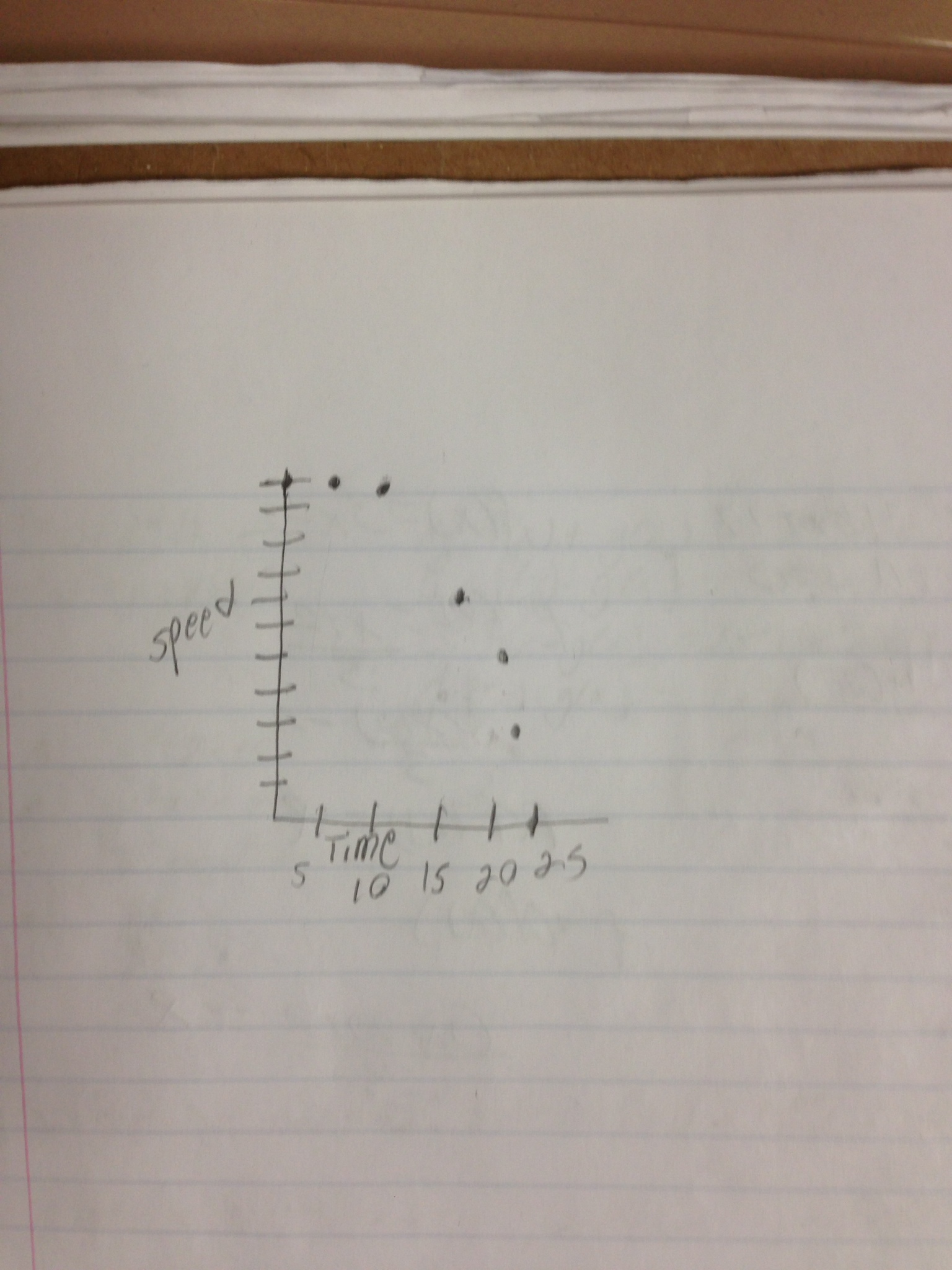
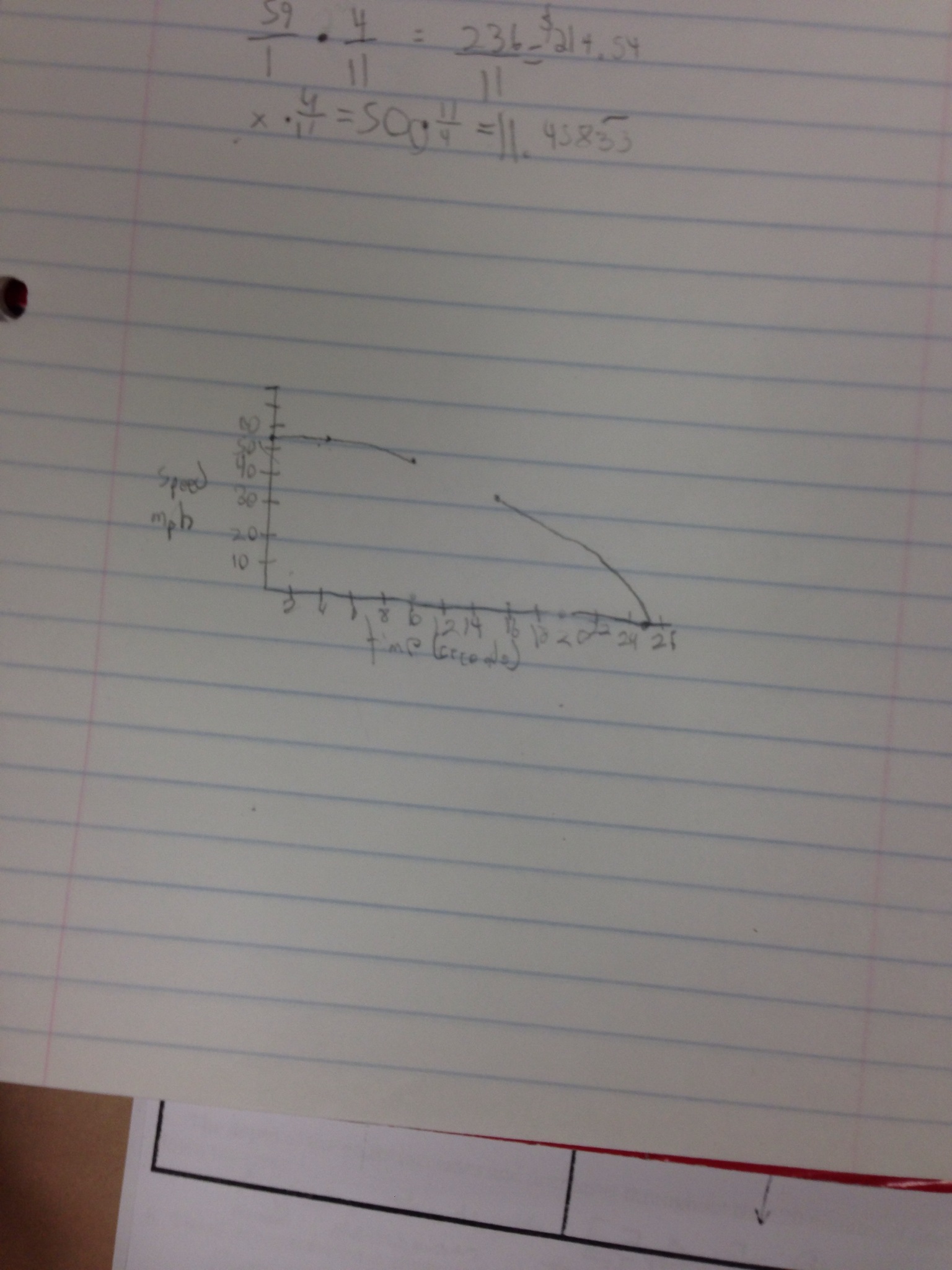
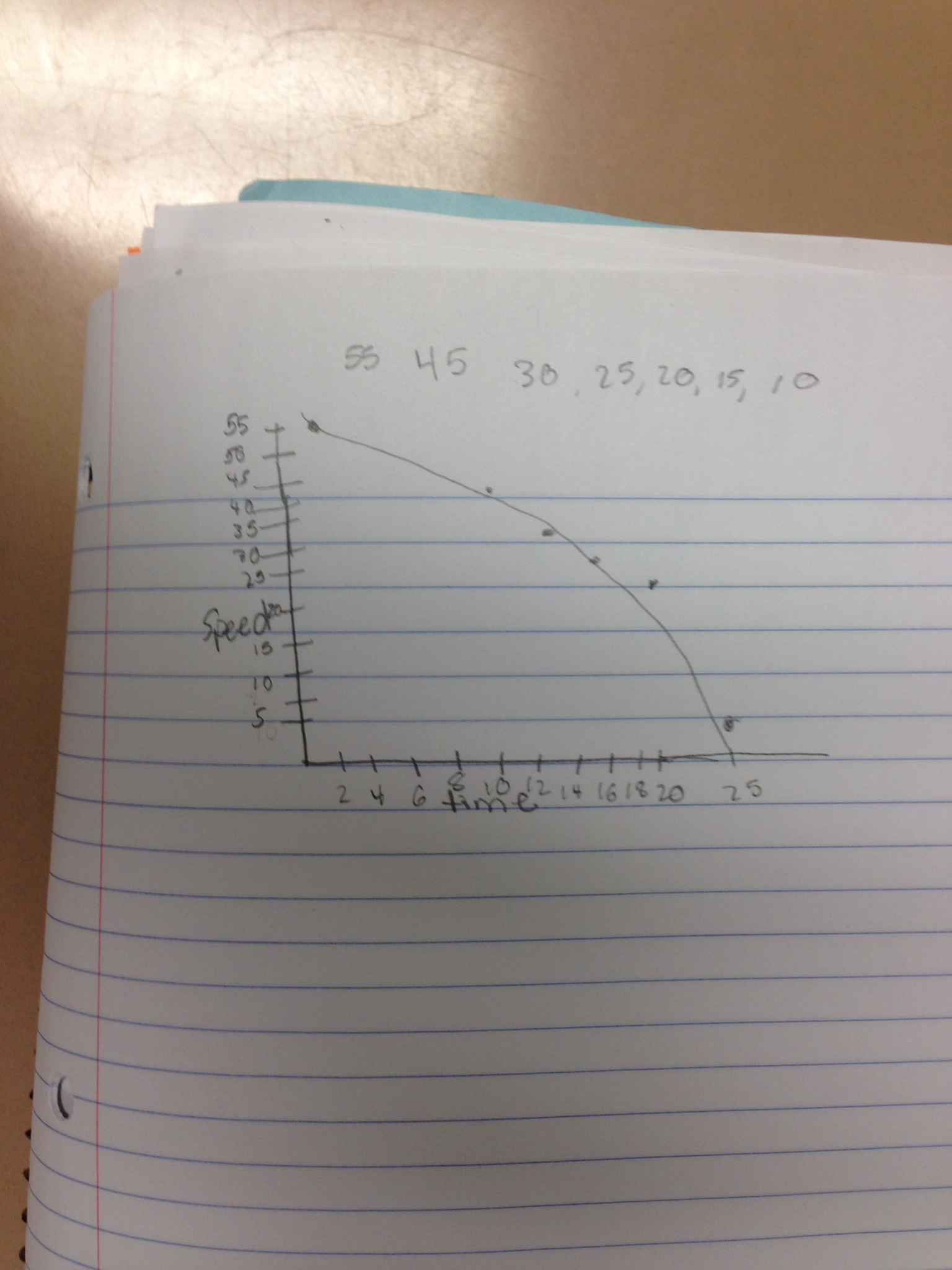
I ask the students to draw a graph of the speed of the car with respect to time.  After playing the video a number of times, I had them share their graphs with their seat partner.  As I circulated the room, I noticed their results fell into one of these three categories:

Graph A

Graph A


Graph B

Graph B


Graph C

Graph C

After examining the options, I had them choose which graph they felt represented the situation most accurately.  Spoiler Alert:  The overwhelming majority of them chose Graph B.  Their reasoning:  it’s unclear what happened to the speed between seconds 10 and 15 therefore, there should be a space in the graph.  Those vying for Graph C cleverly argued that there was no audible “revving of the engine,” indicating that the car continued to slow.  Others supporting C claimed that even though we could not see the speed, they know how a speedometer works and can make a reasonable assumption about what happened in that time frame.

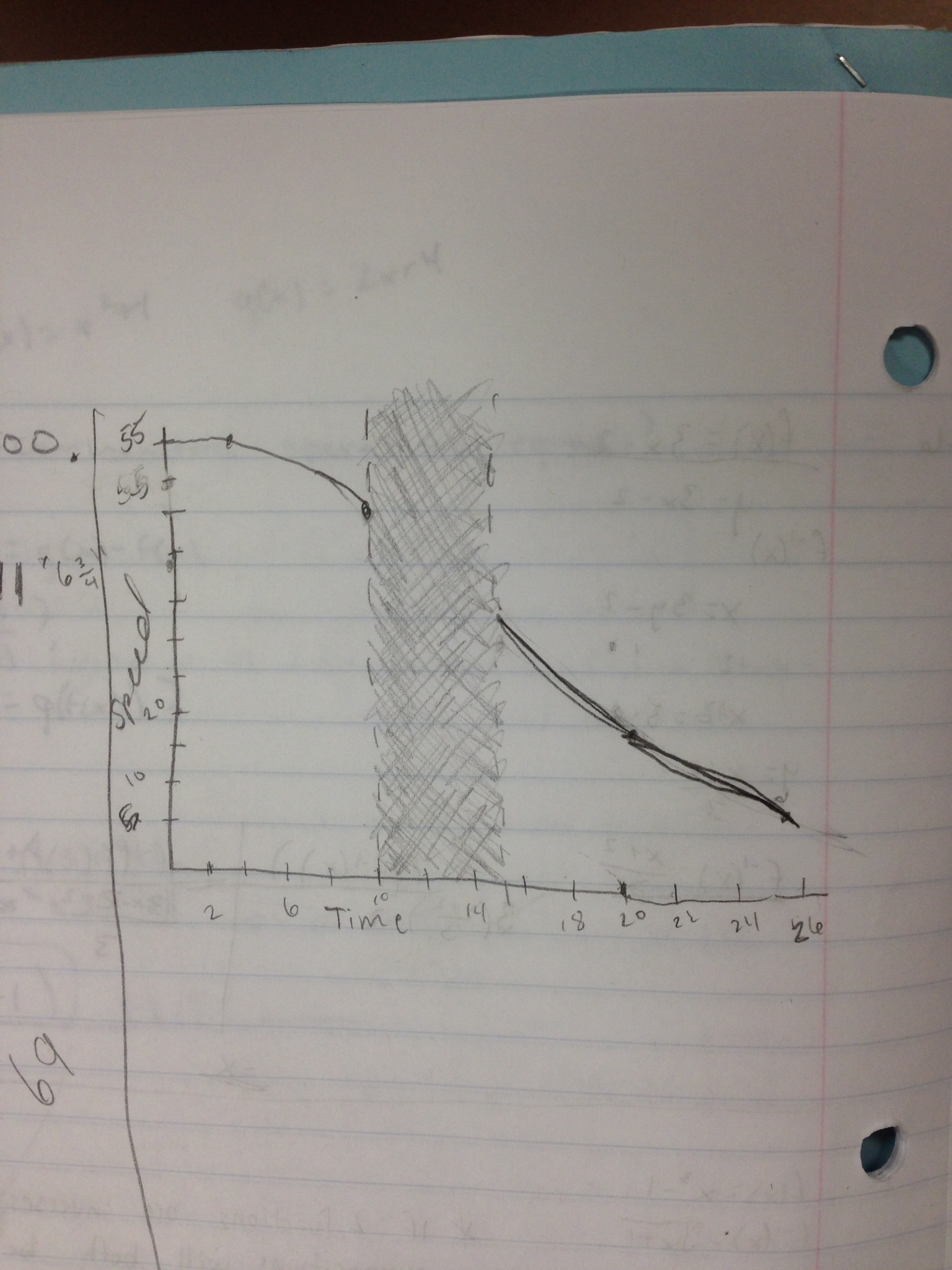
Enter this student’s graph and the Intermediate Value Theorem (trumpets):

IVT graph

I liked this students “shading” through unknown speed region, so I projected it for everyone to discuss.  They were able to determine the value of the function at ten seconds, f(10), was approximately 45 miles per hour and the value of the function at fifteen seconds, f(15), was approximately 35 miles per hour.  They also knew that the car must have reached 40 miles per hour sometime in between 10 and 15 seconds.  “How do you know that?” I pryed.  Gem response of the day:  “Well, speed is continuous and I can’t go from 45 mph to 35 mph without going through 44, 43, 42, 41, 40 mph, and so on.”  Bingo.  Intermediate Value Theorem.  No boring procedural explanation necessary.

We applied this “new” knowledge to a polynomial function so that they could get a handle on some of the algebra and notation used.   And as a bonus, they also seemed to grasp that this theorem does not only apply to crossing the x-axis, a common misconception students had last trimester.

Moving forward, I’ll definitely work on creating a better video!