It’s probability time in my 9th grade prob and stats class.  Call me crazy for giving 9th graders dice and pennies with a month left of school, but it’s how I roll.  (Ha! I’m cracking up over here!)

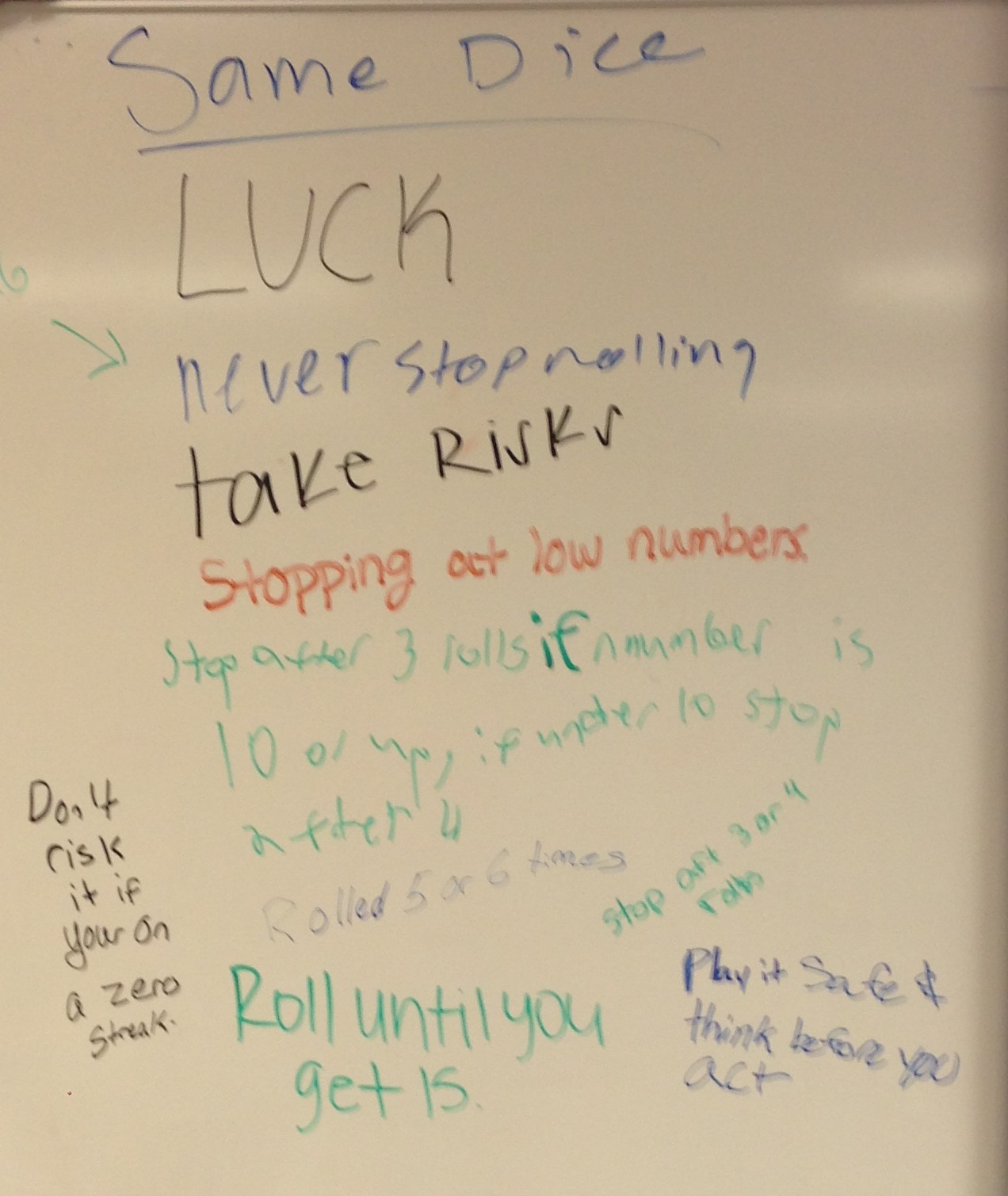
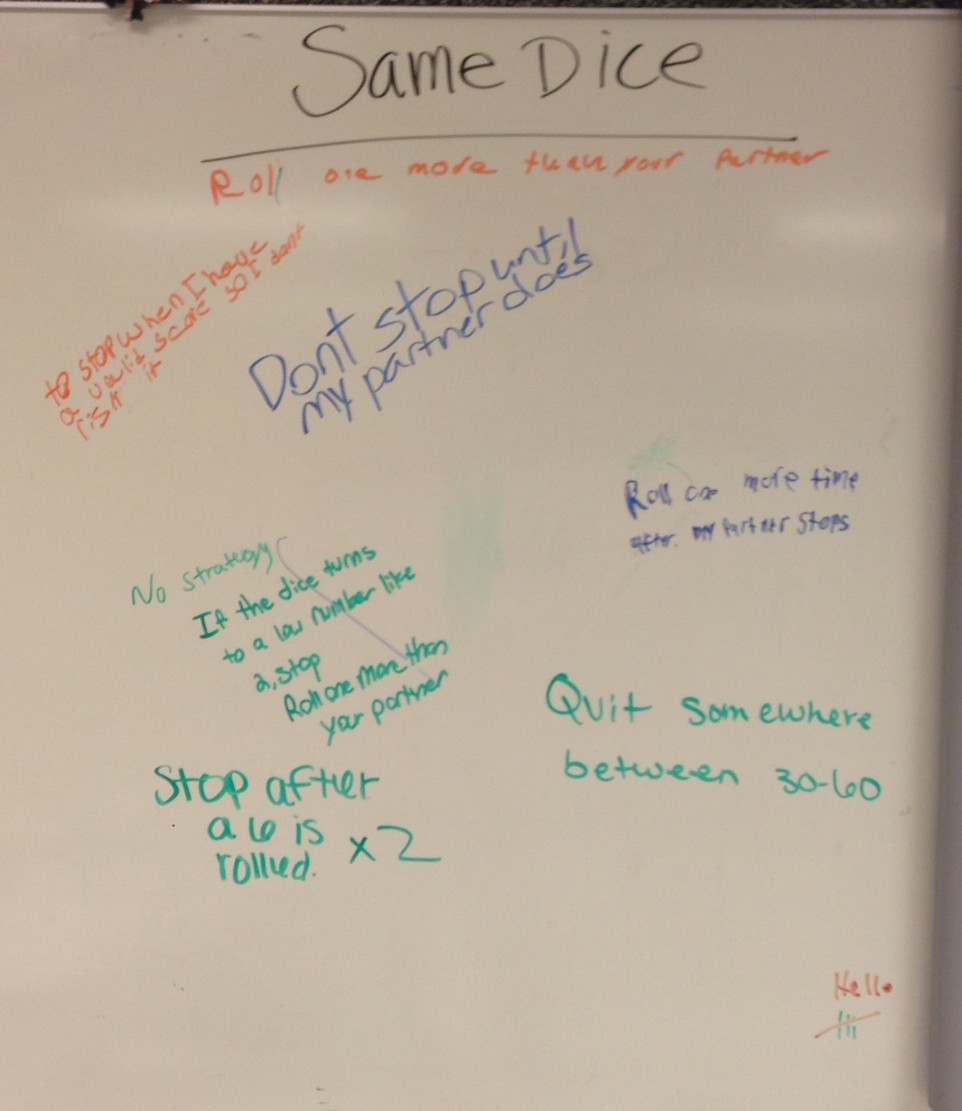
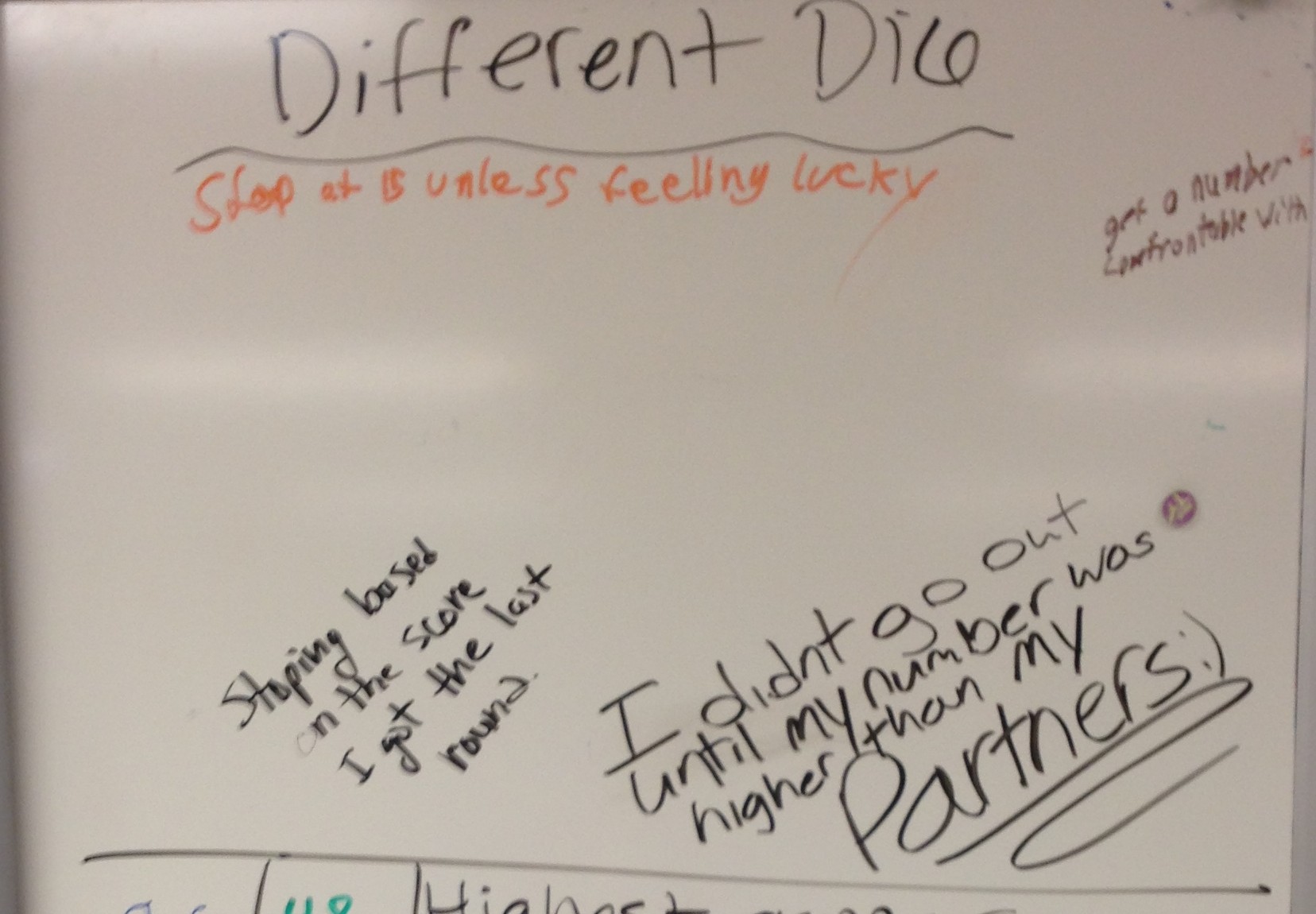
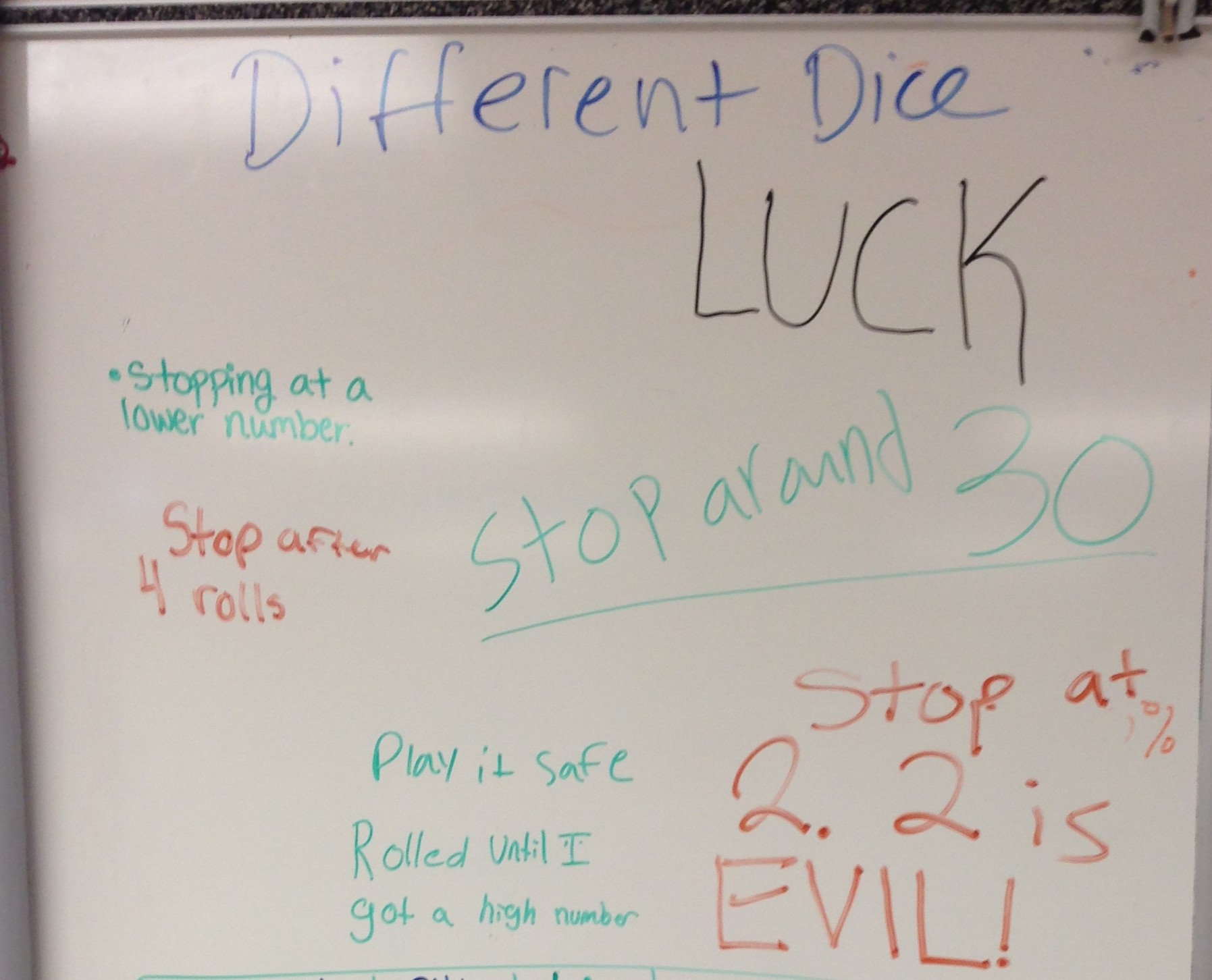
I like to start with the Game of Pig, similar to the game used in the IMP curriculum.  I adapted it a little to have kids compare strategies for when playing with their own dice (or separate from their partner) to playing with the same dice as their partner.

It’s interesting to see their strategies develop here.  Some use very solid ideas like “I stopped when my round score reached 20.”  But I also get to see misconceptions like believing that a “one” will be rolled relatively soon after a “two” is rolled.  Having them share their strategies helps me to see where these misconceptions lie and deal with them before we start calculating any concrete probability.

Tomorrow, we’ll start by discussing which of these are legitimate strategies and which of them are not.

photo 1 (3) photo 1photophoto 4 (1)photo 2

Chipotle for Everyone

I’m hard pressed anymore to find a classroom of high school kids who don’t absolutely adore Chipotle’s menu options.  They all have a favorite, and they own it as THEIR burrito.  (I like Chipotle in particular because as a vegan, I can get a delicious meal, as can any non-vegan meal companion.)

I came across this article from Vox claiming Chipotle’s menu calorie disclosures were inaccurate.  I’m going to give Chipotle the benefit of the doubt here because their website contains a very detailed nutrition calculator which allows you to determine the number of calories for your  customized burrito.

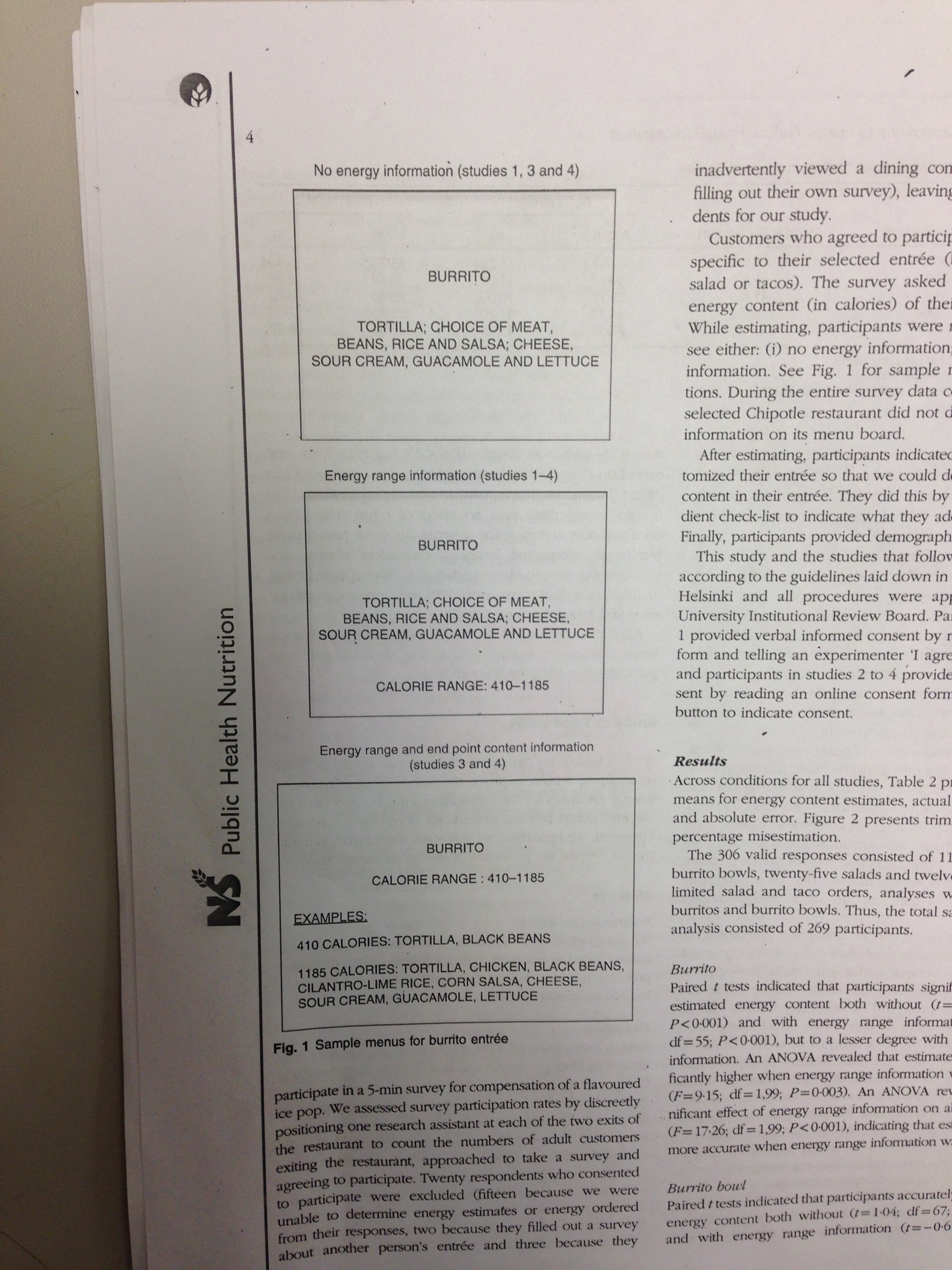
The article references a study from the Journal of Public Health Nutrition which reviews a study in which customers are asked to estimate the calorie content of their meal. Some groups were given no information at all.  Some groups were given a range of calories in which burritos in general fell.  Last, additional groups were given example burritos containing the low and high values in the calorie spread.

I had a randomly selected student create a burrito.  Each class was obviously something different which made it kind of fun.

First, I had them estimate the number of calories in the chosen student’s burrito.

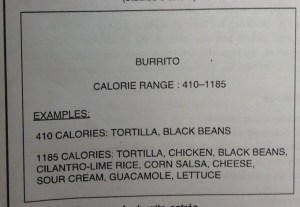
Second, I gave them the calorie range of 410-1185 claimed in which Chipotle’s burritos are claimed to land.  I had them adjust their estimate and give reasoning for their adjustment based on the additional information.

I then showed them the calorie range with an example from the Journal article’s study:
IMG_5054

Third, I wanted them to use the examples above to adjust their estimate once more.

We then talked about how the range of our estimates changed and why.  We also had a discussion about ‘averaging bias’ and how healthy ingredients make us assume that certain food are lower in calories than they actually are.

We were able to discuss the surveying methods done for the study and the demographics of participants, which led to a nice discussion about sampling.  (Evidently high school 9th graders find it odd and quite a bit creepy that participants in the survey were given a “flavored ice pop” in exchange for 5 minutes of their time.)

As long as I had their attention with food, I asked them to estimate whether the student’s burrito had more or less calories than my vegan burrito.  I’ll let you decide:

Student’s Burrito:  chicken, white rice, pinto beans, tomato salsa, cheese, and lettuce

My Burrito:  brown rice, fajita vegetables, black beans, tomato salsa, corn salsa, guacamole, and lettuce.


Alright, Mr. Stadel. We’ve Got Some Bacon Questions

Greetings, Mr. Stadel.  We know that you are very busy.  We appreciate your brief attention.  Rather than bombard you with tweets, we decided to bloggly address our questions and comments about your Bacon Estimates.

First of all, bravo.  You dedicated an entire section of your estimation180 blog to a culinary wonder some refer to as “meat candy.”  Even our vegan teacher felt compelled to engage us with these estimates.  (She says it is for the sake of the learning.)

Second, the time lapse videos of the cooking are pretty sweet.  Too bad the school internet wouldn’t stop buffering.  But nice touch, Mr. Stadel.  Nice touch.

A question:  Did you know that the percent decrease in length of bacon is 38% after cooking, but the percent decrease in width is only 23%?  We figured that out adapting your “percent error” formula to the uncooked/cooked bacon.  Do you have any initial thoughts about that discrepancy?  Is it bacon’s “fibrous” fat/meat striped makeup that allows it to shrink more in length than width, inch for inch?

Also, did you know that the percent decrease in time from the cold skillet to the pre-heated skillet is 29%?  That one was a little harder for us to calculate, because we figured out that we needed to convert the cooking times to seconds rather than minutes and seconds.

To summarize, we wanted to thank you, Mr. Stadel.  Our teacher tells us that you dedicate your time and energy to the estimation180 site so that WE don’t have to learn math out of a textbook.  We wanted to tell you that we appreciate it.  And the bacon.  We appreciate the homage paid to bacon.

Sincerely,

Mrs. Schmidt’s Math Class

St. Francis, MN

Creative Craziness

I teach a lot of 9th graders this trimester. We offer a class called probability and statistics 9 and it is open to 9th grade students who also will have had the quadratic portion of algebra 1 this year. I really enjoy this class for multiple reasons. First, it lends itself very well to applying math to real-world scenarios.  Secondly, the hands-on opportunities are endless.
One of the issues I have been committed to improving with my own professional demeanor is the way I deal with 9th grade boys. Nothing brings out my sarcastic, short-tempered, disagreeable side like the antics of freshman boys. There’s something about the decision to play soccer with a recycling bin that just invokes the my inpatient side. Regardless, I need to develop more patience with this demographic. Boys are unique, both in the way that they act and the way that they perceive acceptable behavior. I’m not talking about “I’m bored” acting out. I’m talking about the “I really need to see if this eraser will fit in this kids ear” kind of acting out. I think that my short fuse has more to do with my failure on my part to  fully understand them rather than gross misbehavior on their part. What I’m really trying to grasp here is not “why can’t these kids sit still?” But more “when they can’t sit still, what makes them want to kick a recycle bin around the room or toss magnets at the learning target?” I think if I had a better understanding of what drives those behaviors, I could deal with them more productively. Suggestions?