I wrote this blog post about a week ago when preparing for my presentation at Twitter Math Camp. I don’t have any resources to post to the TMC Wiki page. All I have is this glimpse into my humanity as a teacher and an account of how I release myself from the burden of powerlessness.
On March 31, 2012, I made the choice to put down my drink for the last time and join Alcoholics Anonymous. This decision had a profound impact on not only my personal relationships and my health, but also on my role as a teacher and my relationships with students.
If you’re at all familiar with the 12 steps, you know that step 1 is the only one that mentions our substance of choice. (Step 1: We admitted we are powerless over [insert substance here] and our lives had become unmanageable.)
Many of the other steps involve an appeal to a power greater than ourselves. Many unfortunately dismiss or reject the real, profound, positive change that can result from a 12-step experience because of this mention of a higher power. The incorrect assumption that this refers to only a religious deity robs many of even exploring the impact the 12 steps can have on their lives.
BUT, since my goal here isn’t to convince you of AA’s ambiguous, non-definition of “God” as you understand Him, I thought it was more productive to talk about how I have applied this work with the 12 steps to my work with students, administrators, and other teachers. Also, my goal is to look at how these same ideas can be applied to your teaching, sans 12-step meetings. I’m here to share my experience, strength, and hope, and consider that the real power you have in your classroom is through accepting your powerlessness over it.
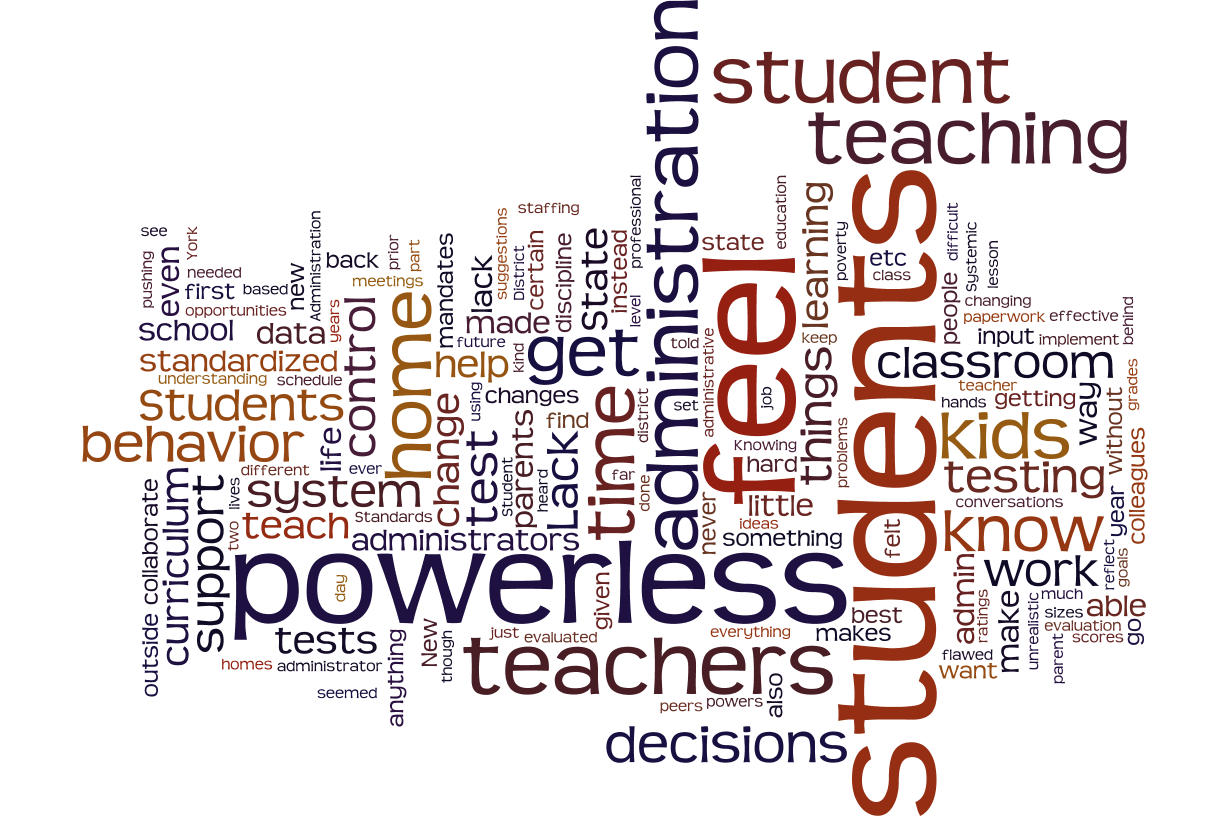
I shared a survey a few weeks back. One of the questions was What do you feel powerless over in your job as an educator?
Because survey answers presented in Wordle form are visually interesting, see if you can pick out some of the common themes here:
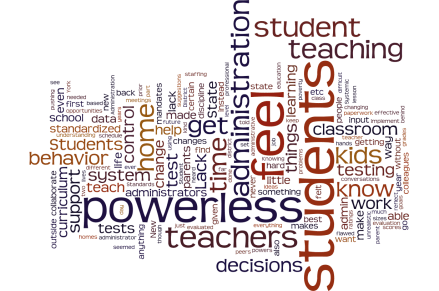
Most of us can clearly identify what we are powerless over, but how do we actually rid ourselves of the resentment we have toward that powerlessness? How do we really accept it and focus our energy on something we do have the power to positively change? For example, we are powerless over the brown-nosing, pompous, know-it-all teacher at the other end of the school. We know we cannot control that they say outlandish things at staff meetings and toot their own horn whenever their mouths are moving. Regardless, even the mention of their name sends us into an anxiety-laced, physical reaction, complete with a roll of the eyes. Wouldn’t we like to be free of the anger that accompanies our interactions with this individual? Because no matter where you go, what school, level, grade, or subject you teach, that person will be there in one form or another.
For me, I’ll call this person…Bert (not his real name). We started teaching at the same time. We had a…miscommunication of sorts. The details don’t matter. What does is that all of my future interactions with Bert were strained, anxiety provoking, and negative. If I was to be completely honest with myself, I needed to make an amends with him.
Whether you get to this point through 12-step work or through your own examination of conscience, the only thing in your control is your actions and your reaction to others. I’m completely powerless over what happened with Bert in the past. I felt he had wronged me. I continued to hold a grudge. And I remained angry and hurt.
It was a Tuesday, really early, 6:30 am. I was sure I’d be the only one needing to talk to Bert. Hi Bert. Over the last seven years, I have not been very friendly. Perhaps you’ve noticed. I’ve had expectations for you that were unfair because you did not know about them. I’m very sorry I’ve treated you in a way that was unkind.
You could tell he was surprised, but relieved. He told me thank you, that my words meant a lot and that he was very glad I took the time to clear the air. I felt fantastic. Like, floating on air, free as a bird, happiest person on the planet AMAZING. The physical reaction I had to the mention of him – gone. My annoyance when he’d speak up at meetings – vanished. I no longer required myself to carry around the burden of being bothered by his actions, which I couldn’t control in the first place. By turning the table to my contribution to the breakdown in communication, I was able to release the effect that his contribution had on me.
This empowered me to use this release of resentment in so many other areas of my teaching.
I was absolutely humbled by the humanity and authenticity that was shared at my session. In the spirit of anonymity, I am not going to share any of that here. I know that when we share our humanity with each other, our students, our fellow colleagues, and our “friends in our phones,” we then allow learning to happen.























 Number Loving Beagle