Alright, Mr. Stadel. We’ve Got Some Bacon Questions

Greetings, Mr. Stadel.  We know that you are very busy.  We appreciate your brief attention.  Rather than bombard you with tweets, we decided to bloggly address our questions and comments about your Bacon Estimates.

First of all, bravo.  You dedicated an entire section of your estimation180 blog to a culinary wonder some refer to as “meat candy.”  Even our vegan teacher felt compelled to engage us with these estimates.  (She says it is for the sake of the learning.)

Second, the time lapse videos of the cooking are pretty sweet.  Too bad the school internet wouldn’t stop buffering.  But nice touch, Mr. Stadel.  Nice touch.

A question:  Did you know that the percent decrease in length of bacon is 38% after cooking, but the percent decrease in width is only 23%?  We figured that out adapting your “percent error” formula to the uncooked/cooked bacon.  Do you have any initial thoughts about that discrepancy?  Is it bacon’s “fibrous” fat/meat striped makeup that allows it to shrink more in length than width, inch for inch?

Also, did you know that the percent decrease in time from the cold skillet to the pre-heated skillet is 29%?  That one was a little harder for us to calculate, because we figured out that we needed to convert the cooking times to seconds rather than minutes and seconds.

To summarize, we wanted to thank you, Mr. Stadel.  Our teacher tells us that you dedicate your time and energy to the estimation180 site so that WE don’t have to learn math out of a textbook.  We wanted to tell you that we appreciate it.  And the bacon.  We appreciate the homage paid to bacon.

Sincerely,

Mrs. Schmidt’s Math Class

St. Francis, MN

When the Answer is E: He Falls Off the Roof and Breaks His Neck

Our annual state testing season is almost here. The juniors will partake in the Minnesota Comprehensive Assessments in Mathematics a week from Tuesday. Our department decided issuing a practice test to all of our juniors would help re-familiarize them with long lost skills. After distributing copies during our monthly staff meeting, I’m always curious if any teachers in other disciplines look at the practice materials. Much to my delight, the choir director approached me at lunch on Friday, test in hand.

Mr. Warren: Is this test just like the MCAs?
Me: Most likely similar. Why?
Mr. Warren: Ok, well look at this one.


Mr. Warren: I think the answer is E, Xai s going to fall and break his neck.

The conversation went on for another few minutes, with me agreeing  that what’s been called “math education” includes ignoring the context of situations and focusing on a procedure.  In fact, I was curious how many juniors who completed this practice test even noticed that the situation was outrageous.

Since we were running on a 2-hr delay schedule Friday, I thought it would be the perfect opportunity to present the problem to my algebra class. They are mostly juniors who have been continually frustrated with a mathematics curriculum that doesn’t make any sense in the real world.

Me: Read through this problem. Does it make sense?

Student: ok, it looks like 32.

I didn’t expect any of them to apply any trigonometry, so I thought we needed to approach the problem differently.  In fact, I wasn’t even concerned about the angle measure.  I wanted them to look at the scenario itself.

Me: Imagine this scenario. We’ve done a lot of estimating in here. We need to envision a 20-foot ladder, three feet away from a house. Does this seem reasonable?

Unfortunately, it did seem reasonable to most of them. I needed another approach.

Me: ok, how could we simulate this in classroom-scaled size?

Student: Get a ruler.

Me: Perfect. How close does it need to be to the wall?

Students: (a chorus of answers)

After exploring multiple methods of calculating exactly how far, we arrived at 1.8 inches.  With as much drama as possible, I set the ruler against the wall, exactly 1.8 inches away.

Me:  Does this look like a ladder that any of you would want to stand on? (of course, a few did).  Keep in mind, this is a TWENTY foot ladder, not a 12 inch ruler.

Student:  Yea, I don’t think anyone is climbing up that ladder and coming down in one piece.

Another Student:  What if they had a spotter?

A spotter!  Now we’re talking.  To be honest, I have no idea if a spotter could hold a 20-foot ladder so that it could be placed three feet from the wall.  But now I’m interested to find out!

I know Mathalicious investigated a similar scenario using a claim from Governor Janet Napolitano.

In my mind, these are the questions that should be circulating Facebook and aggravating parents.  This is the kind of math that should rile up Glenn Beck and company.  Our state of Minnesota opted not to adopt the Common Core State Standards in Mathematics, but requiring this kind of math instead is what is actually dumbing down the curriculum.  It assumes that the real world doesn’t apply, only rote procedure does.  “Just figure out the answer, don’t question the situation,” is what kids read and do over and over when problems like this are solved without real context.  A richer classroom experience for both teachers and students comes when we ask students to assess the reasonableness of situations, create new scenarios that are more appropriate, and solve the new problems they develop.  The CCSS Standards for Mathematical Practice tell students that it’s vital that they “construct viable arguments and critique the reasoning of others.”  I don’t think “critique the reasoning of others” should be reserved for only reasoning created in the classroom.  I’d like my students to critique the reasoning of the creator of these types of problems and others like it that have been deemed a necessary component of high school math success.

Thank you, Mr. Warren for igniting the exciting conversation in my classroom.


Creative Craziness

I teach a lot of 9th graders this trimester. We offer a class called probability and statistics 9 and it is open to 9th grade students who also will have had the quadratic portion of algebra 1 this year. I really enjoy this class for multiple reasons. First, it lends itself very well to applying math to real-world scenarios.  Secondly, the hands-on opportunities are endless.
One of the issues I have been committed to improving with my own professional demeanor is the way I deal with 9th grade boys. Nothing brings out my sarcastic, short-tempered, disagreeable side like the antics of freshman boys. There’s something about the decision to play soccer with a recycling bin that just invokes the my inpatient side. Regardless, I need to develop more patience with this demographic. Boys are unique, both in the way that they act and the way that they perceive acceptable behavior. I’m not talking about “I’m bored” acting out. I’m talking about the “I really need to see if this eraser will fit in this kids ear” kind of acting out. I think that my short fuse has more to do with my failure on my part to  fully understand them rather than gross misbehavior on their part. What I’m really trying to grasp here is not “why can’t these kids sit still?” But more “when they can’t sit still, what makes them want to kick a recycle bin around the room or toss magnets at the learning target?” I think if I had a better understanding of what drives those behaviors, I could deal with them more productively. Suggestions?

Class Commences – an hour I won’t soon forget

Recently, Michael Pershan unearthed a Shell Centre gem straight from the 80’s (literally).  This collection of materials is fantastic, and hopefully demonstrates to both students and teachers that engaging in rich tasks and high-level thinking is timeless.

I decided to give the function unit a shot in my Algebra 2 class today.  Some background on this group of students:  there are 38 juniors and seniors, last hour of the day, in a class geared toward lower-level students.   So far though, the only thing that’s been “lower” in this class is the number of empty desks I have.   I handed out this task, gave minimal directions and let them go for a few minutes on their own:


from:  Shell Centre for Mathematical Education, University of Nottingham, 1985

from: Shell Centre for Mathematical Education, University of Nottingham, 1985

It was so interesting to watch the different ways each of them started.  Some began with 7, since that was the first you saw when reading the graph from left to right.  Others insisted to work from 1 to 7, identifying the corresponding people along the way.  A few worked the other way around, from the people to the graph.

I walked around to make sure each student was able to get started and that those who thought they had determined a solution also supported their claims.  Then, I wrote the numbers 1 – 7 on the dry-erase board, stepped back, and let these kids amaze me.
One student volunteered an answer, and then handed the marker off to another.  I intervened only briefly to make sure that every student had an opportunity to contribute if he or she wanted.  Once 7 names were completed, I knew a couple of them were out of place.  I sat and said nothing, and this entire class showed me what they are capable of.  Here was a class full of students labeled mathematical underachievers completely nailing SMP #3.  Their arguments were viable, their critiques constructive, their discussion productive.  It bothered a few of them that I wouldn’t let them know if/when they were correct.   But most of them are starting to understand that my main focus here is not the correct answer, but the incredibly rich and interesting process they used on their journey to finding it.  They came up with multiple ways to support their answers and noticed tiny details about the people that supported their findings.  For example, did you notice that Alice is wearing heels? According to my students, that is perhaps why she appears slightly taller than Errol.

I had a heart-to-heart with this group when we were done about how proud I was at how they conducted themselves throughout this task.  I’m really thoroughly looking forward to a fantastic trimester with this special group of kids.  Their work on this task gives both of us the confidence that they can tackle something more difficult next time, and they are capable of mastering high-level mathematics this trimester.

Surgery for Function Operations

My college algebra course boasts one of the driest textbooks on the planet. It’s one of those versions that has exercises from 1 to 99 for each section…brutal.   Can you relate?
The topics for college algebra are very standard and cover little more than what students should have encountered recently in their algebra 2 course. I therefore decided that this class would lend itself quite nicely testing out the theory that a high-level, rich question questioning can be facilitated from a traditional, drill-and-kill style textbook.

Previously, I recall that Operations on Functions was a particularly awful topic for both me and my students.  The textbook presents this concept in exactly the way you might think:

f(x) = [expression involving x]  and g(x) = [similar expression involving x]

Find f(x) + g(x), f(x) – g(x), f(g(x), f(x) *g(x), f(x)/g(x)…f(snoozefest)…you get the point.  It’s boring, they’ve done it before, and there’s not much high-level thinking involved.

Fortunately, it’s fixable by asking new questions from the same problems.  For example, have students choose a pair of functions from the book.  We have 99 choices after all!  For example, something quadratic and something linear,  like f(x) = x^2 + 1 and g(x) = 2x+4.

Here come the questions:

  • Which of these function operations are commutative and which are not?  How do you know this?
  • Does this work for all functions, or just the ones that you chose?
  • For what values of x are the non-commutative function operations equal?
  • What do you notice about those values of x for the different operations?
  • Can you prove any of your results?
  • How do the graphs of these new functions compare to the original graphs?

Compositions of functions are the most fun!  Here come some more:

  • For which values of x is f(g(x)) > g(f(x)) for your specific functions?
  •  Do your results hold true if both functions are quadratic?
  • Both linear?
  • How are the graphs of f(g(x)) and g(f(x)) related to both f(x) and g(x)?
  • Don’t forget about f(f(x)) or g(g(x))! How do those relate to our original functions?
  • What about g(g(g(x))) and g(g(g(g(x))))?
  • What do you notice happening each time we compose the function with itself again?
  • Can you generalize your conclusions based on the number of compositions and tell me what g(g(g…g(x)…)) would look like?
  • What do you notice about each of these compositions?
  • What do you notice about their graphs?

A personal favorite of mine is:  If 4x^2 + 16x + 17  =  f(g(x)), what could f(x) and g(x) have been?  This works really well with whiteboards and partners.

I might have students throw out any questions that they find interesting.  In fact, I’ll bet we can come up with at least 99 questions more intriguing than the ones given in the textbook.  Then let them choose which one(s) pique their curiosity.   Now hopefully we’ve taken the time that they would have spend doing 1-99 from a book and turned it into time better spent.


Pattern Power

If you have little kids and you’ve been privy to an episode of Team Umizoomi, then perhaps the title of this post evoked a little jingle in your head. You’re welcome; I’m here all day.

My daughter, although she doesn’t choose Umizoomi over Mickey Mouse as often as I’d like, picked up on patterns relatively quickly after watching this show a couple of times.  She’s 3 years old, and she finds patterns all over the place.  Mostly color and shape patterns, but a string of alternating letters can usually get her attention as well.  These observations of hers made me realize that pattern seeking is something that is innate and our built-in desire for order seeks it out.

High school students search patterns out as well.  For example, I put the numbers 4, 4, 5, 5, 5, 6, 4 so that the custodian knew how many desks should be in each row after it was swept.  It drove students absolutely CRAZY trying to figure out what these numbers meant.  I almost didn’t want to tell them what it really was as I knew they’d be disappointed that it lacked any real mathematical structure.

I’m not as familiar with the elementary and middle school math standards as perhaps I should be, but I’m confident that patterns are almost completely absent from most high school curriculum.  Why are most high school math classes completely devoid of something that is so natural for us?

Dan Meyer tossed out some quotes from David Pimm’s Speaking Mathematically for us to ponder.  This one in particular sheds light on this absence of pattern working in high school mathematics:

Premature symbolization is a common feature of mathematics in schools, and has as much to do with questions of status as with those of need or advantage. (pg. 128)

In other words, we jump to an abstract version of mathematical ideas and see patterns as lacking the “sophistication” that higher-level math is known for.  To be completely honest, this mathematical snobbery is one of the reasons I discounted Visual Patterns at first.  Maybe it was Fawn Nguyen’s charisma that drew me back there, but those patterns have allowed for some pretty powerful interactions in my classroom.   I’ve used them in every class I teach, from remedial mathematics up to college algebra because they are so easy to  differentiate.

I think high school kids can gain a more conceptual understanding of algebraic functions with the use of patterns.  For example, this Nrich task asks students to maximize the area of a pen with a given perimeter.   The students were able to use their pattern-seeking skills to generalize the area of the pen much  more easily than if they had jumped right from the problem context to the abstract formula.  

I also notice that the great high school math textbooks include patterns as a foundation for their algebra curriculum.  For example, Discovering Advanced Algebra begins with recursively defined sequences.  IMP also starts with a unit titled Patterns.   I think these programs highlight what a lot of traditional math curriculums too quickly dismiss:  patterns need to be not only elementary noticings of young math learners but  also valued as an integral part of a rich high school classroom.

Engaging with Engagement

High school students are inherently unpredictable. I’ve been told it’s the condition of their pre-frontal cortex and they can’t help it. I’m sometimes baffled and confused by what intrigues and engages them. If you’ve seen their obsessions with Snapchat, you know what I mean.
Something that always gets teenagers riled up, however, is a statement that challenges their peer group. In fact, I found today, that they’ll engage at a much higher level when presented with data that questions their level of engagement.

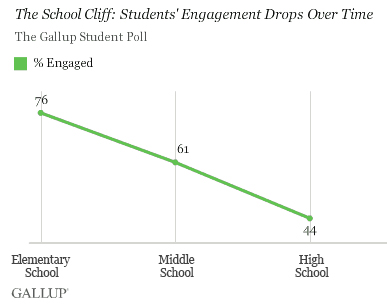
After a little guessing and estimating, I revealed this graph resulting from a recent Gallup poll on student engagement during my 9th grade statistics class today:

Gallup Graph

The kids were fired up right away.  Even if students agreed with the representation, it seemed as though every kid wanted to share his or her interpretation of how student engagement changes over time.  They shared their experiences from their formative years of education and respectfully expressed their frustrations for how much more difficult school gets each year.  Surprisingly, the students seemed to place blame for the overall decline in curriculum immersion on themselves.

Until one boy opened up the floodgates with the proclamation, “In elementary school we get to learn by messing around with stuff.  In high school, all we ever do is listen to the teacher talk and do boring worksheets.”  Expecting me to dismiss this kid’s comment for daring to suggest that the burden of student engagement also lies on the teacher, the class was relieved when I asked this student to expand on his thoughts. Almost simultaneously, multiple hands shot up in the air agreeing with this sad truth many of them were thinking and this young man had the courage to say out loud.  A rich, important, respectful discussion ensued about the difference between being busy in class copying, listening, and doing and being engrossed in activities that facilitate learning.

We continued the conversation by critiquing the methodology used to collect the data for this poll and the misleading representation in the graph.  Sorry, Gallup, my 9th graders spotted the flaw in the using in a self-selected study to represent all students right away.  They also debated the validity of broad categories such as “Elementary School” represented only by 5th graders rather than K – 5.

We discovered that the actual Gallup Student Poll is available online.  The students agreed that Friday was probably not a good day to do a survey about school engagement, but we’re really looking forward to collect and analyze the data on their classmates.

Puzzling Perseverance

School mathematics has a bad reputation for being intellectually unattainable and mind-numbingly boring for many students.  Proclaiming the falsity of these beliefs is usually not enough to convince kids (or people in general) of their untruth.  Students need to experience their own success in mathematics and be given the opportunity to engage in curiosity-sparking mathematics.  For me, one of the very best moments in a classroom is when a self-proclaimed math hater fully engages in a challenge and is motivated to work hard to arrive at a solution.

Enter January 2nd and 3rd.  Students are back for a two-day week which they view as punishment and a rude-awakening from a restful winter break.  To boot, the Governor Dayton announced today at about 11 am that all Minnesota schools will close Monday, January 6th due to impending dangerously cold weather.  You can imagine where the motivation level was in school today.

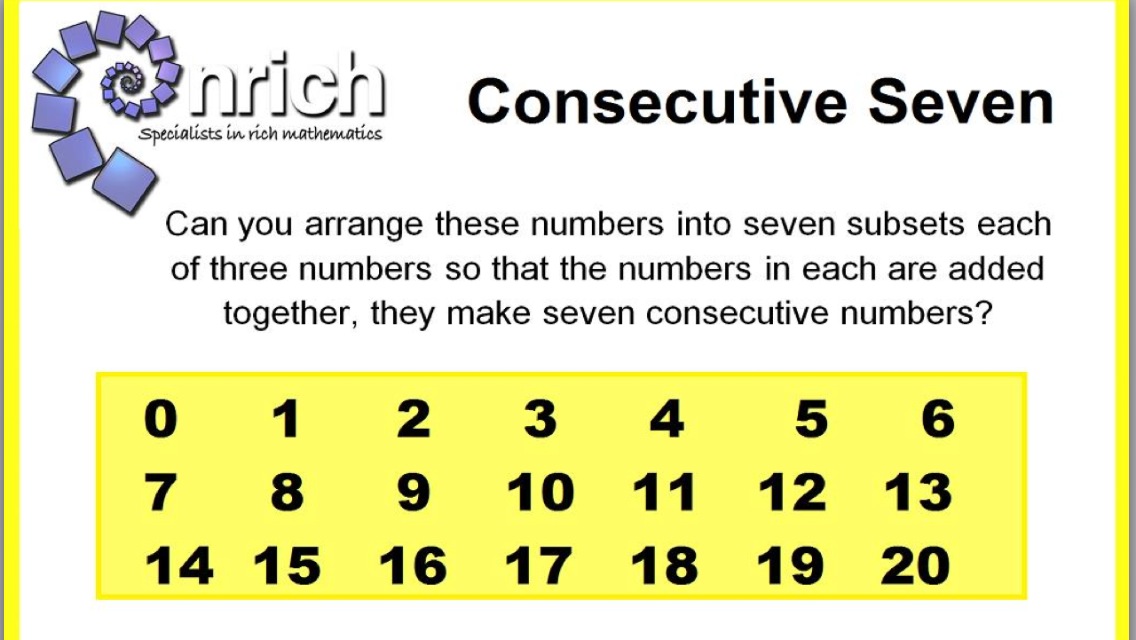
As the CEO of room 114, I decided to make an executive decision and do a puzzle from Nrich (shocking, I know) in my probability and statistics class.  Technically, the students could use the mean or median to help solve the problem, so I wasn’t veering too far off of what I had previously planned.

The Consecutive Seven puzzle starts like this:

IMG_2684 

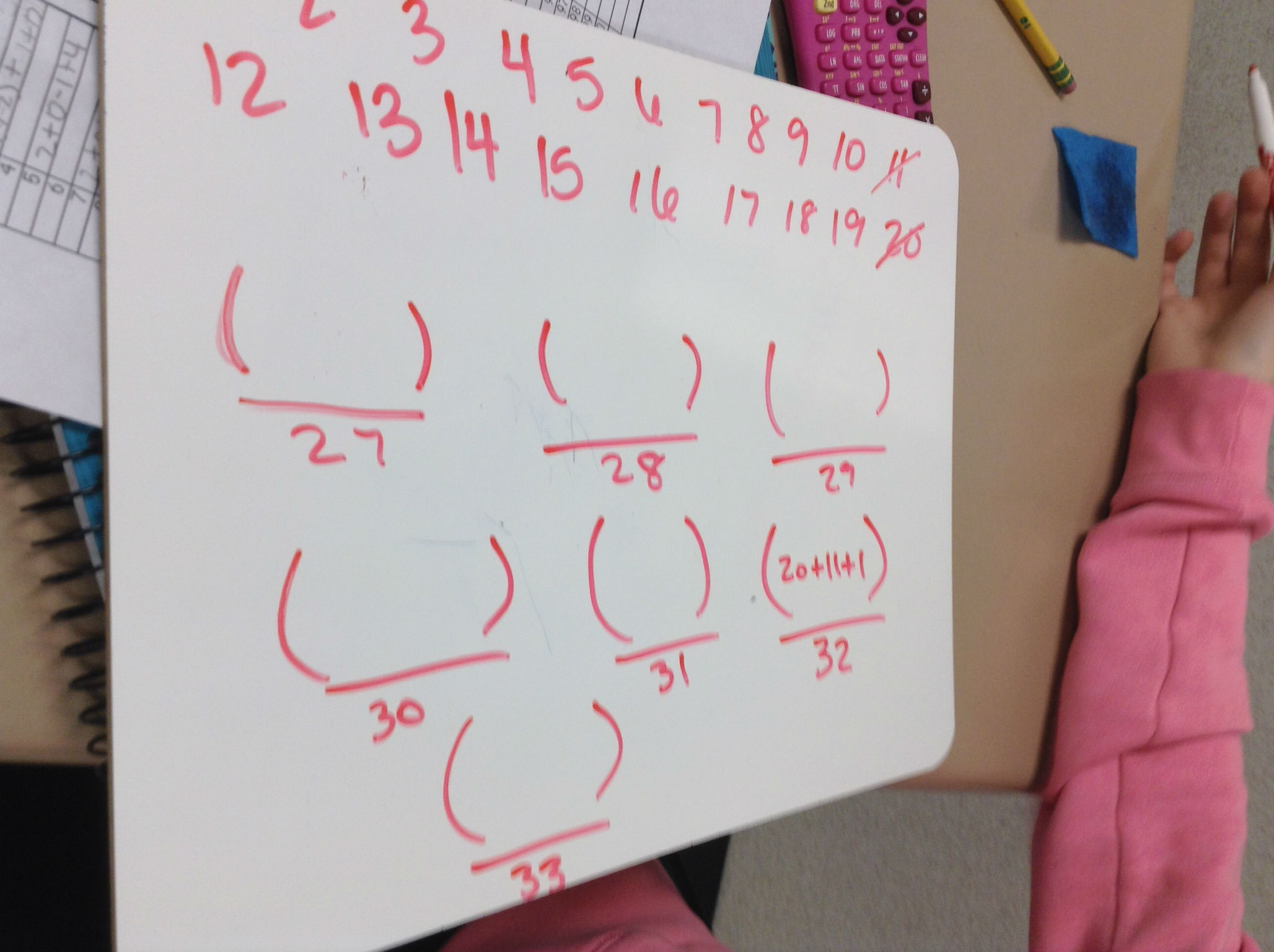
Initially, one student began by explaining to me that she took one number from the beginning of the set, one from the middle and one from the end.  Then she figured the other consecutive sums needed to be above and below that number.  (Spoiler alert:  These numbers actually end up being the seven consecutive sums, so I was very interested in her explanation of how she arrived at those particular answers.  )

IMG_2668

It’s worth noting that this student’s first words to me at the beginning of the trimester term were, “I hate math and I hate sitting in the front.”  So you can imagine my excitement when she dove in head first into this particular task, happily and correctly.

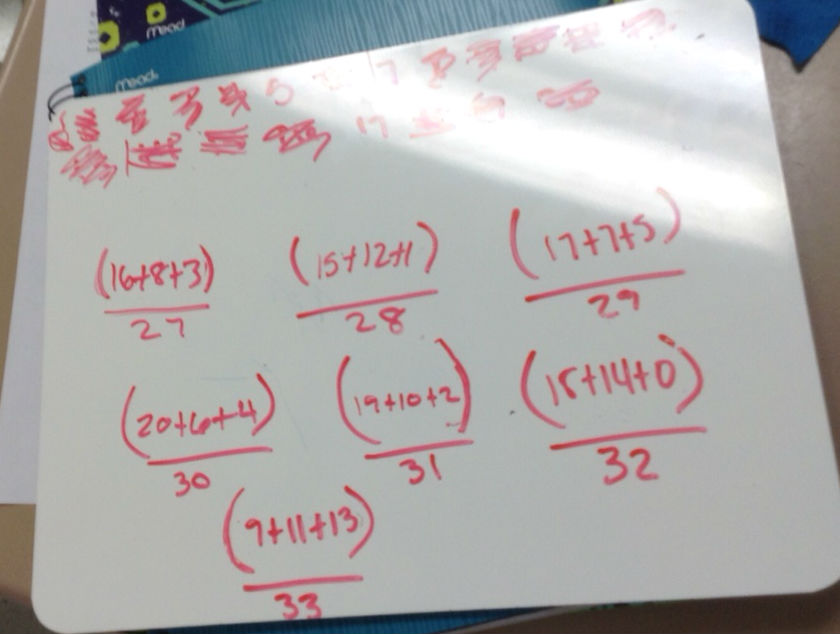
Adding to my excitement about the class’s progress, another girl (who was equally enthusiastic about math at the beginning of the term) was the first one to arrive at a correct solution.  And although she probably wouldn’t admit it, she was thrilled when I took a picture of her work.  And I am more than thrilled to display it here:

photo 2

If you were wondering about how math-love girl #1 fared in completing the task, she persevered and impressed her skeptical cohorts:

photo 1

This phenomenon fascinates and excites me that students, when confronted with a puzzle, highly engaged and motivated throughout the lesson.  Dan Meyer summarized this idea nicely on his blog recently:

“The “real world” isn’t a guarantee of student engagement. Place your bet, instead, on cultivating a student’s capacity to puzzle and unpuzzle herself. Whether she ends up a poet or a software engineer (and who knows, really) she’ll be well-served by that capacity as an adult and engaged in its pursuit as a child.”

And who knows.  Maybe one of the girls featured above will become a puzzling poet.

Curiosity Driven Mathematics

In my very first years of teaching, I used to have students ask me, in that age-old, cliche teenage fashion, “When are we ever going to use this?”  I vividly remember my response being, “Maybe never.  But there are plenty of other things we do in life, like play video games, that have no real-world application. That doesn’t seem to bother us too much.”

In fact, if every moment of our lives needed to apply to the bigger picture, the REAL-world, when would we do anything for pure enjoyment? or challenge?  or even spite?  I know kids are capable of this because some of them spend hours upon hours a day engaging not only with a video game but also collaborating with other people through their game system.

And furthermore, where do we think this resentment for learning math really comes from?  I have a guess…probably adults who have realized that through the course of their lives, being able to solve a polynomial equation algebraically is not all that useful! News flash, math teachers:  Our secret is out! 

There are many kids across all levels of achievement that will not engage in the learning process simply because the state mandates it or the teacher swears by its real-world relevance.  Students (and arguably people in general) are motivated by immediate consequences and results and cannot easily connect that the algebra they are learning today will be the key to success in the future.  They do not care that if they don’t nail down lines, they’ll never have a prayer understanding quadratics.  If they are bored to death by linear functions, I can’t imagine that they have even an inkling of desire to comprehend the inner workings of a parabola.  

What does resonate with learners is the satisfaction of completing a difficult task, puzzling through a complicated scenario, or engaging in something for pure enjoyment.  Kids are naturally problem-solving balls of curiosity.   There are ways to provoke curiosity and interest while simultaneously engaging in rich mathematics.  I think many teachers assume that in mathematics, especially Algebra, curiosity and deep understanding need to be mutually exclusive, and I’m positive that mindset is dead wrong.  For example, show this card trick to any group of kids, and you’d be hard-pressed to find a group who isn’t trying to figure out how it works.  I also think you’d be hard-pressed to find the real-world relevance to a card trick.  It’s still no less amazing, as well as algebraic.  


The fabulous life of Megan Schmidt

I read an article recently that asked when being “busy” became the new black.

When we ask students how they are, we always get the same answer: tired. Teachers, on the other hand can always be counted on to tell you how BUSY they are. Sometimes, you’ll even be lucky enough to get a teacher to tell you, “busy, but good.” As if to say, “I want to be polite, but get the heck out of my room so I can get something done!”

I once asked myself, if I had extra hours in the day, would I use them to be more productive with what I have on my plate? Or would I find new projects to fill up the time? If I’m being honest with myself, I’d have to say it would be the latter.

My day begins at about 5:25 am after about 45 alarm snoozes. I unglue the two beagles that have suctioned themselves to my arms and feet during the night. My husband and I leave to drop our daughter off at Montessori at 6:15. I want to take this moment to acknowledge how blessed I am to work at the same school as my husband. Getting to drop our daughter off together is a priceless bonus. I’m always drawn to the different building sets and usually sit down and play with her before we head off to our own school.

We try to arrive a little before 7am which doesn’t always happen.  Our school day starts at 7:25am so those 25 minutes can be pretty frantic.  Lunch goes into the fridge in the math office on my way to my room.  Then I walk into my classroom and wonder why I left it such a mess the afternoon before.  I then organize my paper stacks to give my desk some semblance of order.  I then need to run upstairs to grab copies, say hello to the office professionals up there, and hit the bathroom (very important).

We run a 5 period, trimester schedule, which makes each of our classes 68 minutes.  First hour is math recovery, which is about 20 kids that have failed a previous math course.  Their abilities are all over the place and their motivation to do mathematics is as well.  It’s a challenge to engage them sometimes, but they’ve gotten to know Andrew Stadel pretty well.  As Mr. Stadel talked about in his recent post, I too have acquired some puzzles over the course of the last 9 years and let this class work with them during the last 20 or so minutes of class.

Second hour is college algebra so I’ve got 7 minutes to run to the bathroom (I know but I drink a lot of soda).  This class is amazingly exhausting.  I’ve been just blown away by the mental power in that room.  When I give them a problem, those kids go AT IT.  I swear that the brain sweat is palpable.

Third hour is my prep period.  I have a million things going on during this 68 minutes since I am also the head of our department.  I never feel like I get enough done, but is there any teacher that feels like they are caught up ever?

We then have a 28-minute “study hall” time where kids can study, meet with clubs, go to the media center, make up assessments, etcetera.  Most students use the time to sit and chill out.  I don’t blame them; high school demands a lot.

At about 11:30, 4th hour officially begins.  This is an advanced probability and statistics course, and it has been fun to challenge these kids with real world scenarios.   These kids are naturally curious, and we often spend an entire class period discussing a problem and all of the statistics that come into play.  I end that class period wishing I taught it more than once a day.

It’s now 12:41.  Yep, the day starts at 7:25 and some of the kids don’t eat until 12:41.  Brutal.  I run to the bathroom, suck down my kale salad, and laugh with my co-workers.  One great thing about my department is lunch usually brings about hilariousness for one reason or another.   I really enjoy that comradery and I’m very lucky to be part of a department that enjoys one another.

1:17 is the beginning of 5th hour, so I will of course need to run to the bathroom one last time.  This class is college algebra again.  This is the last hour of the day, so the kids are a little more energetic but no less mathematically clever.

The bell rings at 2:25 for the day.  Unless I have a meeting after school, I leave between 2:50 and 3:30.  I want to get my T25 workout done before I pick up my daughter from her school.  (T25 is a great workout program from Beachbody.  Best workout I’ve ever done.)

Once my daughter is home, we usually build with Legos, play a game, or make a fort.  Bedtime routine starts at 6:00 so it’s not long before we are watching her allotted half-hour of TV and then reading books.  (I try to suggest Team Umizoomi everyday, but their mighty math powers are usually trumped by Minnie and her Bowtique.)

She’s asleep by about 7:30pm and we won the kid sleeping lottery, so unless it is an extreme circumstance, we don’t hear from her until we wake her in the morning.  Now it’s time to catch up on blogs, lesson plans, working through problems, or adding student feedback.  Since mathematics has also become a personal passion of mine, working on these things at night is enjoyable as well as productive.

I enjoy most of my days because I have a pretty positive outlook on being a teacher.  I have a strong belief that what I do makes a difference and that belief is what drives my passion for teaching.  When you show kids that you believe in them, there is a tremendous benefit to both you AND them.  Each day, I try to spread that to my students.  If they know that I believe in them first, they are more likely to believe in themselves and achieve more mathematically.