Class: 9th grade prob and stats. Topic:  Linear regression.  Enter: the Laundry Data.

The data sheet seemed to spark a LOT of curiosity.  In retrospect, I wish I would have given them some time to Notice and Wonder about the detergents.  Probably I’d also add some estimation first about these bottles of detergent rather than just handing them the data.  I should have known better.

Still, an interesting discussion ensued about ounces of detergent and loads of laundry.  We plotted the points on Desmos and wanted to choose two of them to create our linear model.  I teach three sections of this class and all three classes picked different points to make their equation.

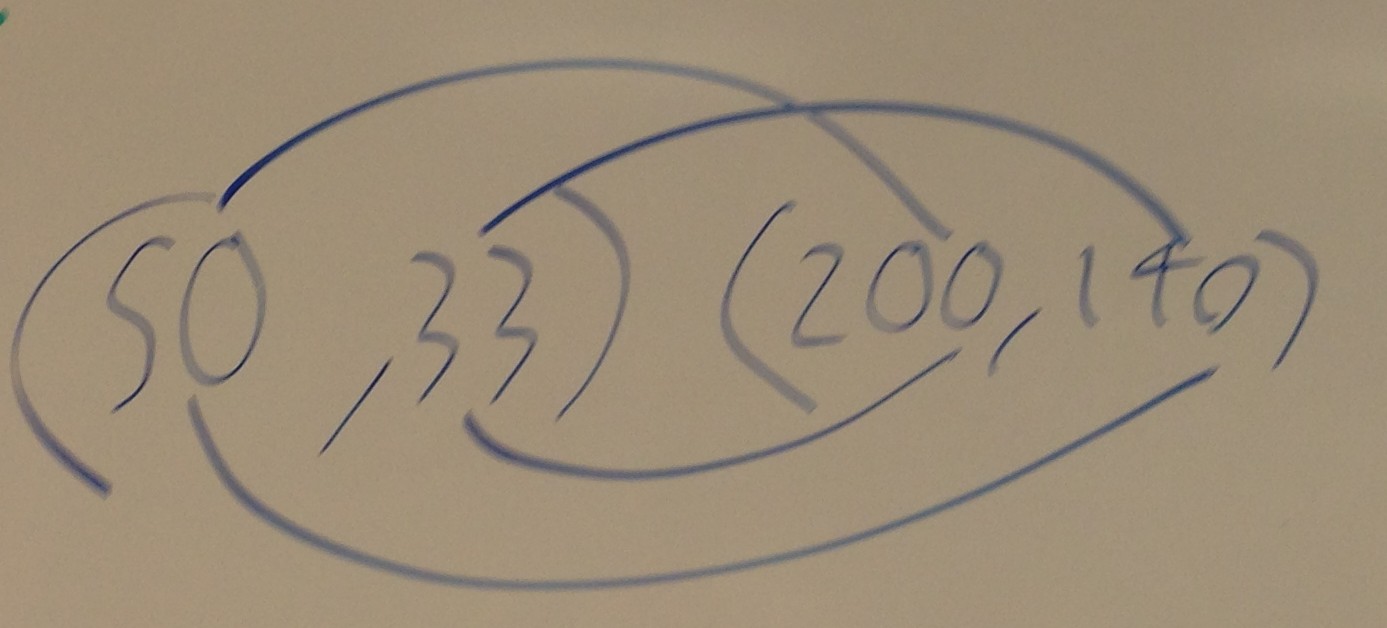
One class picked (50, 33) and (200, 140), and after determining that they needed to find the slope in order to write the equation of the line, I posed that question to them.  How would we find the slope between these two points.  Crickets.

I want to note that a good minute of silence and eye-contact avoidance went by before one brave student spoke up.

S:  You FOIL them.

Me:  Can you explain what you mean by that?

S:  (coming to the board) You multiply them like this.
IMG_5025

Me:  What do we think of what S just wrote up here?  (at least 8 hands shot up in the air)

Me:  Please put your hands down and let’s discuss this.  What I like about what S just did here is he got us started somewhere.  He was willing to take a guess and risk being wrong.  Before S showed us his idea, no one was willing to volunteer their method.  Now that S has broken the silence, lots of you seem ready to discuss.  Thank you S for starting us somewhere.

After this student broke the ice, we came up with about 4 ways to determine the slope of this line and about 8 ways overall to figure out the equation of the line between these two points.  In the past, I would have said to this student, “No, we don’t FOIL, who has another idea?”  Now I know that allowing this student to explain his method does multiple things.  First, it helps the other students practice patience and courtesy when listening and responding to this student whose solution they know is incorrect.  Second, it is a great opportunity for students to engage in SMP #3: Construct viable arguments and critique the reasoning of others.  Third, it provides an opportunity to praise the value in providing the wrong answer.  So much of math class for these students has been about getting the right answers.  I’m glad this teachable moment came about for students to learn from the wrong one.

The Satanic Sheep in Class

Here’s the backstory:    And I was overstressed by situations not involving my students.   My goal for the day was to not take my undue stress out on students.  A student in one of my classes finds what most would call odd (like satanic sheep) to be particularly amusing. I’m sure you’ve had many of these cherubs in your own classes. This day, it was the sheep, horns, fire, a devil’s tail, the works.  I was mildly intrigued at this point.  This kid then made a rather punny joke about his creature having steel wool.  This exchange of oddities had me forgetting about my tough day and laughing at the cleverness of a 9th grade boy.

Satanic Sheep

Since this event, the student has stepped up his math game tremendously.  He has demonstrated over and over his intuitive numerical abilities as well as his persistence in solving difficult problems.  He adds his own creative edge to my class as well as strives to thoughtfully engage in the activity at hand.

I kept the picture and put it in a prominent place on my desk as a reminder that what first comes across as outlandish and tough has soft bleating heart underneath.   I think a lot of people don’t see past the satanic sheep and miss the creative, caring, hardworking problem solver underneath.   My challenge to you: find a “satanic sheep” in your class.  Show them you appreciate the creativity they add to your classroom mix.  You may be pleasantly surprised at what comes next.


Earth Day Trash or Cafeteria Treasure?

I had intentions of scouring the internet for the perfect Earth Day activity. Luckily, I came across this:
I saw Beyond Traditional Math’s lesson on the Pacific Garbage Patch, and more than anything, I was impressed with his work and inspired to learn more about this floating mass of plastic-y mess twice the size of Texas floating in the Pacific Ocean. His focus on this Plastics issue made me examine where this permanent substance permeates our lives.  In short, every single piece of plastic that has ever been manufactured is still on earth today. Every. Single. Bit.

I showed this video from the blog post in my classes today:

I supervise the lunch room each day for about 30 minutes and I was in awe as I watched student after student empty his or her tray into the garbage.  Each time, I watched at least one plastic utensil fall into the trash.  One, after another, after another.  I inquired with the cafeteria staff how many of this flatware was disposed of each school year at our school.

Stop for a second:  1500 high school students.  How many plastic tableware do you think we toss out every year?

According to the super-helpful cafeteria staff, we started the practice of using disposable forks, spoons, sporks, and knives after it was discovered that much of our metal silverware was ending up in the trash.  (The pig farmer that collected the compost for feed was not too keen on metal spoons ending up in his pig feed.)  I was informed that we go through as a high school, about 3 cases of forks, 2 cases of spoons, 2 cases of sporks, and 1 case of knives each week.  That’s 8 cases, 1000 per case, every week, for 40 weeks.  320,000 pieces of plastic, every school year, in the trash.  And that plastic lasts forever.  In the trash.

Now, I didn’t want to go about suggesting to a hardworking group of school cafeteria employees that they should change their utensil type because I’m on an Earth Day mission.  But, I thought it was an interesting question to pose to my 5th hour Algebra class:  which would be better to use and why?

I was very impressed with the detail and consideration they applied to the question.  How much metal silverware would be needed to supply the entire school for a day?  Is there time to wash them between lunches?  Between breakfast and lunch even?  Should we consider that extra labor and water cost in the price of the metal tableware?  How would we estimate that?  How can we condition the entire school to stop tossing the silverware and throw it into a separate bin when returning trays? Wouldn’t the metal utensils end up in the trash, costing more money?

We found out that there was definitely a financial savings when purchasing metal utensils of approximately $1500 per year.  I asked the students to weigh in on whether this was worth the hassle of the switch.  I love the interesting answers I get from questions like this.  I didn’t necessarily know what to expect, but I got some very thoughtful answers which considered many of the variables in play in this situation.  The discussion seemed to indicate that the students recognized that even a small switch like plastic or metal utensils requires careful consideration and precise implementation and wouldn’t operate like an on/off switch.  A good day.

Catwalk Mystery

I wanted to quickly share an awesome activity that is usable in a variety of classes.  A website I use occasionally to browse teacher resources is TES.  This UK based site is a treasure trove of shared lessons and activities.  This gem, Amelie’s Fashion Mystery starts with a simple question:  Will Amelie make it to the catwalk in time?   Students work through mathematical clues in order to determine if this supermodel makes it on time to the fashion show.  The task requires students to utilize a huge range of math skills and is differentiated with two versions.   Thank you Jake Mansell for a great activity.  Here are the files:   AmelieFashionMysteryintroslideandvisibilitygraph AmelieFashionMystery(visibilityfromgraph) AmelieFashionMystery(visibilityfromformula) (1)

Creative Craziness

I teach a lot of 9th graders this trimester. We offer a class called probability and statistics 9 and it is open to 9th grade students who also will have had the quadratic portion of algebra 1 this year. I really enjoy this class for multiple reasons. First, it lends itself very well to applying math to real-world scenarios.  Secondly, the hands-on opportunities are endless.
One of the issues I have been committed to improving with my own professional demeanor is the way I deal with 9th grade boys. Nothing brings out my sarcastic, short-tempered, disagreeable side like the antics of freshman boys. There’s something about the decision to play soccer with a recycling bin that just invokes the my inpatient side. Regardless, I need to develop more patience with this demographic. Boys are unique, both in the way that they act and the way that they perceive acceptable behavior. I’m not talking about “I’m bored” acting out. I’m talking about the “I really need to see if this eraser will fit in this kids ear” kind of acting out. I think that my short fuse has more to do with my failure on my part to  fully understand them rather than gross misbehavior on their part. What I’m really trying to grasp here is not “why can’t these kids sit still?” But more “when they can’t sit still, what makes them want to kick a recycle bin around the room or toss magnets at the learning target?” I think if I had a better understanding of what drives those behaviors, I could deal with them more productively. Suggestions?

Block Talk With My Kid

I often wonder if my daughter will view the occupational status of her parents through eyes of appreciation or resentment.  Will she loathe the fact that teacher parents are more aware of the goings-on of their child’s academic life? Or perhaps she will more often appreciate that math homework help will be easy to come by at home?  Both of these scenarios have the potential to have a positive impact on her achievement.  However, I had a profound realization today that what actually will help my daughter be successful is maybe neither of those things.  While she may not be able to get away with teenage class antics as easily as her peers whose parents are not teachers, I do not think that what my husband and I provide for our daughter’s intellectual growth is something that only teachers can give.  ANY parent can engage in rich conversations with their children and see a growth mindset at work.

I want to give proper credit to Christopher Danielson for his Talking Math with Your Kids website and book that drew my attention to how I was interacting with my child mathematically.  As a secondary teacher, I am grateful to have gotten a better understanding of how number sense develops in young children and how I can help foster that development.  Danielson’s website, Talking Math with Kids has been invaluable in recognizing the everyday math conversation opportunities to have with my daughter.

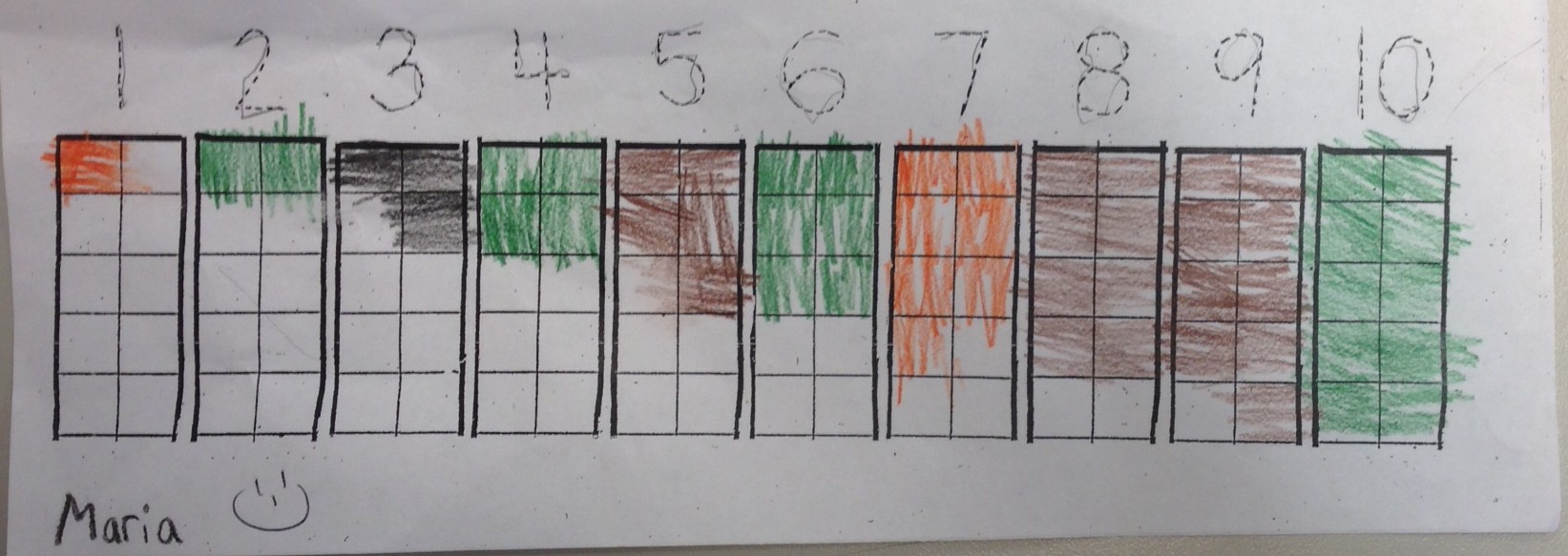
Her preschool days have been spent at a Montessori school.  Although the noodle necklaces, punch cards, and snips of paper are an everyday treat, I was particularly excited when Maria came home with this gem the other day:

IMG_3225

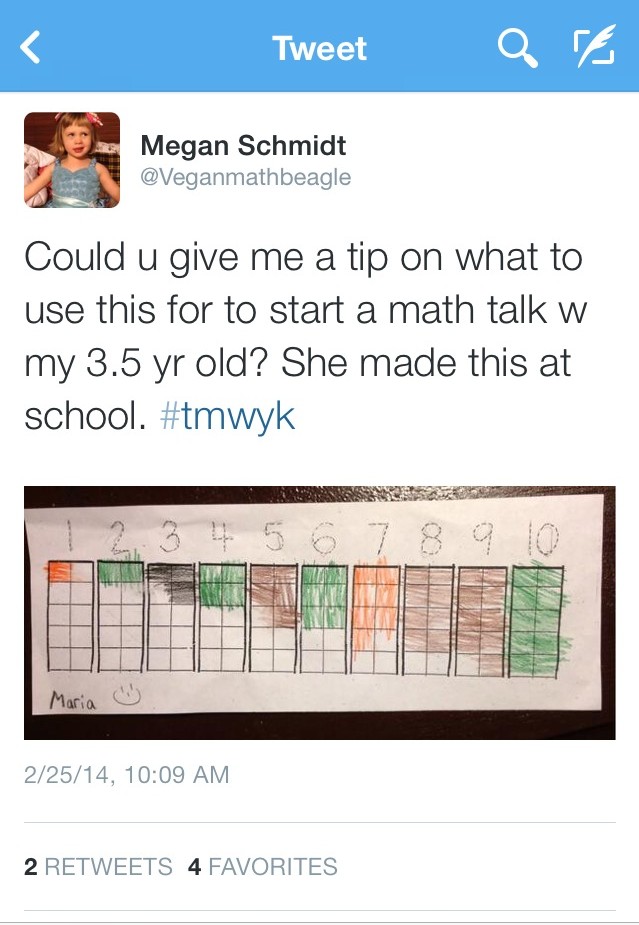
Of course my immediate excitement was over the fact that the correct number of squares were colored for each number.  But then I realized that there might be a rich math conversation potential involving that worksheet.  But, I had no idea what to do with it.   I threw it out on Twitter and got many great ideas, including:

IMG_3226 Tweet Response 2 Tweet Response

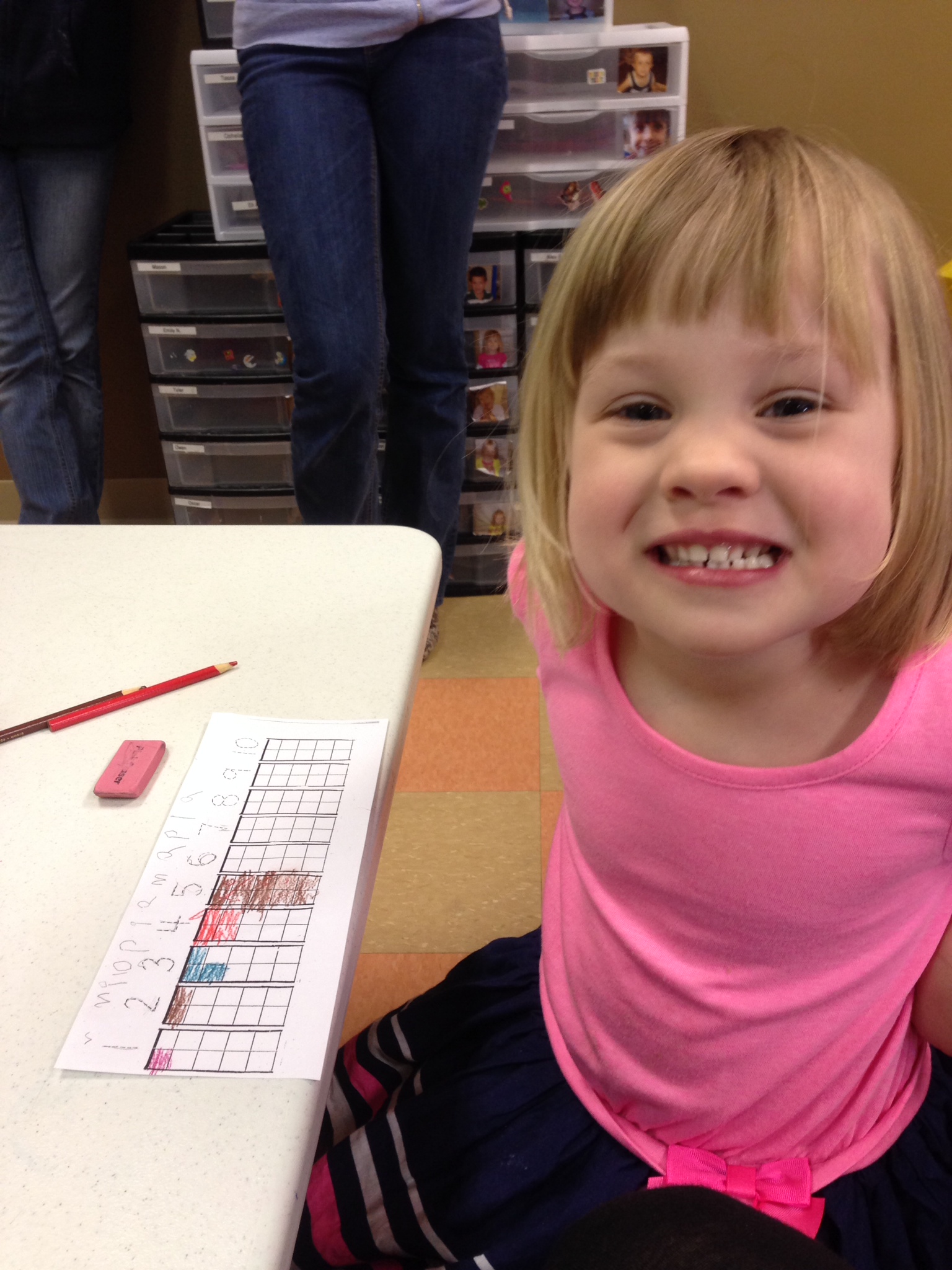
Friday was Parent Day at Montessori Central, so I took this as an opportunity to talk some math with my kid.  Luckily, I talked her into this same worksheet.  We explored all kinds of great number-driven curiosities:  which ones make squares, which ones make rectangles, which ones make neither?  How many squares are left over after it’s colored?  How are the rectangles for 2, 4, 6, and 8 alike?

I realized after that experience the limitations of the number worksheet.  For instance, the numbers at the top, while providing an opportunity for “tracing,” don’t allow the learner to explore a particular number any further.  I wanted Maria to explore more ways to color 6 boxes, but her 3.5 year old brain saw the “7” above the next 10-block and would not allow it.  Some worksheet surgery might be in my future.

I do not think that being a teacher makes these conversations natural.  I saw something was mathematically correct, but I didn’t have much experience with turning that into a real mathematically rich conversation with my daughter.  I’m thankful for both the math teacher and parent twitter community for throwing ideas my way.   Any parent is capable of taking something they like and turning it into a teachable moment.   When interacting with our kids, we need to do less showing and more asking; less telling and more listening.  She seems happy about it, doesn’t she?

IMG_3222

Diagnostic Questions – A Tribute

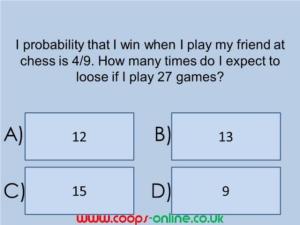
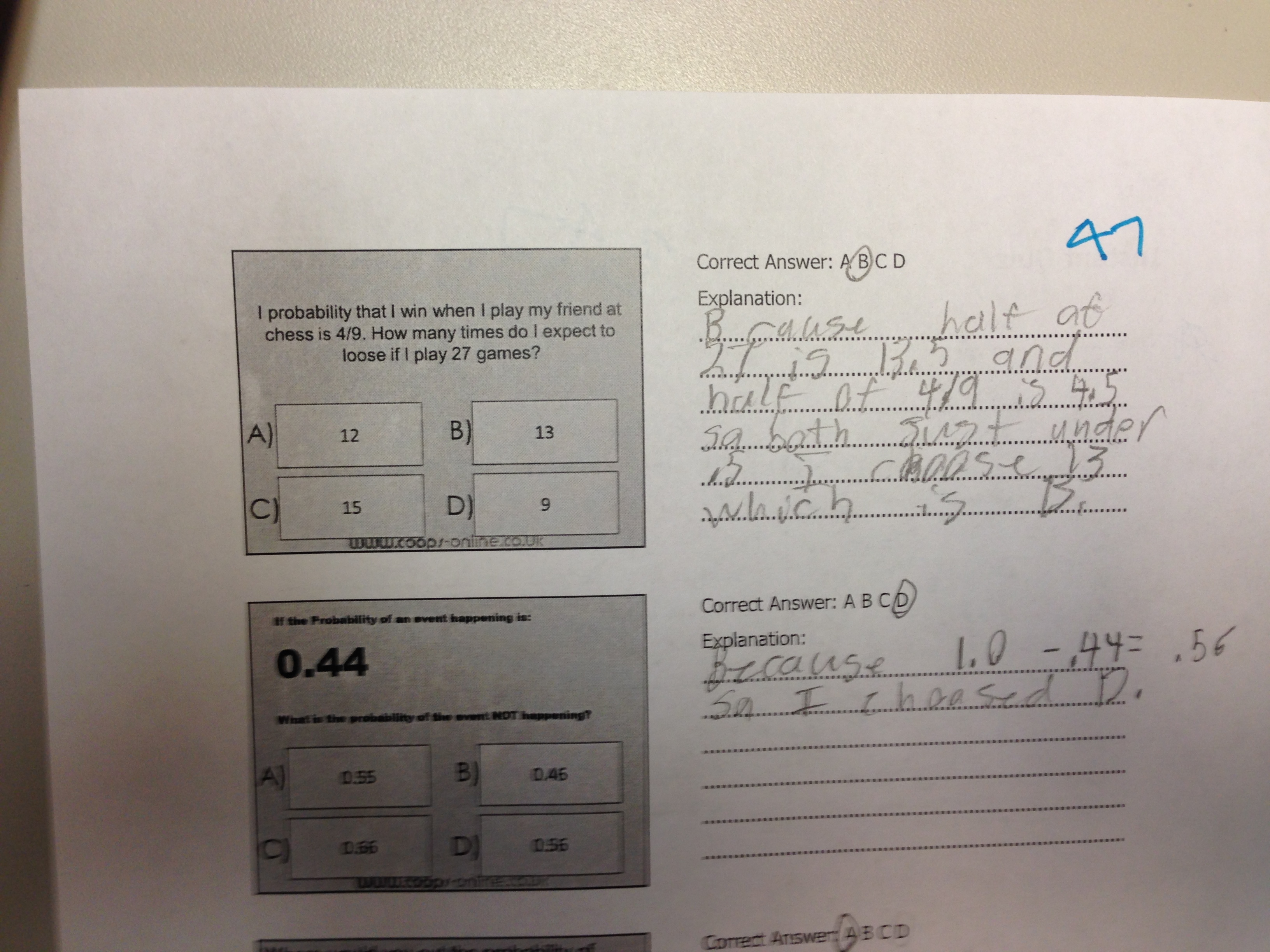
The brilliant Diagnostic Questions website has been live for a few months now.  After using it once, I’ve completely convinced of its profound positive potential in my classroom.  Craig Barton and Simon Woodhead really have outdone themselves in creating a database of diagnostic questions.  If you have struggled with anticipating student responses or identifying sources of errors, this resource is a total winner.  The site allows teachers to quickly create quizzes that identify student misconceptions.  For example, here is a question from the ‘Probability – Experimental’ section:

 diagnostic-question-926

All of these answers are carefully crafted so that the teacher can see what students aren’t grasping. Here is an example of student work:

IMG_4105

Now I’m able to see how this student got 13, rather than just marking it wrong and moving on.  Obviously this isn’t a new phenomenon to have students explain their answers to multiple choice questions.  However, two key features of this website make it noteworthy above other sites that feature multiple choice questions:

1.  The deliberate multiple choice answers chosen to manifest misconceptions

2.  The easy-to-use format of the site allowing teachers to quickly create, administer, and grade these quizzes.

Thank you, Mr. Barton and Mr. Woodhead for this tremendously helpful tool.  I look forward to contributing questions to your database in the near future.

She Defines Resilience – One Year Later

We are defined not only by what we do, day to day, but also by how we react and utilize our seemingly random hand of cards in life.  I’ve found over 33 years of life, the mark of character that differentiates those who excel and succeed from those who do not is resilience.  I can point to former students as examples:  The college graduate who grew up with an absent mother and a drug addicted father? Resilience.  The home-care nurse whose parents didn’t value an education past high school?  Resilience.  The successful plumber whose best friend committed suicide his sophomore year of high school?  Resilience.

It seems fitting to give a Webster’s definition of resilience here, however, I think that we all can picture individuals who personify our meaning of the word.   For me, above all, those people are my brother, Matthew, and my sister-in-law Danielle.   This story isn’t about me, or my reaction to this event.  It’s about them and what they have taught the world about resilience and the power of hope.  I hope my intentions come across as I recap their story.

One year ago, January 30th, 2013, Danielle, while finishing up a nursing clinical suffered a massive hemorrhage resulting from a burst aneurysm on the right side of her brain.  She was rushed to the local hospital where she was taken into surgery and given a very bleak prognosis.  The sobbing ER doctor explained to my brother that his wife was probably going to die.  My younger brother, who I’d always joked as being “30 going on 19” now was faced with an incomprehensible, life-altering situation.  He captures his emotion poignantly on a Caring Bridge post about the account of the moment when he told that doctor, as well as the hospital chaplain to F-ing get his wife to Iowa City!  I think those words have defined his attitude on the situation that it does not matter what has plagued us in the past.  He knew she had much more to give this world, so let’s get out of her way so she can fight to give it.

Reflecting during anniversaries of events seems to be a cultural norm and a time to remind ourselves of where we came from and how much further we have to go. A year ago today, we watched in udder horror and shock as Danielle lay motionless, lifeless, with small tubes ushering blood from her brain.  Furthermore, we observed silently as every half an hour, a nurse would shine a light in her eyes and ask for a reaction that never came.  “No change,” became the most chilling words I’ve ever heard.  I didn’t say it at the time, but I went to bed that night believing our precious Danielle was most likely gone.

The next day brought new light, and a miracle.  The overnight nurse said she had never seen anything like it.  When prompted to wiggle her toes, Danielle obliged.  “Thumbs up if you hear me, Danielle?”  And it was the most beautiful thumb I’ve ever seen.  She began her recovery that day and has not stopped since.  In one year, Danielle has gone from “probably going to die” to thriving and living.  Her personality, again, lights up the room as it always had.  She walks with less and less assistance each day and remains poised and confident that she will walk in the Bix 7 this summer.  Every day my brother is there by her side, emotionally and physically.  From the hospital ICU to a rehabilitation center in Ankeny, Iowa.  And now back home, where he’d turn their house upside down if he had to in order to ensure her comfort.

One of Danielle’s doctors said, “When you’ve seen one brain injury, you’ve seen…one brain injury.”  I believe these words are not necessarily a testament to the brain alone but the person in control of it.  Danielle proved that her fate was not finalized and her husband stood by her side believing the same.  These two incredible people inspire me every day to be a better person and to remember that all people fight a battle, in their bodies and their minds.  And I am so thankful for their presence in my life, and the opportunity to learn from them.

Danielle with my daughter, Maria this Christmas.

Danielle with my daughter, Maria this Christmas.

Pattern Power

If you have little kids and you’ve been privy to an episode of Team Umizoomi, then perhaps the title of this post evoked a little jingle in your head. You’re welcome; I’m here all day.

My daughter, although she doesn’t choose Umizoomi over Mickey Mouse as often as I’d like, picked up on patterns relatively quickly after watching this show a couple of times.  She’s 3 years old, and she finds patterns all over the place.  Mostly color and shape patterns, but a string of alternating letters can usually get her attention as well.  These observations of hers made me realize that pattern seeking is something that is innate and our built-in desire for order seeks it out.

High school students search patterns out as well.  For example, I put the numbers 4, 4, 5, 5, 5, 6, 4 so that the custodian knew how many desks should be in each row after it was swept.  It drove students absolutely CRAZY trying to figure out what these numbers meant.  I almost didn’t want to tell them what it really was as I knew they’d be disappointed that it lacked any real mathematical structure.

I’m not as familiar with the elementary and middle school math standards as perhaps I should be, but I’m confident that patterns are almost completely absent from most high school curriculum.  Why are most high school math classes completely devoid of something that is so natural for us?

Dan Meyer tossed out some quotes from David Pimm’s Speaking Mathematically for us to ponder.  This one in particular sheds light on this absence of pattern working in high school mathematics:

Premature symbolization is a common feature of mathematics in schools, and has as much to do with questions of status as with those of need or advantage. (pg. 128)

In other words, we jump to an abstract version of mathematical ideas and see patterns as lacking the “sophistication” that higher-level math is known for.  To be completely honest, this mathematical snobbery is one of the reasons I discounted Visual Patterns at first.  Maybe it was Fawn Nguyen’s charisma that drew me back there, but those patterns have allowed for some pretty powerful interactions in my classroom.   I’ve used them in every class I teach, from remedial mathematics up to college algebra because they are so easy to  differentiate.

I think high school kids can gain a more conceptual understanding of algebraic functions with the use of patterns.  For example, this Nrich task asks students to maximize the area of a pen with a given perimeter.   The students were able to use their pattern-seeking skills to generalize the area of the pen much  more easily than if they had jumped right from the problem context to the abstract formula.  

I also notice that the great high school math textbooks include patterns as a foundation for their algebra curriculum.  For example, Discovering Advanced Algebra begins with recursively defined sequences.  IMP also starts with a unit titled Patterns.   I think these programs highlight what a lot of traditional math curriculums too quickly dismiss:  patterns need to be not only elementary noticings of young math learners but  also valued as an integral part of a rich high school classroom.

Engaging with Engagement

High school students are inherently unpredictable. I’ve been told it’s the condition of their pre-frontal cortex and they can’t help it. I’m sometimes baffled and confused by what intrigues and engages them. If you’ve seen their obsessions with Snapchat, you know what I mean.
Something that always gets teenagers riled up, however, is a statement that challenges their peer group. In fact, I found today, that they’ll engage at a much higher level when presented with data that questions their level of engagement.

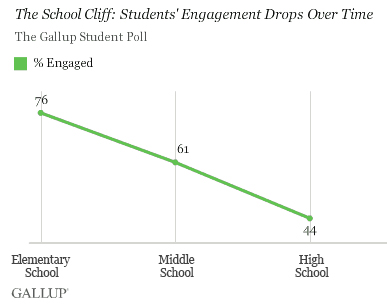
After a little guessing and estimating, I revealed this graph resulting from a recent Gallup poll on student engagement during my 9th grade statistics class today:

Gallup Graph

The kids were fired up right away.  Even if students agreed with the representation, it seemed as though every kid wanted to share his or her interpretation of how student engagement changes over time.  They shared their experiences from their formative years of education and respectfully expressed their frustrations for how much more difficult school gets each year.  Surprisingly, the students seemed to place blame for the overall decline in curriculum immersion on themselves.

Until one boy opened up the floodgates with the proclamation, “In elementary school we get to learn by messing around with stuff.  In high school, all we ever do is listen to the teacher talk and do boring worksheets.”  Expecting me to dismiss this kid’s comment for daring to suggest that the burden of student engagement also lies on the teacher, the class was relieved when I asked this student to expand on his thoughts. Almost simultaneously, multiple hands shot up in the air agreeing with this sad truth many of them were thinking and this young man had the courage to say out loud.  A rich, important, respectful discussion ensued about the difference between being busy in class copying, listening, and doing and being engrossed in activities that facilitate learning.

We continued the conversation by critiquing the methodology used to collect the data for this poll and the misleading representation in the graph.  Sorry, Gallup, my 9th graders spotted the flaw in the using in a self-selected study to represent all students right away.  They also debated the validity of broad categories such as “Elementary School” represented only by 5th graders rather than K – 5.

We discovered that the actual Gallup Student Poll is available online.  The students agreed that Friday was probably not a good day to do a survey about school engagement, but we’re really looking forward to collect and analyze the data on their classmates.