Brain Sweat

I’ve talked about my Algebra 2 class at length on this blog over the last 2 months, and as the trimester comes to a close, I want to celebrate the positives in this class as much as possible.  They frustrate me sometimes, but the bottom line is I’m willing to fight and fight hard to make their experience with math more positive.  Ultimately, they’ve been dealt an unfair hand:  crammed into giant classes and labeled incapable of high-level mathematics.  They are capable of more than they give, but they also deserve much more than they’ve been given.

The perpetual optimist in me wants to continue to celebrate their achievements and play the hand they’ve been dealt as best we can.  Today we took on Robert Kaplinsky’s Cheeseburger Lesson.  I’m not sure why I’m constantly drawn to this lesson, since the picture of the 100×100 makes me a little ill.  Perhaps it’s the constant student engagement I get from it, time after time.  The intriguing thought that someone actually purchased this godzilla-burger hooks students every time.

What I liked most about my class’s efforts toward this task was the multiple revisions they had before arriving at the correct answer.  I had many students assume that a 3×3 cost the same as three cheeseburgers, only to find that their burger only needed one bun.

Below is a student’s work that I really appreciated.  At the end of the activity, he said,

Mrs. Schmidt, I’m sweating.  I thought so hard on this problem that I’m sweating.  But I believe I have the right answer.”

photo 5

If I’m being completely honest overall, this class has tested me, day in and day out.  I’ve worked very hard, but in the end, I’m not sure I taught them much of anything worthwhile.  I hope I have, but I’m not sure I did.  A class size of 36 seemed insurmountable, and perhaps in some ways, I never really overcame it.  Unfortunately, next year’s class size projections promise more of the same.  The silver lining, however, is that I get another crack at teaching this same course, and I’m 100% sure I can do it better the next time around.

Authentic, Value-Added Algebra

About a month ago, my algebra class was working on the Math Forum’s Free Scenario called Val’s Values.  

There was a lot to question here (which they did) and a lot to wonder (which they did as well).  Something that was unsettling, however, was that they did not know the age of Val or Amir which they felt was pertinent to answering a major question:  Who has spent more on jackets in his/her lifetime?

We made some age estimates and answered our own question as best we could, but it felt less authentic than it could have been.  So, we submitted a comment on Valerie’s blog and today our attention to precision was answered with a response.

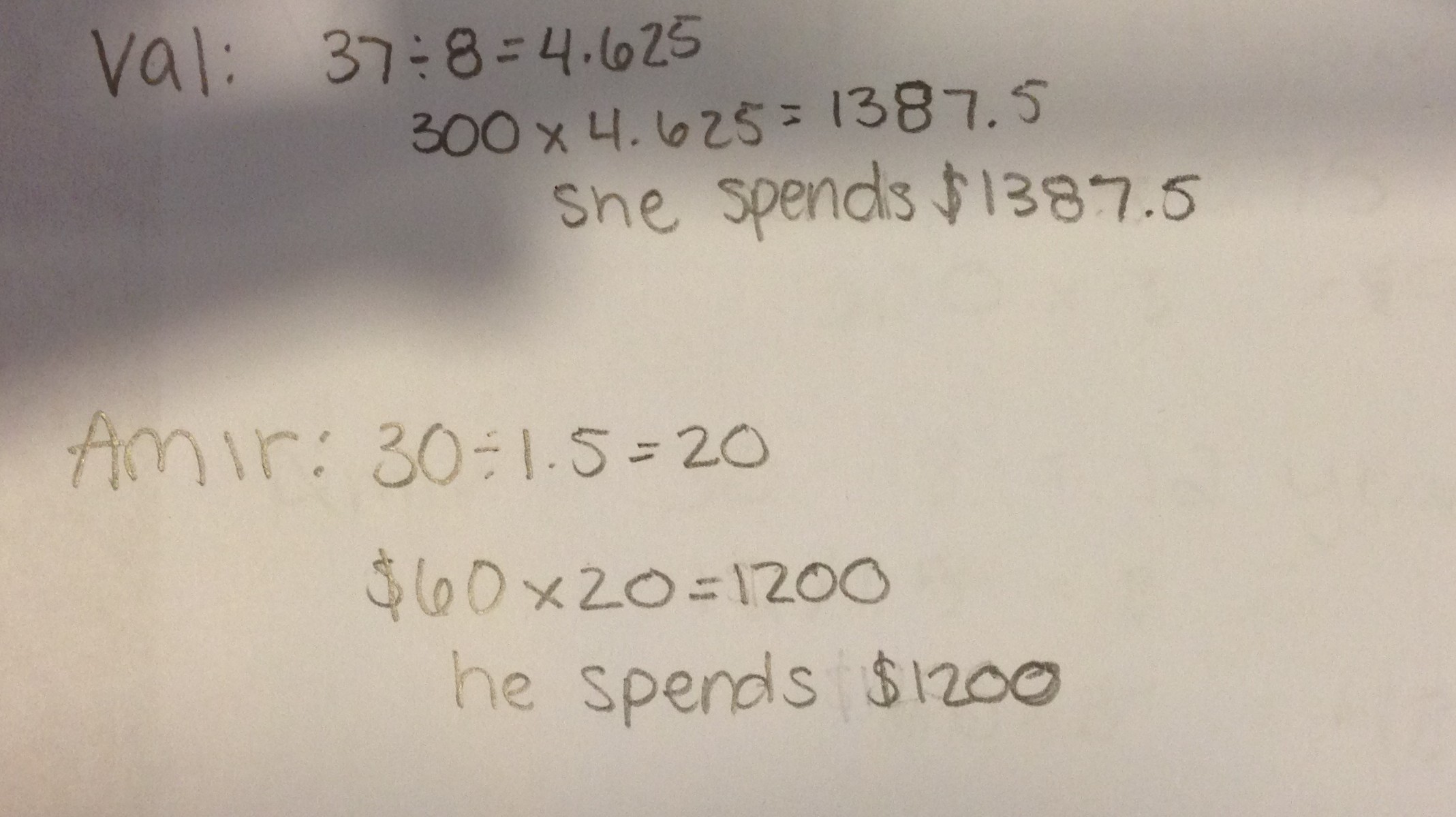
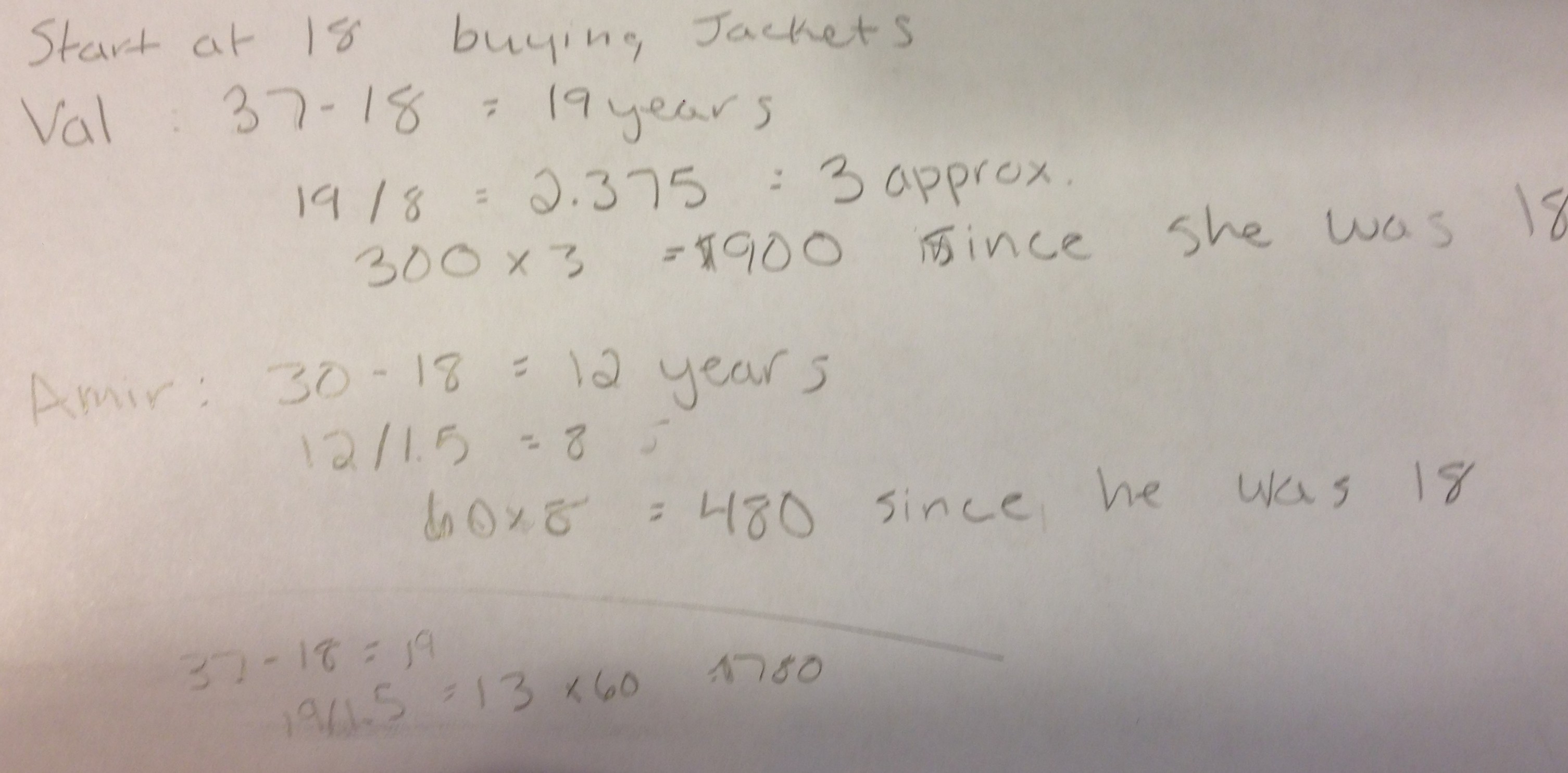
I gave my class another go at figuring out who spent more on jackets.  Here are a couple of their responses:

IMG_5293 IMG_5291

What impressed me overall with their approach to this problem was not necessarily the mathematics itself.  The magic was in their careful identification of important variables and analysis of what mattered and what didn’t.  Additionally, they were able to look past the “right” answer and truly own THEIR answer from THEIR assumptions.  I had very few students ask Is this right?  Instead, they were communicating their methods with one another and challenging the reasonableness of their results.  The spark:  the flexibility of the scenario and the real response from a Math Forum Team Member willing to help add some authenticity to a classroom task.  Thank you, Valerie Klein.  We appreciate it.


Etcetera, etc….

I love it when students figure stuff out.

I love it even more when:

A.  Students figure out things that, as a teacher, I didn’t  notice myself.

B.  Students who are labeled as “not good at figuring stuff out” figure stuff out.

Here’s what we did today in Algebra 2:

number pyramids

This is a SMILE resource from the National STEM Centre.  The problem I thought I would encounter is the word “etc.”  Kids don’t do well with “etc.” Etcetera is vague, non-committal, and easily dismissed.  To a student, etcetera usually means “I’ll ignore this and see if no one notices.”

It is helpful for me to be more specific with my expectations of students, especially when their mathematical well being is at stake.  But today, I was feeling a little vague and non-committal myself, so I handed out the sheet, explained what was going on and let them go…etc.

There are no words I love to hear more in my classroom than “Mrs. Schmidt, look what I figured out.”  And today was chock FULL of those statements.  Here are a few:

  • The triangles are always as wide as they are tall.
  • The sum of the base of triangles 3-wide is 3/4 of the top number.
  • As the triangles get larger, the percentage of the peak number gets smaller.
  • The percentage decrease is related to the size of the triangle
  • If the triangle has an odd numbered base, then the center number in the base is always related to the peak number.

There were lots more.  I was very proud of this class’s resolve in addressing the Etcetera.


If you’re decently competent in the area of probability, you might know that your chances of winning fall below things like “death from a vending machine” and “having identical quadruplets.”  This doesn’t stop many people from playing.  I think playing the lottery is more about the chance to dream of what our lives would be like with that much money rather than actually believing we could win.

In the UK, the lottery consists of picking 6 numbers between 1 and 49.  Any player to match all 6 numbers is the grand prize winner.  The chances of this are certainly astronomically low.  A fun question to ask a class of students:  If we bought a lottery ticket for every different combination of 6 numbers to ensure we’d win, how high would that stack of tickets reach?

In the task Do You Feel Lucky, Nrich tackles the idea of evaluating advice given on raising your chances of winning this seemingly impossible lottery. Students are asked to comment on the validity of the advice given and one in particular caught my eye:

When picking lottery numbers, choose numbers that sum between 100 and 200 because the total is rarely outside this range.  

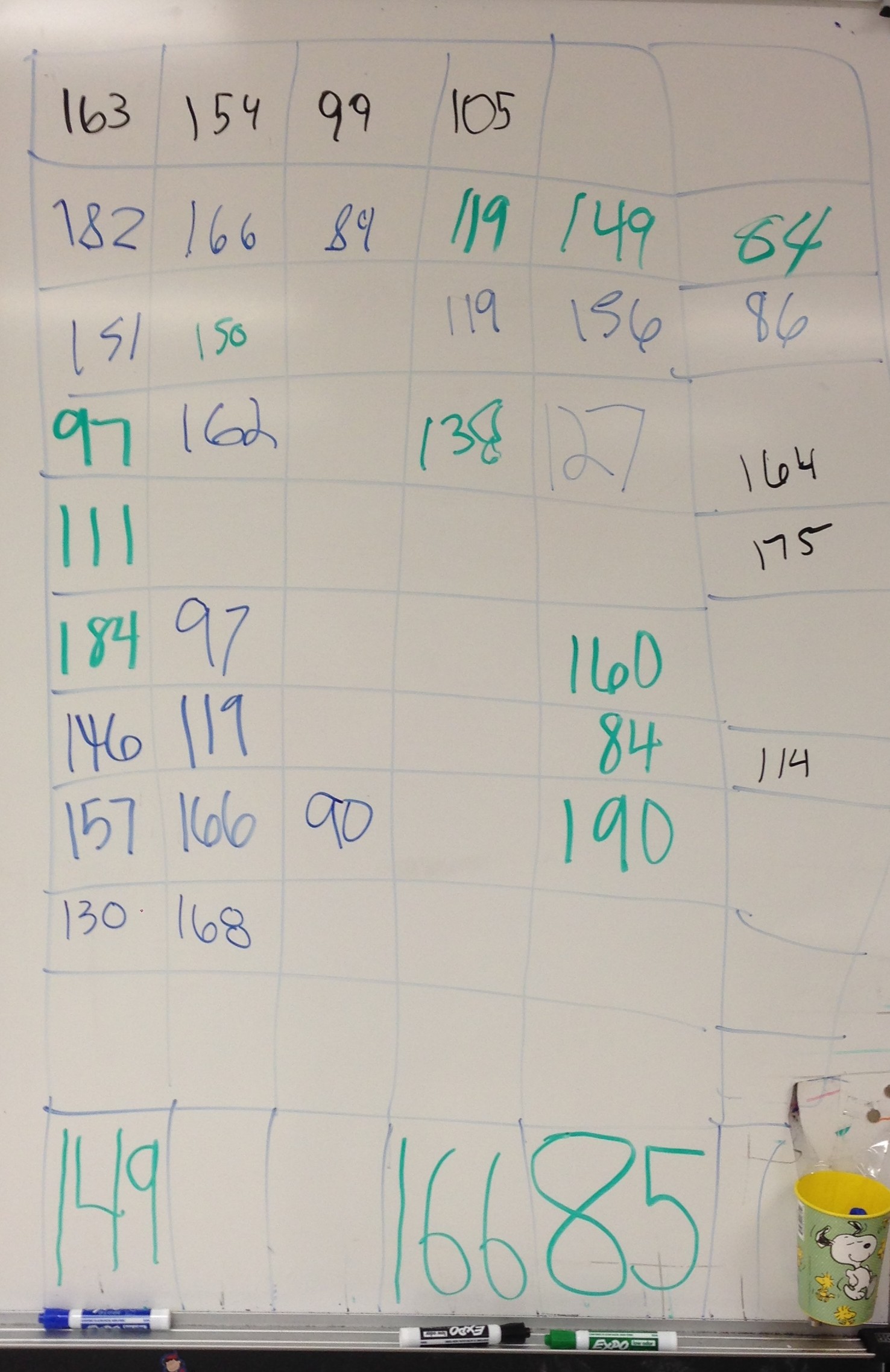
Whoa.  There are so many ways we could evaluate the validity of that claim.  So I sent my students off to the races. Most of them wanted to use a random integer selector and then gather the data from the class’s trials.

IMG_5135

GeoGebra Results:

Lottery

Lots for them to talk about here.  Lots of questions for them to ask as well.  Does the range seem too wide?  Do we have enough trials?  What do we make of the dip in the middle?  Should we change the bar graph to have different class sizes?  Would a box plot have been more appropriate?  What about the descriptive statistics?  Would those help us out?

I’m hoping next year to extend this into more of a class activity rather than an impromptu discussion.


Nrich’s Digit Doozy

If you are a math teacher who hasn’t taken some time to get lost in the problems on Nrich, stop reading this and go there  right now.  You’ll need to finish reading this post tomorrow because that’s how long you will be immersed in its seemingly endless array of engaging problems.

Today, my intention was to do a little starter activity with my 9th graders to help support their number sense.

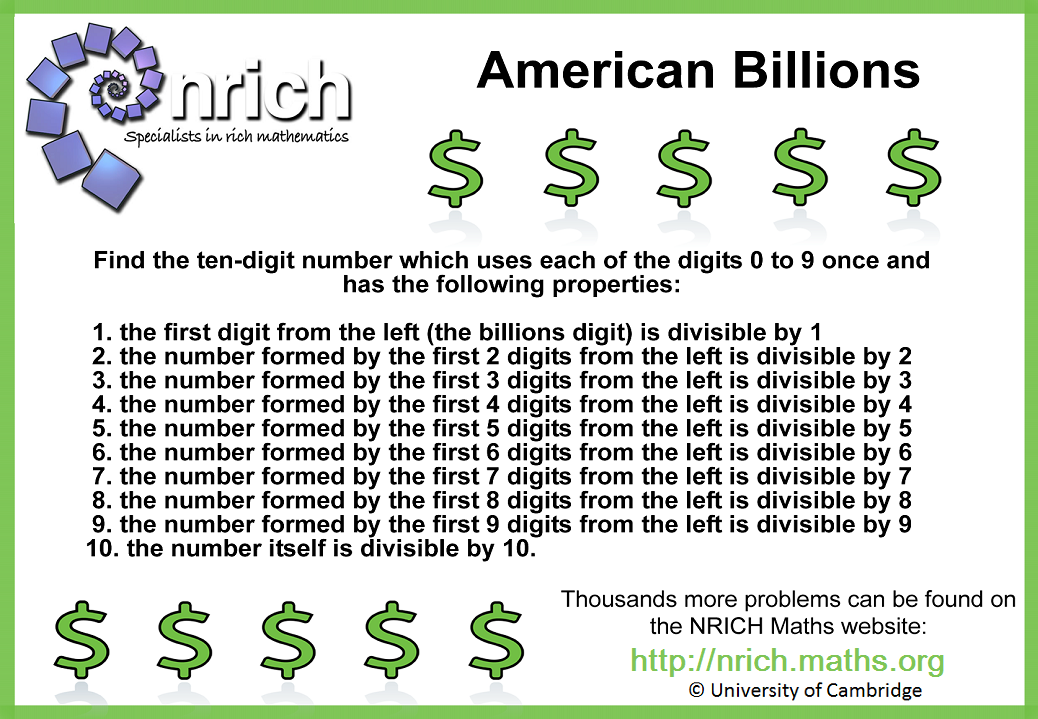
Here’s the basis of the problem:

american billions C

For two out of three of my classes, it turned into a whole-class period problem-solving extravaganza.  Seriously.  30 minutes later, the brain sweat is still palpable in the room.  There were so many calculators in use, I think the smartphones were starting to get jelous.

Some chose to use whiteboards, some choose numbered cards 0 – 9 while some wanted to use paper.  It was so interesting to me to see them figure things out that must be true about the different number places.  A few remembered the divisibility rules for 3 and shared them.  Then they were able to put the divisibility rules for 2 and 3 together to get divisibility for 6.  I didn’t even know that there was a divisibility rule for 4 and 8!

Some student observations:

  • The 2nd, 4th, 6th, and 8th numbers need to be even.
  • The last number must be 0.
  • The 5th number must be five, since the last number must be 0.
  • The first three numbers have to add up to a multiple of 3.
  • The first 9 numbers need to add up to a multiple of 9.

I even had a student say, “How much longer do we get to play this game?”  Music to my ears.

It’s difficult to give students a task that you know most of them won’t solve which is why I’ve shied away from this one in the past.  I made sure to praise the efforts of those that were able to get their numbers to work for all except one of the digits.   (For example, their 2, 3, 4, 5, 6, 8, 9, and 10 digit numbers worked, but their 7 digit number didn’t).

Nrich gives another variation on this task by making it a game.  Basically, students take turns creating 1, 2, 3…digit numbers by choosing from the 0 – 9 digit cards until someone can’t use any more of the cards.  I think having them play this activity as a game would help alleviate some of the discontent of feeling like this problem was too difficult to solve.


Chipotle for Everyone

I’m hard pressed anymore to find a classroom of high school kids who don’t absolutely adore Chipotle’s menu options.  They all have a favorite, and they own it as THEIR burrito.  (I like Chipotle in particular because as a vegan, I can get a delicious meal, as can any non-vegan meal companion.)

I came across this article from Vox claiming Chipotle’s menu calorie disclosures were inaccurate.  I’m going to give Chipotle the benefit of the doubt here because their website contains a very detailed nutrition calculator which allows you to determine the number of calories for your  customized burrito.

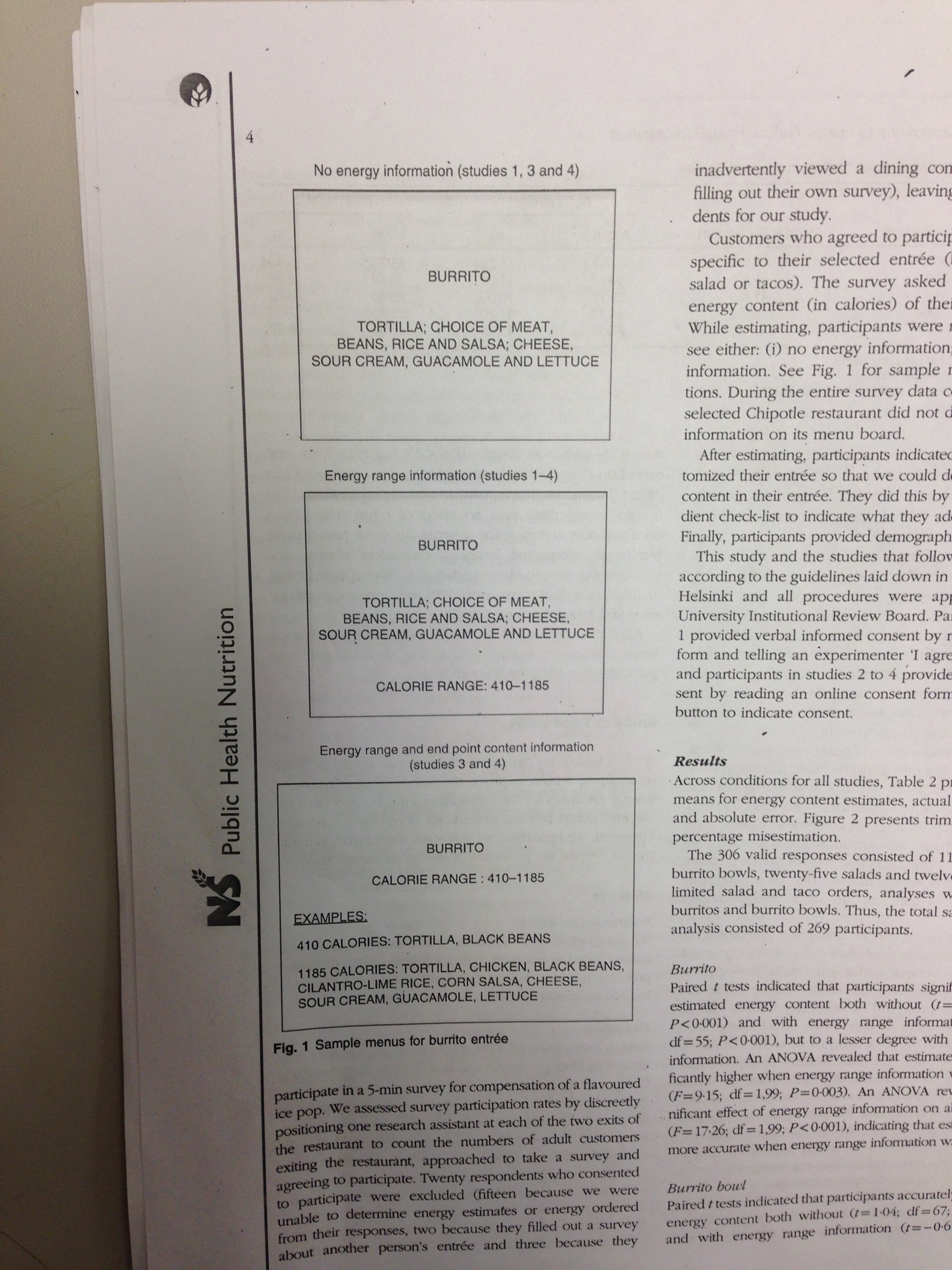
The article references a study from the Journal of Public Health Nutrition which reviews a study in which customers are asked to estimate the calorie content of their meal. Some groups were given no information at all.  Some groups were given a range of calories in which burritos in general fell.  Last, additional groups were given example burritos containing the low and high values in the calorie spread.

I had a randomly selected student create a burrito.  Each class was obviously something different which made it kind of fun.

First, I had them estimate the number of calories in the chosen student’s burrito.

Second, I gave them the calorie range of 410-1185 claimed in which Chipotle’s burritos are claimed to land.  I had them adjust their estimate and give reasoning for their adjustment based on the additional information.

I then showed them the calorie range with an example from the Journal article’s study:

IMG_5054

Third, I wanted them to use the examples above to adjust their estimate once more.

We then talked about how the range of our estimates changed and why.  We also had a discussion about ‘averaging bias’ and how healthy ingredients make us assume that certain food are lower in calories than they actually are.

We were able to discuss the surveying methods done for the study and the demographics of participants, which led to a nice discussion about sampling.  (Evidently high school 9th graders find it odd and quite a bit creepy that participants in the survey were given a “flavored ice pop” in exchange for 5 minutes of their time.)

As long as I had their attention with food, I asked them to estimate whether the student’s burrito had more or less calories than my vegan burrito.  I’ll let you decide:

Student’s Burrito:  chicken, white rice, pinto beans, tomato salsa, cheese, and lettuce

My Burrito:  brown rice, fajita vegetables, black beans, tomato salsa, corn salsa, guacamole, and lettuce.


A Desmosian Gem

I finally had a chance to do the Function Carnival with my classes.  Thank you to Desmos, Christopher Danielson, and Dan Meyer for their work on this project.

As David Cox captured in his blog previously, the real power of this activity is the immediate feedback.


When the graph looks like the one below and 8+ rocket men burst out of the cannon, the students see that right away and adjust for it.

Rocketman


Dan had mentioned in a blog post a while back that “this stuff is really difficult to do well.”  After seeing students work through this activity today, I can appreciate the difficulty in creating an online math activity that gives both students and teachers detailed feedback in real time.

Some observations:

  • Students don’t realize at first that you can see their work live.  I allowed them to “play” for a minute, but some may need more encouragement.
  • A tool to allow you to communicate digitally with the class would be nice.  Google chat, for example?
  • Some students don’t realize that the bumper car SHOULD crash and make their graph to avoid it.
  • A student or two misunderstood the graph misconception questions and went back and changed their graphs to look like the misconception graphs.
  • It was interesting to see which students wanted their graphs to be perfect versus which ones said there’s was “good enough.”  It would be interesting to have a discussion about which is appropriate in the particular situation.

Bravo, Dan, Christopher and the Desmosians.  Thank you for creating an online math activity that gives me some faith in online math activities for the future.

Class: 9th grade prob and stats. Topic:  Linear regression.  Enter: the Laundry Data.

The data sheet seemed to spark a LOT of curiosity.  In retrospect, I wish I would have given them some time to Notice and Wonder about the detergents.  Probably I’d also add some estimation first about these bottles of detergent rather than just handing them the data.  I should have known better.

Still, an interesting discussion ensued about ounces of detergent and loads of laundry.  We plotted the points on Desmos and wanted to choose two of them to create our linear model.  I teach three sections of this class and all three classes picked different points to make their equation.

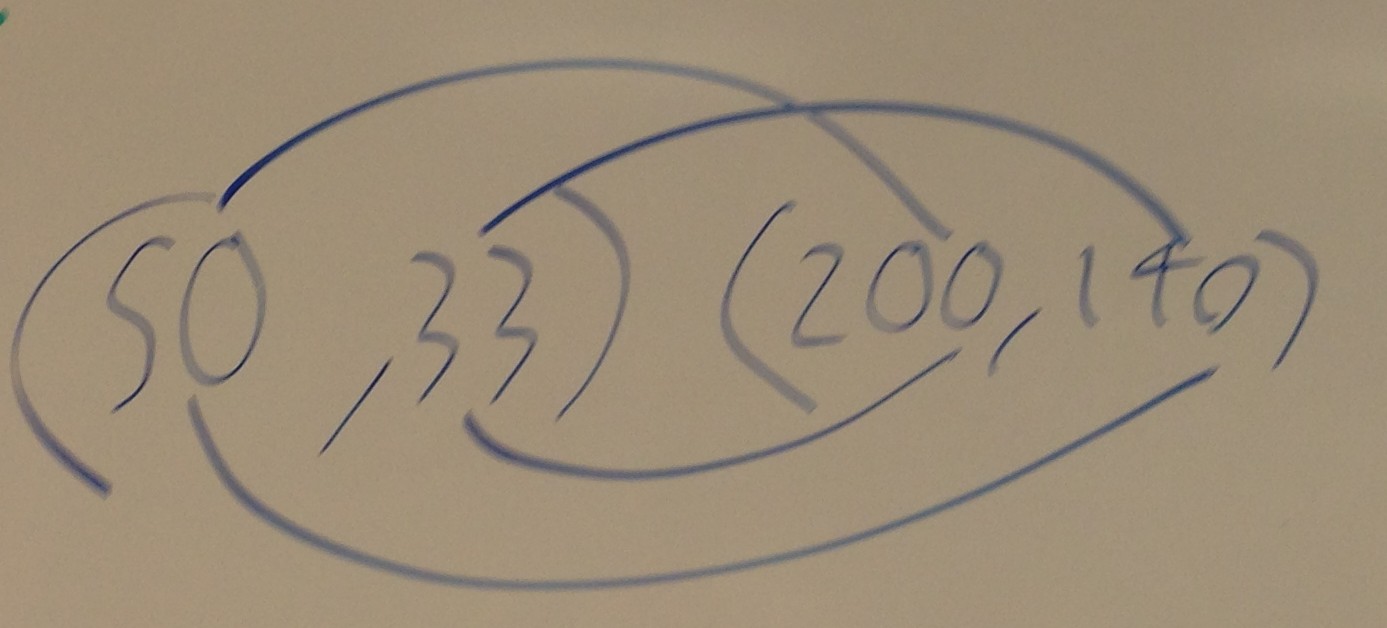
One class picked (50, 33) and (200, 140), and after determining that they needed to find the slope in order to write the equation of the line, I posed that question to them.  How would we find the slope between these two points.  Crickets.

I want to note that a good minute of silence and eye-contact avoidance went by before one brave student spoke up.

S:  You FOIL them.

Me:  Can you explain what you mean by that?

S:  (coming to the board) You multiply them like this.

IMG_5025

Me:  What do we think of what S just wrote up here?  (at least 8 hands shot up in the air)

Me:  Please put your hands down and let’s discuss this.  What I like about what S just did here is he got us started somewhere.  He was willing to take a guess and risk being wrong.  Before S showed us his idea, no one was willing to volunteer their method.  Now that S has broken the silence, lots of you seem ready to discuss.  Thank you S for starting us somewhere.

After this student broke the ice, we came up with about 4 ways to determine the slope of this line and about 8 ways overall to figure out the equation of the line between these two points.  In the past, I would have said to this student, “No, we don’t FOIL, who has another idea?”  Now I know that allowing this student to explain his method does multiple things.  First, it helps the other students practice patience and courtesy when listening and responding to this student whose solution they know is incorrect.  Second, it is a great opportunity for students to engage in SMP #3: Construct viable arguments and critique the reasoning of others.  Third, it provides an opportunity to praise the value in providing the wrong answer.  So much of math class for these students has been about getting the right answers.  I’m glad this teachable moment came about for students to learn from the wrong one.

Alright, Mr. Stadel. We’ve Got Some Bacon Questions

Greetings, Mr. Stadel.  We know that you are very busy.  We appreciate your brief attention.  Rather than bombard you with tweets, we decided to bloggly address our questions and comments about your Bacon Estimates.

First of all, bravo.  You dedicated an entire section of your estimation180 blog to a culinary wonder some refer to as “meat candy.”  Even our vegan teacher felt compelled to engage us with these estimates.  (She says it is for the sake of the learning.)

Second, the time lapse videos of the cooking are pretty sweet.  Too bad the school internet wouldn’t stop buffering.  But nice touch, Mr. Stadel.  Nice touch.

A question:  Did you know that the percent decrease in length of bacon is 38% after cooking, but the percent decrease in width is only 23%?  We figured that out adapting your “percent error” formula to the uncooked/cooked bacon.  Do you have any initial thoughts about that discrepancy?  Is it bacon’s “fibrous” fat/meat striped makeup that allows it to shrink more in length than width, inch for inch?

Also, did you know that the percent decrease in time from the cold skillet to the pre-heated skillet is 29%?  That one was a little harder for us to calculate, because we figured out that we needed to convert the cooking times to seconds rather than minutes and seconds.

To summarize, we wanted to thank you, Mr. Stadel.  Our teacher tells us that you dedicate your time and energy to the estimation180 site so that WE don’t have to learn math out of a textbook.  We wanted to tell you that we appreciate it.  And the bacon.  We appreciate the homage paid to bacon.

Sincerely,

Mrs. Schmidt’s Math Class

St. Francis, MN

When the Answer is E: He Falls Off the Roof and Breaks His Neck

Our annual state testing season is almost here. The juniors will partake in the Minnesota Comprehensive Assessments in Mathematics a week from Tuesday. Our department decided issuing a practice test to all of our juniors would help re-familiarize them with long lost skills. After distributing copies during our monthly staff meeting, I’m always curious if any teachers in other disciplines look at the practice materials. Much to my delight, the choir director approached me at lunch on Friday, test in hand.

Mr. Warren: Is this test just like the MCAs?
Me: Most likely similar. Why?
Mr. Warren: Ok, well look at this one.


Mr. Warren: I think the answer is E, Xai s going to fall and break his neck.

The conversation went on for another few minutes, with me agreeing  that what’s been called “math education” includes ignoring the context of situations and focusing on a procedure.  In fact, I was curious how many juniors who completed this practice test even noticed that the situation was outrageous.

Since we were running on a 2-hr delay schedule Friday, I thought it would be the perfect opportunity to present the problem to my algebra class. They are mostly juniors who have been continually frustrated with a mathematics curriculum that doesn’t make any sense in the real world.

Me: Read through this problem. Does it make sense?

Student: ok, it looks like 32.

I didn’t expect any of them to apply any trigonometry, so I thought we needed to approach the problem differently.  In fact, I wasn’t even concerned about the angle measure.  I wanted them to look at the scenario itself.

Me: Imagine this scenario. We’ve done a lot of estimating in here. We need to envision a 20-foot ladder, three feet away from a house. Does this seem reasonable?

Unfortunately, it did seem reasonable to most of them. I needed another approach.

Me: ok, how could we simulate this in classroom-scaled size?

Student: Get a ruler.

Me: Perfect. How close does it need to be to the wall?

Students: (a chorus of answers)

After exploring multiple methods of calculating exactly how far, we arrived at 1.8 inches.  With as much drama as possible, I set the ruler against the wall, exactly 1.8 inches away.

Me:  Does this look like a ladder that any of you would want to stand on? (of course, a few did).  Keep in mind, this is a TWENTY foot ladder, not a 12 inch ruler.

Student:  Yea, I don’t think anyone is climbing up that ladder and coming down in one piece.

Another Student:  What if they had a spotter?

A spotter!  Now we’re talking.  To be honest, I have no idea if a spotter could hold a 20-foot ladder so that it could be placed three feet from the wall.  But now I’m interested to find out!

I know Mathalicious investigated a similar scenario using a claim from Governor Janet Napolitano.

In my mind, these are the questions that should be circulating Facebook and aggravating parents.  This is the kind of math that should rile up Glenn Beck and company.  Our state of Minnesota opted not to adopt the Common Core State Standards in Mathematics, but requiring this kind of math instead is what is actually dumbing down the curriculum.  It assumes that the real world doesn’t apply, only rote procedure does.  “Just figure out the answer, don’t question the situation,” is what kids read and do over and over when problems like this are solved without real context.  A richer classroom experience for both teachers and students comes when we ask students to assess the reasonableness of situations, create new scenarios that are more appropriate, and solve the new problems they develop.  The CCSS Standards for Mathematical Practice tell students that it’s vital that they “construct viable arguments and critique the reasoning of others.”  I don’t think “critique the reasoning of others” should be reserved for only reasoning created in the classroom.  I’d like my students to critique the reasoning of the creator of these types of problems and others like it that have been deemed a necessary component of high school math success.

Thank you, Mr. Warren for igniting the exciting conversation in my classroom.